NEET UG 2011 — Modern Physics
Physics Modern Physics questions from NEET UG 2011.
Other Years
20 Modern Physics Questions from 2011
A transistor is operated in common emitter configuration at $V_C=2 \mathrm{~V}$ such that a change in the base current from $100 \mu \mathrm{A}$ to $300 \mu \mathrm{A}$ produces a change in the collector current from $10 \mathrm{~mA}$ to $20 \mathrm{~mA}$. The current gain is
A nucleus ${ }_n^m X$ emits one $\alpha$-particle and two $\beta^{-}$particles. The resulting nucleus is
In photoelectric emission process from a metal of work function $1.8 \mathrm{eV}$, the kinetic energy of most energetic electrons is $0.5 \mathrm{eV}$. The corresponding stopping potential is
Pure Si at $500 \mathrm{~K}$ has equal number of electron $\left(n_e\right)$ and hole $\left(n_h\right)$ concentrations of $1.5 \times 10^{16} \mathrm{~m}^{-3}$. Doping by indium increases $n_h$ to $4.5 \times 10^{22} \mathrm{~m}^{-3}$. The doped semiconductor is of
The threshold frequency for a photo-sensitive metal is $3.3 \times 10^{14} \mathrm{~Hz}$. If light of frequency $8.2 \times 10^{14} \mathrm{~Hz}$ is incident on this metal, the cut-off voltage for the photo-electric emission is nearly
In forward biasing of the $p-n$ junction
Out of the following which one is not a possible energy for a photon to be emitted by hydrogen atom according to Bohr's atomic model?
The half-life of a radioactive isotope $X$ is $50 \mathrm{yr}$. It decays to another element $Y$ which is stable. The two elements $X$ and $Y$ were found to be in the ratio of $1: 15$ in a sample of a given rock. The age of the rock was estimated to be
Electrons used in an electron microscope are accelerated by a voltage of $25 \mathrm{kV}$. If the voltage is increased to $100 \mathrm{kV}$ then the de-Broglie wavelength associated with the electrons would
Light of two different frequencies whose photons have energies $1 \mathrm{eV}$ and $2.5 \mathrm{eV}$ respectively illuminate a metallic surface whose work function is $0.5 \mathrm{eV}$ successively. Ratio of maximum speeds of emitted electrons will be
A zener diode, having breakdown voltage equal to $15 \mathrm{~V}$, is used in a voltage regulator circuit shown in figure. The current through the diode is 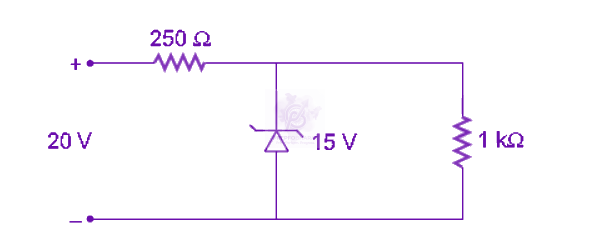
A radioactive nucleus of mass $M$ emits a photon of frequency $v$ and the nucleus recoils. The recoil energy will be
Fusion reaction takes place at high temperature because
Photoelectric emission occurs only when the incident light has more than a certain minimum
Two radioactive nuclei $P$ and $Q$, in a given sample decay into a stable nucleous $R$. At time $t=0$, number of $P$ species are $4 N_0$ and that of $Q$ are $N_0$. Half-life of $P$ (for conversion to $R$ ) is 1 min where as that of $Q$ is $2 \mathrm{~min}$. Initially there are no nuclei of $R$ present in the sample. When number of nuclei of $P$ and $Q$ are equal, the number of nuclei of $R$ present in the sample would be
The power obtained in a reactor using $\mathrm{U}^{235}$ disintegration is $1000 \mathrm{~kW}$. The mass decay of $\mathrm{U}^{235}$ per hour is
If a small amount of antimony is added to germanium crystal
The wavelength of the first line of Lyman series for hydrogen atom is equal to that of the second line of Balmer series for a hydrogen like ion. The atomic number $Z$ of hydrogen like ion is
In the following figure, the diodes which are forward biased, are A. 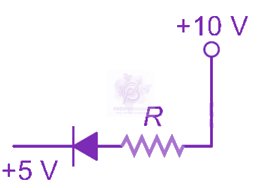 B.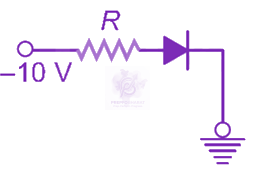 C.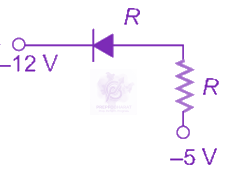 D.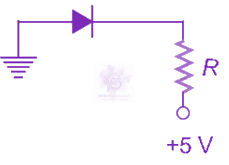
Symbolic representation of four logic gates are shown as 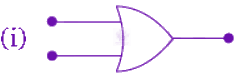 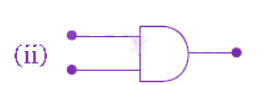  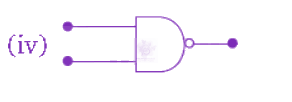 Pick out which ones are for AND, NAND and NOT gates, respectively.