Mechanics PYQ — Page 7
NEET UG Physics — Mechanics previous year questions with solutions.
All Mechanics Questions (512)
A wire of length $L$, area of cross section $A$ is hanging from a fixed support. The length of the wire changes to ${L}_{1}$ when mass $M$ is suspended from its free end. The expression for Young's modulus is:
A point mass $m$ is moved in a vertical circle of the radius $r$ with the help of a string. The velocity of the mass is $\sqrt{7gr}$ at the lowest point. The tension in the string at the lowest point is:
The angle of $1'$ (minute of arc) in radian is nearly equal to
What is the depth at which the value of acceleration due to gravity becomes $\frac{1}{n}$, times the value at the surface of the earth? (radius of the earth $=R$)
A body weighs $200 N$ on the surface of the earth. How much will it weigh half way down to the centre of the earth?
A mass $m$ is attached to a thin wire and whirled in a vertical circle. The wire is most likely to break, when
Two particles $A$ and $B$ are moving in uniform circular motion in concentric circles of radii ${r}_{A}$ and ${r}_{B}$ with speed ${v}_{A}$ and ${v}_{B}$, respectively. Their time period of rotation is the same. The ratio of angular speed of $A$ to that of $B$ will be,
A block of mass $10 kg$ is in contact against the inner wall of a hollow cylindrical drum of radius$1m$. The coefficient of friction between the block and the inner wall of the cylinder is $0.1$. The minimum angular velocity needed for the cylinder to keep the block stationary when the cylinder is vertical and rotating about its axis will be $(g=10 m{s}^{-2})$,
An object of mass $500 \mathrm{~g}$, initially at rest acted upon by a variable force whose $\mathrm{X}$ component varies with $\mathrm{X}$ in the manner shown. The velocities of the object a point $X=8 \mathrm{~m}$ and $X=12 \mathrm{~m}$, would be the respective values of (nearly) 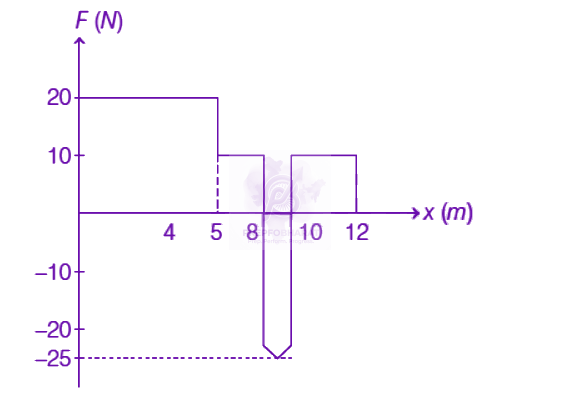
A body of mass $m$ is kept on a rough horizontal surface (coefficient of friction $=\mu$ ). Horizontal force is applied on the body, but it does not move. The resultant of normal reaction and the frictional force acting on the object is given $\mathrm{F}$, where $\mathrm{F}$ is
A particle moving with velocity $\vec{V}$ is acted by three forces shown by the vector triangle $PQR$. The velocity of the particle will 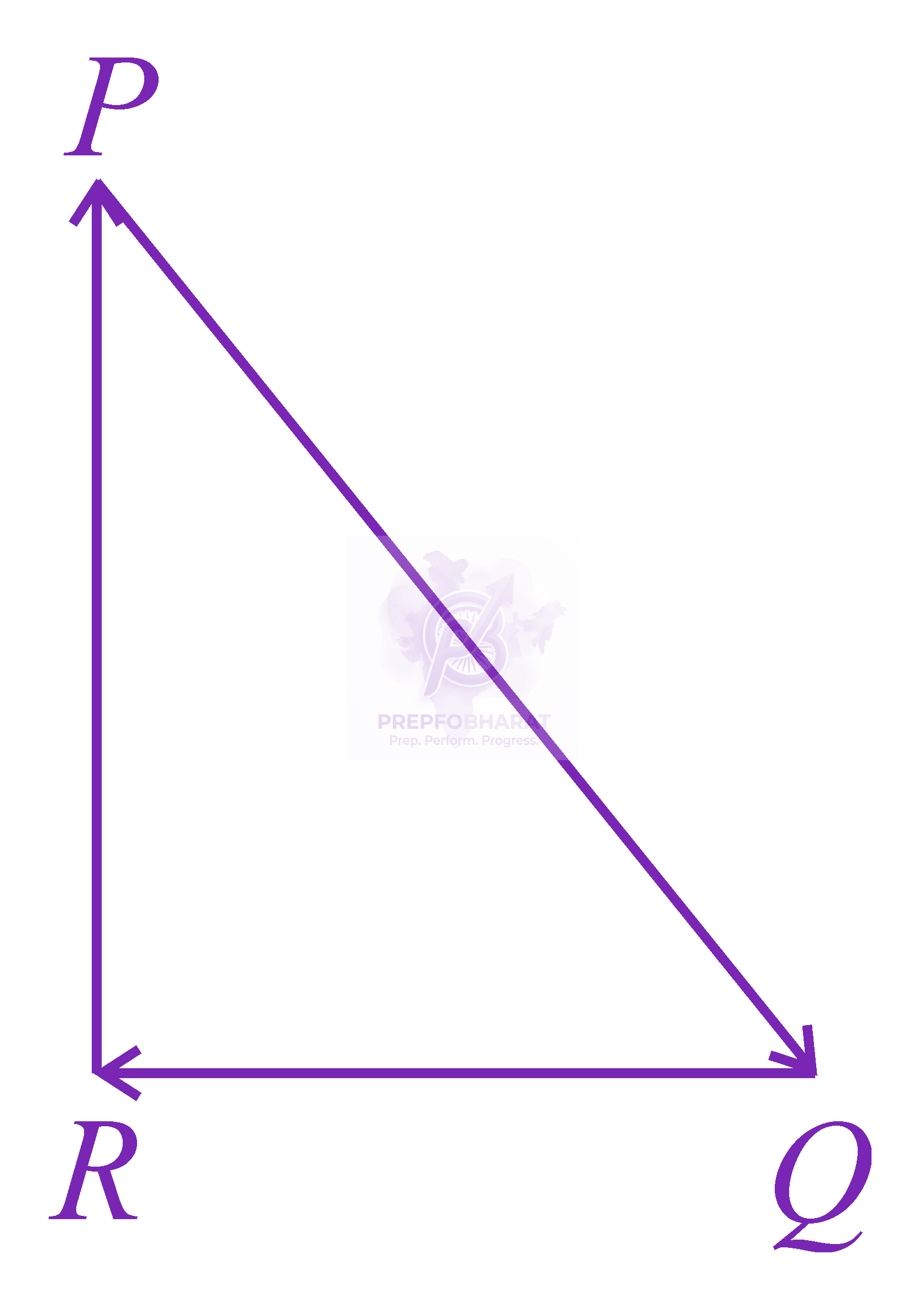
A small hole of area cross-section $2 m{m}^{2}$ is present near the bottom of a fully filled open tank of height $2 m.$ Taking $g=10 m{s}^{-2}$, the rate of flow of water through the open hole would be nearly
In an experiment, the percentage of error occurred in the measurement of physical quantities $A,B,C$ and $D$ are 1%, 2%, 3% and 4%, respectively. Then the maximum percentage of error in the measurement $X$, where $X=\frac{{A}^{2}{B}^{\frac{1}{2}}}{{C}^{\frac{1}{3}}{D}^{3}}$ will be
A solid cylinder of mass $2 \mathrm{~kg}$ and radius $50 \mathrm{~cm}$ rolls up an inclined plane of angle inclination $30^{\circ}$. The centre of mass of cylinder has speed of $4 \mathrm{~m} / \mathrm{s}$. The distance travelled by the cylinder on the inclined surface will be : (Take $g=10 \mathrm{~m} / \mathrm{s}^2$ )
A force $F=20+10y$ acts on a particle in $y$-direction where $F$ is in Newton and $y$ is in meter. Work done by this force to move the particle from $y=0$ to $y=1 m$ is
A soap bubble having radius of $1 mm$ is blown from a detergent solution having a surface tension of $2.5\times {10}^{-2} N{m}^{-1}.$ The pressure inside the bubble equals at a point ${Z}_{0}$ below the free surface of water in a container. Taking $g=10 m{s}^{-2},$ density of water $={10}^{3} kg{m}^{-3},$ the value of ${Z}_{0}$ is
The unit of thermal conductivity is
A particle of mass $5 \mathrm{~m}$ at rest suddenly breaks on its own into three fragments. Two fragments of mass m each move along mutually perpendicular direction with each speed v. The energy released during the process is
The stress-strain curves are drawn for two different materials $\mathrm{X}$ and $\mathrm{Y}$. It is observed that the ultimate strength point and the fracture point are close to each other for material X but are far apart for material Y. We can say that materials $\mathrm{X}$ and $\mathrm{Y}$ are likely to be (respectively)
Assuming that the gravitational potential energy of an object at infinity is zero, the change in potential energy (final - initial) of an object of mass $m$, when taken to a height $\mathrm{h}$ from the surface of earth (of radius $\mathrm{R}$ ) is given by,
The time period of a geo-stationary satellite is $24 \mathrm{~h}$, at a height $6 R_E-R_E$ is the radius of earth) from surface of earth. The time period of another satellite whose height is $2.5 \mathrm{R}_{\mathrm{E}}$ from surface will be
A person standing on the floor of an elevator drops a coin. The coin reaches the floor in time $t_1$ if the elevator is at rest and in time $t_2$ if the elevator is moving uniformly. The which of the following option is correct?
When a block of mass $M$ is suspended by a long wire of length $L$, the length of the wire becomes $(L+l).$ The elastic potential energy stored in the extended wire is
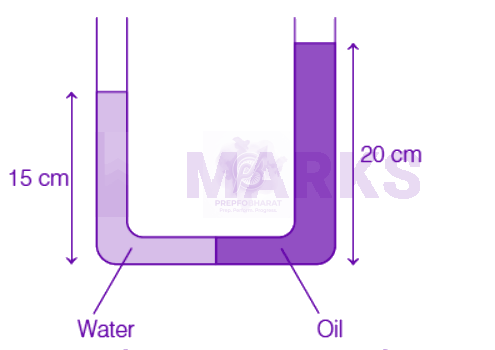
In a u-tube as shown in a figure, water and oil are in the left side and right side of the tube respectively. The heights from the bottom for water and oil columns are $15 \mathrm{~cm}$ and $20 \mathrm{~cm}$ respectively. The density of the oil is $\left[\right.$ take $\left.\rho_{\text {water }}=1000 \mathrm{~kg} / \mathrm{m}^3\right]$