Mechanics PYQ — Page 8
NEET UG Physics — Mechanics previous year questions with solutions.
All Mechanics Questions (512)
The speed of a swimmer in still water is $20 m{s}^{-1}.$ The speed of river water is $10 m{s}^{-1}$ and is flowing due east. If he is standing on the south bank and wishes to cross the river along the shortest path, the angle at which he should make his strokes with respect to the north is given by
Two small spherical metal balls, having equal masses, are made from materials of densities $\rho_1$ and $\rho_2\left(\rho_1=8 \rho_2\right)$ and have radii of $1 \mathrm{~mm}$ and $2 \mathrm{~mm}$, respectively. They are made to fall vertically (from rest) in viscous medium whose coefficient of viscosity equals $\eta$ and whose density is $0.1 \rho_2$. The ratio of their terminal velocities would be
A particle starting from rest, moves in a circle of radius ' $r$ '. It attains a velocity of $\mathrm{v}_0 \mathrm{~m} / \mathrm{s}$ in the $\mathrm{n}^{\text {th }}$ round. Its angular acceleration will be
A person travelling in a straight line moves with a constant velocity $\mathrm{v}_1$ for certain distance ' $\mathrm{x}$ ' and with a constant velocity $\mathrm{v}_2$ for next equal distance. The average velocity $v$ is given by the relation
Two bullets are fired horizontally and simultaneously towards each other from roof tops of two buildings $100 \mathrm{~m}$ apart and of same height of $200 \mathrm{~m}$ with the same velocity of $25 \mathrm{~m} / \mathrm{s}$. When and where will the two bullets collides. $\left(\mathrm{g}=10 \mathrm{~m} / \mathrm{s}^2\right)$
The work done to raise a mass $m$ from the surface of the earth to a height $h$, which is equal to the radius of the earth is:
A disc of radius $2 m$ and mass $100 kg$ rolls on a horizontal floor. Its centre of mass has speed of $20 cm{s}^{-1}.$ How much work is needed to stop it?
Body $A$ of mass $4m$ moving with speed $u$ collides with another body $B$ of mass $2m$ at rest. The collision is head on and elastic in nature. After the collision, the fraction of energy lost by the colliding body $A$ is
The main scale of a vernier calliper has $\mathrm{n}$ divisions/cm. n divisions of the vernier scale coincide with $(n-1)$ divisions of main scale. The least count of the vernier callipers is
An object flying in air with velocity $(20 \hat{i}+25 \hat{j}-12 \hat{k})$ suddenly breaks in two pieces whose masses are in the ratio $1: 5$. The smaller mass flies off with a velocity $(100 \hat{i}+35 \hat{j}+8 \hat{k})$. The velocity of the larger piece will be
A solid cylinder of mass $2 kg$ and radius $4 cm$ is rotating about its axis at the rate of $3\mathrm{rpm}$. The torque required to stop after $2\pi$ revolutions is
When an object is shot from the bottom of a long smooth inclined plane kept at an angle $60^{\circ}$ with horizontal, it can travel a distance ${x}_{1}$ along the plane. But, when the inclination is decreased to $30^{\circ}$ and the same object is shot with the same velocity, it can travel ${x}_{2}$ distance. Then ${x}_{1}:{x}_{2}$ will be
Which one of the following statements is incorrect?
A block of mass m is placed on a smooth inclined wedge $ABC$ of inclination $\theta$ as shown in the figure. The wedge is given an acceleration $a$ towards the right. The relation between $a$ and $\theta$ for the block to remain stationary on the wedge is 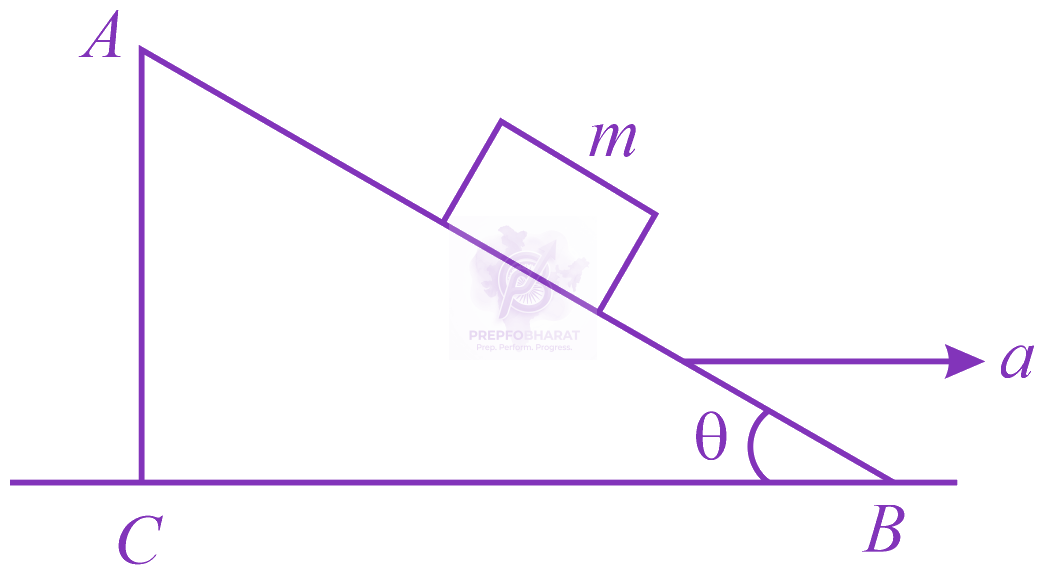
If the mass of the Sun were ten times smaller and the universal gravitational constant were ten times larger in magnitude, which of the following is not correct?
Three objects, $A$: (a solid sphere), $B$: (a thin circular disk) and $C$: (a circular ring), each have the same mass $M$ and radius $R$. They all spin with the same angular speed $\omega$ about their own symmetric axes. The amounts of work $(W)$ required to bring them to rest, would satisfy the relation
The moment of the force, $\vec{F}=4\hat{i}+5\hat{j}-6\hat{k}$ at $( 2,0,-3 ),$ about the point $( 2,-2,-2 ),$ is given by
A body initially at rest and sliding along a frictionless track from a height $h$ (as shown in the figure) just completes a vertical circle of diameter $AB=D$. The height $h$ is equal to, 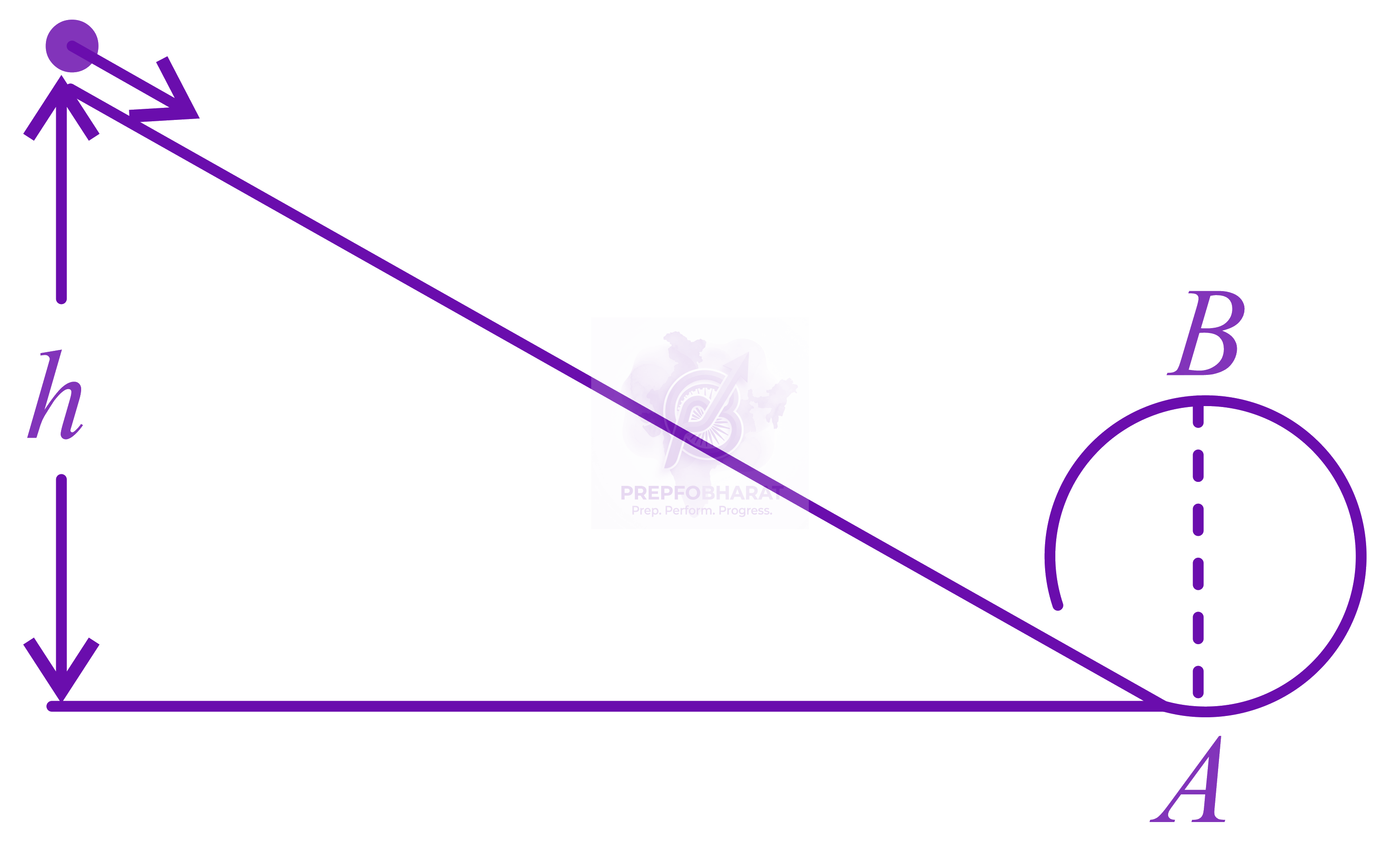
The kinetic energies of a planet in an elliptical orbit about the Sun, at positions, $A, B$ and $C$ are ${K}_{A}, {K}_{B} and {K}_{C}$, respectively. $AC$ is the major axis and $SB$ is perpendicular to $AC$ at the position of the Sun $S$ as shows in the figure. Then 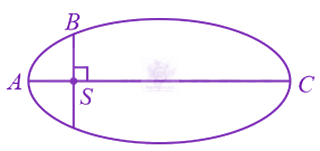
A small sphere of radius $r$ falls from rest in a viscous liquid. As a result, heat is produced due to viscous force. The rate of production of heat when the sphere attains terminal velocity, is proportional to
Two wires are made of the same material and have the same volume. The first wire has cross-sectional area $A$ and the second wire has cross-sectional area $3A.$ If the length of the first wire is increased by $\Delta l$ on applying a force $F,$ how much force is needed to stretch the second wire by the same amount?
A moving block having mass $m,$ collides with another stationary block having mass $4m.$ The lighter block comes to rest after collision. When the initial velocity of the lighter block is $v,$ then the value of coefficient of restitution $(e)$ will be
A toy car with charge q moves on a frictionless horizontal plane surface under the influence of a uniform electric field $\vec{E}$. Due to the force $q\vec{E}$, its velocity increases from 0 to $6 m{s}^{-1}$ in one second duration. At that instant the direction of the field is reversed. The car continues to move for two more seconds under the influence of this field. The average velocity and the average speed of the toy car between $0$ to $3$ seconds are respectively
A solid sphere is in rolling motion. In rolling motion a body possesses translational kinetic energy $({K}_{t})$ as well as rotational kinetic energy $({K}_{r})$ simultaneously. The ratio ${K}_{t}:({K}_{t}+{K}_{r})$ for the sphere is