Mechanics PYQ — Page 9
NEET UG Physics — Mechanics previous year questions with solutions.
All Mechanics Questions (512)
A student measured the diameter of a small steel ball using a screw gauge of least count $0.001\mathrm{cm}$. The main scale reading is $5\mathrm{mm}$ and ${25}^{th}$ division of circular scale coincides with reference line. If screw gauge has a zero error of $-0.004\mathrm{cm}$, the correct diameter of the ball is
A solid sphere is rotating freely about its symmetric axis in free space. The radius of the sphere is increased keeping its mass same. Which of the following physical quantities would remain constant for the sphere?
Consider a drop of rain water having mass $1g$ falling from a height of $1\mathrm{km}$. It hits the ground with a speed of $50 m{s}^{-1}$. Take $g$ constant with a value $10 m{s}^{-2}$. The work done by the (i) gravitational force and the (ii) resistive force of air is
Two astronauts are floating in gravitational free space after having lost contact with their spaceship. The two will:
The acceleration due to gravity at a height $1 km$ above the earth is the same as at a depth $d$ below the surface of earth. Then
A physical quantity of the dimensions of length that can be formed out of $c,G$ and $\frac{{e}^{2}}{4\pi {\epsilon }_{0}}$, where [$c$ is velocity of light, $G$ is universal constant of gravitation, $e$ is charge & ${\epsilon }_{0}$ is permittivity of free space]:
A spring of force constant $k$ is cut into lengths of ratio $1:2:3$. They are connected in series and the new force constant is $k'$. If now they are connected in parallel and force constant is $k''$, then$k':k''$ is
Preeti reached the metro station and found that the escalator was not working. She walked up the stationary escalator in time ${t}_{1}$. On other days, if she remains stationary on the moving escalator, then the escalator takes her up in time ${t}_{2}$. The time taken by her to walk up on the moving escalator will be
The bulk modulus of a spherical object is $B$. If it is subjected to uniform pressure $p$, the fractional decrease in radius is
A $U$ tube with both ends open to the atmosphere is partially filled with water. Oil, which is immiscible with water, is poured into one side until it stands at a distance of $10\mathrm{mm}$ above the water level on the other side. Meanwhile, the water rises by $65\mathrm{mm}$ from its original level (see diagram). The density of the oil is____$({\rho }_{w}=1000\mathrm{kg} {m}^{-3})$ 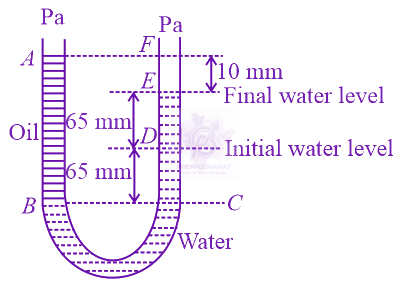
The $x$ and $y$ coordinates of the particle at any time are $x=5t-2{t}^{2}$ and $y=10t$ respectively, where $x$ and $y$ are in meters and $t$ is in seconds. The acceleration of the particle at $t=2 s$ is
Two blocks $A$ and $B$ of masses $3m$ and $m$ respectively are connected by a massless and inextensible string. The whole system is suspended by a massless spring as shown in figure. The magnitudes of acceleration of $A$ and $B$ immediately after the string is cut, are respectively 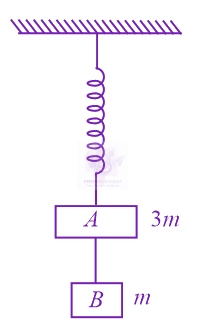
Two discs of same moment of inertia $( I )$ are rotating in same sense about their regular axis passing through centre and perpendicular to the plane of disc with angular velocities ${\omega }_{1}$ and ${\omega }_{2}$. They are brought into contact face to face coinciding the axis of rotation. The expression for loss in energy during this process is
One end of string of length $l$ is connected to a particle of mass $m$ and the other end is connected to a small peg on a smooth horizontal table. If the particle moves in circle with speed $v$, the net force on the particle (directed towards center) will be ($T$ represents the tension in the string)
Which of the following statements are correct? (i) Centre of mass of a body always coincides with the centre of gravity of the body. (ii) Centre of mass of a body is the point at which the total gravitational torque on the body is zero (iii) A couple on a body produce both translational and rotational motion in a body. (iv) Mechanical advantage greater than one means that small effort can be used to lift a large load.
A rope is wound around a hollow cylinder of mass $3 kg$ and radius $40 cm.$ What is the angular acceleration of the cylinder if the rope is pulled with a force of $30 N$?
A uniform circular disc of radius $\text{50}\text{ cm}$ at rest is free to rotate about an axis which is perpendicular to its plane and passes through its centre. It is subjected to a torque which produces a constant angular acceleration of $2.0 rad {s}^{-2}$. Its net acceleration in $m {s}^{-2}$ at the end of $\text{2.0 s}$ is approximately:
Two identical balls $A$ and $B$ having velocities of $0.5m{s}^{-1}$ and $-0.3m{s}^{-1}$, respectively, collide elastically in one dimension. The velocities of $B$ and $A$ after the collision, respectively, will be
A body of mass $1\mathrm{kg}$ begins to move from rest under the action of a time dependent force $\vec{F}=(2t \hat{i}+3{t}^{2} \hat{j})N$, where $\hat{i}$and $\hat{j}$ are unit vectors along x and y axis. What power will be developed by the force at the time t?
A car is negotiating a curved road of radius $\text{R}$. The road is banked at an angle $\theta$. The coefficient of friction between the tyres of the car and the road is ${\mu }_{s}$. The maximum safe velocity on this road is:
If the velocity of a particle is $\upsilon =At+B{t}^{2}$, where $\text{A}$ and $\text{B}$ are constants, then the distance travelled by it between $\text{1} \text{s}$ and $\text{2} \text{s}$ is:
At what height from the surface of earth the gravitation potential and the value of g are $-5.4\times {10}^{7 }J k{g}^{-2}$ and $6.0 m {s}^{-2}$ respectively? Take the radius of earth as $6400 km$:
A particle of mass $10g$ moves along a circle of radius $6.4\mathrm{cm}$with a constant tangential acceleration. What is the magnitude of this acceleration if the kinetic energy of the particle becomes equal to $8\times {10}^{-4} J$ by the end of the second revolution after the beginning of the motion?
A disk and a sphere of same radius but different masses roll off on two inclined planes of the same altitude and length. Which one of the two objects gets to the bottom of the plane first?