Mechanics PYQ — Page 6
NEET UG Physics — Mechanics previous year questions with solutions.
All Mechanics Questions (512)
From a circular ring of mass $M$ and radius $R$ an arc corresponding to a $90^{\circ}$ sector is removed. The moment of inertia of the remaining part of the ring about an axis passing through the centre of the ring and perpendicular to the plane of the ring is $K$ times $M{R}^{2}$. Then the value of $K$ is___
The velocity of a small ball of mass $M$ and density $\rho$, when dropped in a container filled with glycerine becomes constant after some time. If the density of glycerine is $\frac{\rho }{2}$, then the viscous force acting on the ball will be:
The escape velocity from the Earth's surface is $v$. The escape velocity from the surface of another planet having a radius four times that of Earth and the same mass density is:
If $E$ and $G$ respectively denote energy and gravitational constant, then $\frac{E}{G}$ has the dimensions of:
A uniform rod of length $200\mathrm{cm}$ and mass $500g$ is balanced on a wedge placed at $40\mathrm{cm}$ mark. A mass of $2\mathrm{kg}$ is suspended from the rod at $20\mathrm{cm}$ and another unknown mass $m$ is suspended from the rod at $160\mathrm{cm}$ mark as shown in the figure. Find the value of $m$ such that the rod is in equilibrium. $(g=10m{s}^{-2})$ 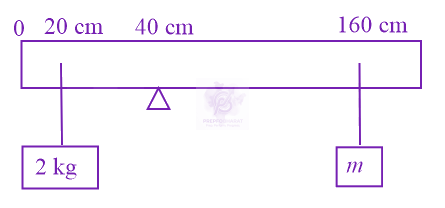
If force $[F]$, acceleration $[A]$ and time $[T]$ are chosen as the fundamental physical quantities. Find the dimensions of energy.
A liquid does not wet the solid surface if angle of contact is:
A screw gauge has least count of $0.01\mathrm{mm}$ and there are $50$ divisions in its circular scale. The pitch of the screw gauge is:
Two bodies of mass $4 \mathrm{kg}$ and $6 \mathrm{kg}$ are tied to the ends of a massless string. The string passes over a pulley which is frictionless (see figure). The acceleration of the system in terms of acceleration due to gravity $(g)$ is: 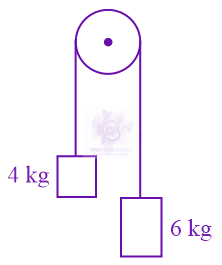
Find the torque about the origin when a force of $3\hat{j}N$ acts on a particle whose position vector is $2\hat{k}m$.
Calculate the acceleration of the block and trolly system shown in the figure. The coefficient of kinetic friction between the trolly and the surface is $0.05.$ ($g=10m{s}^{-2},$ mass of the string is negligible and no other friction exists). 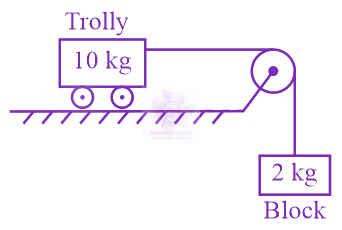
Time intervals measured by a clock give the following readings: $1.25s,1.24s,1.27s,1.21s$ and $1.28s$. What is the percentage relative error of the observations?
Two particles of mass $5 \mathrm{kg}$ and $10 \mathrm{kg}$ respectively are attached to the two ends of a rigid rod of length $1 m$ with negligible mass. The centre of mass of the system from the $5 \mathrm{kg}$ particle is nearly at a distance of:
A plano-convex lens of unknown material and unknown focal length is given. With the help of a spherometer we can measure the
A ball is thrown vertically downward with a velocity of $20m{s}^{-1}$ from the top of a tower. It hits the ground after some time with a velocity of $80m{s}^{-1}$. The height of the tower is: $(g=10m{s}^{-2})$
The energy required to break one bond in DNA is ${10}^{–20}J$. This value in $\mathrm{eV}$ is nearly
A capillary tube of radius $r$ is immersed in water and water rises in it to a height $h$. The mass of the water in the capillary is $5g$. Another capillary tube of radius $2r$ is immersed in water. The mass of water that will rise in this tube is:
Dimensions of stress are:
A body weighs $72N$ on the surface of the earth. What is the gravitational force on it, at a height equal to half the radius of the earth?
Three identical spheres, each of mass $M,$ are placed at the corners of a right angle triangle with mutually perpendicular sides equal to $2m$ (see figure). Taking the point of intersection of the two mutually perpendicular sides as the origin, find the position vector of centre of mass. 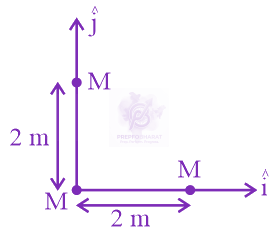
The angular speed of the wheel of a vehicle is increased from, $360\mathrm{rpm}$ to $1200\mathrm{rpm}$ in $14s$. Its angular acceleration is,
A person sitting in the ground floor of a building notices through the window, of height $1.5m,$ a ball dropped from the roof of the building crosses the window in $0.1s.$ What is the velocity of the ball when it is at the topmost point of the window? $(g=10m{s}^{-2})$
Taking into account of the significant figures, what is the value of $9.99m–0.0099m$?
A barometer is constructed using a liquid (density $=760\mathrm{kg}{m}^{-3}$) What would be the height of the liquid column, when a mercury barometer reads $76\mathrm{cm}?$ (density of mercury $=13600\mathrm{kg}{m}^{-3}$)