Mechanics PYQ — Page 17
NEET UG Physics — Mechanics previous year questions with solutions.
All Mechanics Questions (512)
A body, under the action of a force $\overrightarrow{\mathrm{F}}=6 \hat{\mathrm{i}}-8 \hat{\mathrm{j}}+10 \hat{\mathrm{k}}$, acquires an acceleration of 1 $\mathrm{ms}^{-2}$. The mass of this body must be
A bus is moving with a speed of $10 \mathrm{~ms}^{-1}$ on a straight road. A scooterist wishes to overtake the bus in $100 \mathrm{~s}$. If the bus is at a distance of $1 \mathrm{~km}$ from the scooterist, with what speed should the scooterist chase the bus?
Four identical thin rods each of mass $M$ and length $l$, form a square frame. Moment of inertia of this frame about an axis through the centre of the square and perpendicular to its plane is
Two bodies of mass $1 \mathrm{~kg}$ and $3 \mathrm{~kg}$ have position vectors $\hat{i}+2 \hat{j}+\hat{k}$ and $-3 \hat{i}-2 \hat{j}+\hat{k}$, respectively. The centre of mass of this system has a position vector
A particle starts its motion from rest under the action of a constant force. If the distance covered in first 10 seconds is $\mathrm{S}_1$ and that covered in the first 20 seconds is $\mathrm{S}_2$ then :
A block of mass $M$ is attached to the lower end of a vertical spring. The spring is hung from a ceiling and has force constant value $\mathrm{k}$. The mass is released from rest with the spring initially unstretched. The maximum extension produced in the length of the spring will be :
A body of mass $1 \mathrm{~kg}$ is thrown upwards with a velocity $20 \mathrm{~ms}^{-1}$. It momentarily comes to rest after attaining a height of $18 \mathrm{~m}$. How much energy is lost due to air friction ? $\left(\mathrm{g}=10 \mathrm{~ms}^{-2}\right)$
A particle starts its motion from rest under the action of a constant force. If the distance covered in first $10 \mathrm{~s}$ is $\mathrm{s}_1$ and that covered in the first $20 \mathrm{~s}$ is $\mathrm{s}_2$, then
An explosion blows a rock into three parts. Two parts go off at right angles to each other. These two are, $1 \mathrm{~kg}$ first part moving with a velocity of $12 \mathrm{~ms}^{-1}$ and $2 \mathrm{~kg}$ second part moving with a velocity of $8 \mathrm{~ms}^{-1}$. If the third part flies off with a velocity of $4 \mathrm{~ms}^{-1}$, its mass would be
A block of mass $M$ is attached to the lower end of a vertical spring. The spring is hung from a ceiling and has force constant value $k$. The mass is released from rest with the spring initially unstretched. The maximum extension produced in the length of the spring will be
A thin circular ring of mass $M$ and radius $R$ is rotating in a horizontal plane about an axis vertical to its plane with a constant angular velocity $\omega$. If two objects each of mass $m$ be attached gently to the opposite ends of a diameter of the ring, the ring will then rotate with an angular velocity
If $\overrightarrow{\mathrm{F}}$ is the force acting on a particle having position vector $\vec{r}$ and $\vec{\tau}$ be the torque of this force about the origin, then
A bus is moving with a speed of $10 \mathrm{~ms}^{-1}$ on a straight road. A scooterist wishes to overtake the bus in $100 \mathrm{~s}$. If the bus is at a distance of $1 \mathrm{~km}$ from the scooterist, with what speed should the scooterist chase the bus ?
The mass of lift is $2000 \mathrm{~kg}$. When the tension in the supporting cable is $28000 \mathrm{~N}$, then its acceleration is :
The mass of a lift is $2000 \mathrm{~kg}$. When the tension in the supporting cable is $28000 \mathrm{~N}$, then its acceleration is
If $\overrightarrow{\mathrm{F}}$ is the force acting on a particle having position vector $\overrightarrow{\mathrm{r}}$ and $\vec{\tau}$ be the torque of this force about the origin, then :
An explosion blows a rock into three parts Two parts go off at right angles to each other. These two are, $1 \mathrm{~kg}$ first part moving with a velocity of $12 \mathrm{~ms}^{-1}$ and $2 \mathrm{~kg}$ second part moving with a velocity of $8 \mathrm{~ms}^{-1}$. If the thirds part files off with a velocity of $4 \mathrm{~ms}^{-1}$, its mass would be :
An engine pumps water continuously through a hose. Water leaves the hose with a velocity $\mathrm{v}$ and $\mathrm{m}$ is the mass per unit length of the water jet. What is the rate which kinetic energy is imparted to water ?
A body, under the action of a force $\overrightarrow{\mathrm{F}}=6 \hat{\mathrm{i}}-8 \hat{\mathrm{j}}+10 \hat{\mathrm{k}}$, acquires an acceleration of $1 \mathrm{~m} / \mathrm{s}^2$. The mass of this body must be :
Two bodies of mass $1 \mathrm{~kg}$ and $3 \mathrm{~kg}$ have position vectors $\hat{\mathrm{i}}+2 \hat{\mathrm{j}}+\hat{\mathrm{k}}$ and $-3 \hat{\mathrm{i}}-2 \hat{\mathrm{j}}+\hat{\mathrm{k}}$, respectively. The centre of mass of this system has a position vector :
Which two of the following five physical parameters have the same dimensions? (1) energy density (2) refractive index (3) dielectric constant (4) Young's modulus (5) magnetic field
A thin rod of length $L$ and mass $M$ is bent at its midpoint into two halves so that the angle between them is $90^{\circ}$. The moment of inertia of the bent rod about an axis passing through the bending point and perpendicular to the plane defined by the two halves of the rod is
Three forces acting on a body are shown in the figure. To have the resultant force only along the y-direction, the magnitude of the minimum additional force needed is 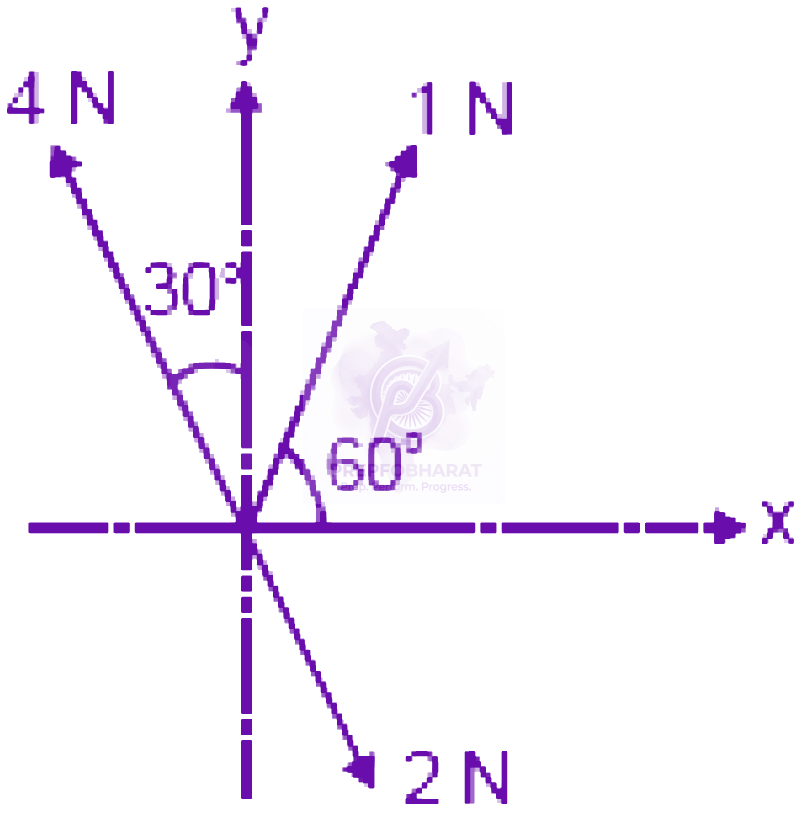
If the error in the measurement of radius of a sphere is $2 \%$, then the error in the determination of volume of the sphere will be