Mechanics PYQ — Page 16
NEET UG Physics — Mechanics previous year questions with solutions.
All Mechanics Questions (512)
(1) Centre of gravity (CG) of a body is the point at which the weight of the body acts. (2) Centre of mass coincides with the centre of gravity if the earth is assumed to have infinitely large radius. (3) To evaluate the gravitational field intensity due to any body at an external point, the entire mass of the body can be considered to be concentrated at its CG. (4) The radius of gyration of any body rotating about an axis is the length of the perpendicular dropped from the CG of the body to the axis. Which one of the following pairs of statements is correct?
From a circular disc of radius $R$ and mass $9 \mathrm{M}$, a small disc of mass $M$ and radius $\frac{R}{3}$ is removed concentrically. The moment of inertia of the remaining disc about an axis perpendicular to the plane of the disc and passing through its centre is
Two particles which are initially at rest, move towards each other under the action of their internal attraction. If their speeds are $\mathrm{v}$ and $2 \mathrm{v}$ at any instant, then the speed of centre of mass of the system will be
Six vectors $\vec{a}$ through $\vec{f}$ have the magnitudes and directions indicated in the figure. Which of the following statements is true? 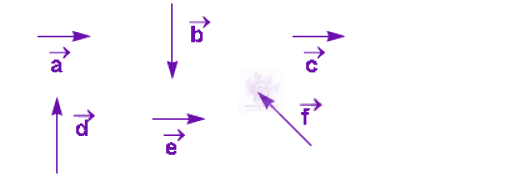
The dependence of acceleration due to gravity $g$ on the distance $r$ from the centre of the earth, assumed to be a sphere of radius $R$ of uniform density is as shown in figures below (1) 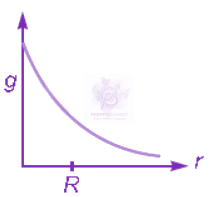 (2)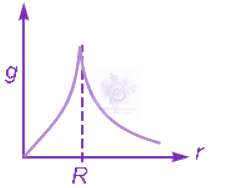 (3)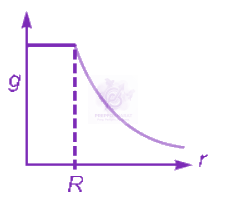 (4)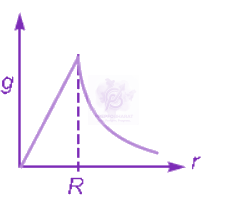 The correct figure is
A particle moves a distance $\mathrm{x}$ in time $\mathrm{t}$ according to equation $x=(t+5)^{-1}$. The acceleration of particle is proportional to
A man of $50 \mathrm{~kg}$ mass is standing in a gravity free space at a height of $10 \mathrm{~m}$ above the floor. He throws a stone of $0.5 \mathrm{~kg}$ mass downwards with a speed $2 \mathrm{~ms}^{-1}$. When the stone reaches the floor, the distance of the man above the floor will be
The dimension of $\frac{1}{2} \varepsilon_0 \mathrm{E}^2$, where $\varepsilon_0$ is permittivity of free space and $E$ is electric field, is
A ball moving with velocity $2 \mathrm{~ms}^{-1}$ collides head on with another stationary ball of double the mass. If the coefficient of restitution is 0.5 , then their velocities (in $\mathrm{ms}^{-1}$ ) after collision will be
A student measures the distance traversed in free fall of a body, initially at rest in a given time. He uses this data to estimate $g$, the acceleration due to gravity. If the maximum percentage errors in measurement of the distance and the time are $e_1$ and $e_2$ respectively, the percentage error in the estimation of $g$ is
A particle of mass $M$ is situated at the centre of a spherical shell of same mass and radius a. The gravitational potential at a point situated at a/ 2 distance from the centre, will be
A circular disk of moment of inertia $I_t$ is rotating in a horizontal plane, about its symmetry axis, with a constant angular speed $\omega_i$. Another disk of moment of inertia $I_b$ is dropped coaxially onto the rotating disk. Initially the second disk has zero angular speed. Eventually both the disks rotate with a constant angular speed $\omega_{\mathrm{f}}$. The energy lost by the initially rotating disc due to friction is
A thin circular ring of mass $M$ and radius $r$ is rotating about its axis with constant angular velocity $\omega$. Two objects each of mass $m$ are attached gently to the opposite ends of a diameter of the ring. The ring now rotates with angular velocity given by
An alpha nucleus of energy $\frac{1}{2} \mathrm{mv}^2$ bombards a heavy nuclear target of charge $Z e$. Then the distance of closest approach for the alpha nucleus will be proportional to
The speed of a projectile at its maximum height is half of its initial speed. The angle of projection is
A block of mass $\mathrm{m}$ is in contact with the cart $\mathrm{C}$ as shown in the figure. 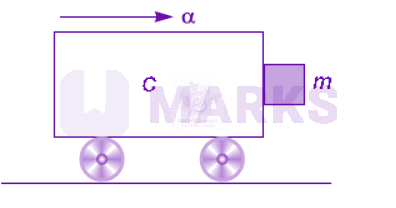 The coefficient of static friction between the block and the cart is $\mu$. The acceleration $\alpha$ of the cart that will prevent the block from falling satisfies
A ball is dropped from a high rise platform at $\mathrm{t}=0$ starting from rest. After $6 \mathrm{~s}$ another ball is thrown downwards from the same platform with a speed $\mathrm{v}$. The two balls meet at $\mathrm{t}=18 \mathrm{~s}$. What is the value of $\mathrm{v}$ ? (take $g=10 \mathrm{~ms}^{-2}$ )
The figure shows elliptical orbit of a planet $m$ about the sun $\mathrm{S}$. The shaded area SCD is twice the shaded are $\mathrm{SAB}$. It $t_1$ is the time for the planet to move from $C$ to $D$ and $t_2$ is the time to move from $A$ to $B$ then 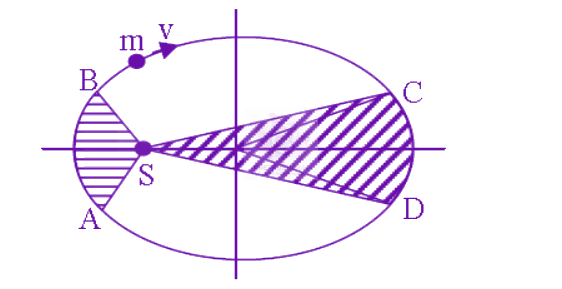
An engine pumps water continuously through a hose. Water leaves the hose with a velocity $y$ and $m$ is the mass per unit length of the water jet. What is the rate at which kinetic energy is imparted to water ?
A thin circular ring of mass $\mathrm{M}$ and radius $\mathrm{R}$ is rotating in a horizontal plane about an axis vertical to its plane with a constant angular velocity $\omega$. If two objects each mass $m$ be attached gently to the opposite ends of a diameter of the ring, the ring, will then rotate with an angular velocity:
If the dimensions of a physical quantity are given by $\left[\mathrm{M}^{\mathrm{a}} \mathrm{L}^{\mathrm{b}} \mathrm{T}^{\mathrm{c}}\right]$, then the physical quantity will be :
If the dimensions of a physical quantity are given by $\mathrm{M}^{\mathrm{a}} \mathrm{L}^{\mathrm{b}} \mathrm{T}^c$, then the physical quantity will be
Four identical thin rods each of mass $M$ and length $l$, from a square frame. Moment of inertia of this frame about an axis through the centre of the square and perpendicular to its plane is :
A body of mass $1 \mathrm{~kg}$ of thrown upwards with a velocity $20 \mathrm{~m} / \mathrm{s}$. It momenetarily comes to rest after attaining a height of $18 \mathrm{~m}$. How much energy is lost due to air friction ? $$ \left(\mathrm{g}=10 \mathrm{~m} / \mathrm{s}^2\right) $$