Mechanics PYQ — Page 15
NEET UG Physics — Mechanics previous year questions with solutions.
All Mechanics Questions (512)
A planet moving along an elliptical orbit is closest to the sun at a distance $r_1$ and farthest away at a distance of $r_2$. If $y_1$ and $v_2$ are the linear velocities at these points respectively, then the ratio $\frac{y_1}{y_2}$ is
A missile is fired for maximum range with a initial velocity of $20 \mathrm{~m} / \mathrm{s}$. If $g=10 \mathrm{~m} / \mathrm{s}^2$, the range of the missile is
A projectile is fired at an angle of $45^{\circ}$ with the horizontal. Elevation angle of the projectile at its highest point as seen from the point of projection is
A particle of mass $m$ is thrown upwards from the surface of the earth, with a velocity $u$. The mass and the radius of the earth are, respectively, $M$ and $R . G$ is gravitational constant and $g$ is acceleration due to gravity on the surface of the earth. The minimum value of $u$ so that the particle does not return back to earth, is
The dimensions of $\left(\mu_0 \varepsilon_0\right)^{-1 / 2}$ are
The moment of inertia of a thin uniform rod of mass $M$ and length $L$ about an axis passing through its mid-point and perpendicular to its length is $I_0$. Its moment of inertia about an axis passing through one of its ends and perpendicular to its length is
A mass $m$ moving horizontally (along the $x$-axis) with velocity $v$ collides and sticks to mass of $3 m$ moving vertically upward (along the $y$-axis) with velocity $2 v$. The final velocity of the combination is
A particle of mass $M$ is situated at the centre of spherical shell of mass and radius $a$. The magnitude of the gravitational potential at a point situated at $\frac{a}{2}$ distance from the centre, will be
Force $F$ on a particle moving in a straight line varies with distance $d$ as shown in the figure. The work done on the particle during its displacement of $12 \mathrm{~m}$ is 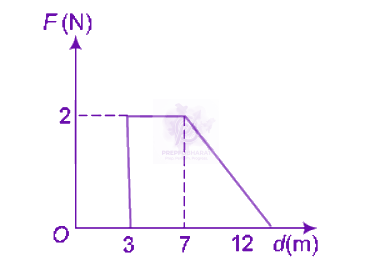
A boy standing at the top of a tower of $20 \mathrm{~m}$ height drops a stone. Assuming $g=10 \mathrm{~ms}^{-2}$, the velocity with which it hits the ground is
A body projected vertically from the earth reaches a height equal to earth's radius before returning to the earth. The power exerted by the gravitational force is greatest
The density of material in CGS system of units is $4 \mathrm{~g} / \mathrm{cm}^3$. In a system of units in which unit of lengths is $10 \mathrm{~cm}$ and unit of mass is $100 \mathrm{~g}$, the value of density of material will be
Which one of the following is present as an active ingredient in bleaching powder for bleaching action?
A small mass attached to a string rotates on frictionless table top as shown. If the tension is the string is increased by pulling the string causing the radius of the circular motion to decrease by a factor of 2 , the kinetic energy of the mass will 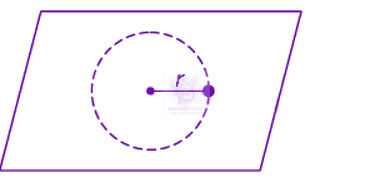
A body is moving with velocity $30 \mathrm{~m} / \mathrm{s}$ towards east. After $10 \mathrm{~s}$ its velocity becomes $40 \mathrm{~m} / \mathrm{s}$ towards north. The average acceleration of the body is
A particle moves in a circle of radius $5 \mathrm{~cm}$ with constant speed and time period $0.2 \pi \mathrm{s}$. The acceleration of the particle is
A particle covers half of its total distance with speed $v_1$ and the rest half distance with speed $v_2$. Its average speed during the complete journey is
The solid cylinder and a hollow cylinder, both of the same mass and same external diameter are released from the same height at the same time on a inclined plane. Both roll down without slipping. Which one will reach the bottom first?
An engine pumps water through a hose pipe. Water passes through the pipe and leaves it with a velocity of $2 \mathrm{~ms}^{-1}$. The mass per unit length of water in the pipe is $100 \mathrm{kgm}^{-1}$. What is the power of the engine?
A particle of mass $M$ starting from rest undergoes uniform acceleration. If the speed acquired in time $T$ is $v$, the power delivered to the particle is
A particle has initial velocity $(3 \hat{\mathrm{i}}+4 \hat{\mathrm{j}})$ and has acceleration $(0.1 \hat{\mathrm{i}}+0.3 \hat{\mathrm{j}})$. Its speed after $10 \mathrm{~s}$ is
A gramophone record is revolving with an angular velocity $\omega$. A coin is placed at a distance $\mathrm{r}$ from the centre of the record. The static coefficient of friction is $\mu$. The coin will revolve with the record if
The additional kinetic energy to be provided to a satellite of mass $m$ revolving around a planet of mass $M$, to transfer it from a circular orbit of radius $R_1$ to another of radius $R_2\left(R_2>R_1\right)$ is
The radii of circular orbits of two satellites A and $B$ of the earth are $4 R$ and $R$, respectively. If the speed of satellite $A$ is $3 v$, then the speed of satellite $B$ will be