Mechanics PYQ — Page 11
NEET UG Physics — Mechanics previous year questions with solutions.
All Mechanics Questions (512)
The cylindrical tube of a spray pump has radius $R$ , one end of which has $n$ fine holes, each of radius $r$ . If the speed of the liquid in the tube is $V$ , the speed of the ejection of the liquid through the holes is :
The heart of a man pumps $5$ litres of blood through the arteries per minute at a pressure of $150\mathrm{mm}$ of mercury. If the density of mercury be $13.6\times {10}^{3} kg{m}^{-3}$ and $g=10 m{s}^{-2}$, then the power of heart in watt is:
A wind with speed $40m{s}^{-1}$ blows parallel to the roof of a house. The area of the roof is $250 {m}^{2}$ . Assuming that the pressure inside the house is atmospheric pressure, the force exerted by the wind on the roof and the direction of the direction of the force will be : $({\rho }_{\mathrm{air}}=1.2\mathrm{kg}{m}^{-3})$
A remote-sensing satellite of earth revolves in a circular orbit at a height of $0.25\times {10}^{6}$ m above the surface of earth. If earth's radius is $6.38\times {10}^{6} m$ and $g=9.8 m {s}^{-2}$, then the orbital speed of the satellite is: Mass of earth undefined
A particle of mass $m$ is driven by a machine that delivers a constant power $k$ watts. If the particle starts from rest the force on the particle at time $t$ is:
A mass $\text{m}$ moves in a circle on a smooth horizontal plane with velocity ${v}_{0}$ at a radius ${R}_{0}$ . The mass is attached to a string which passes through a smooth hole in plane as shown. 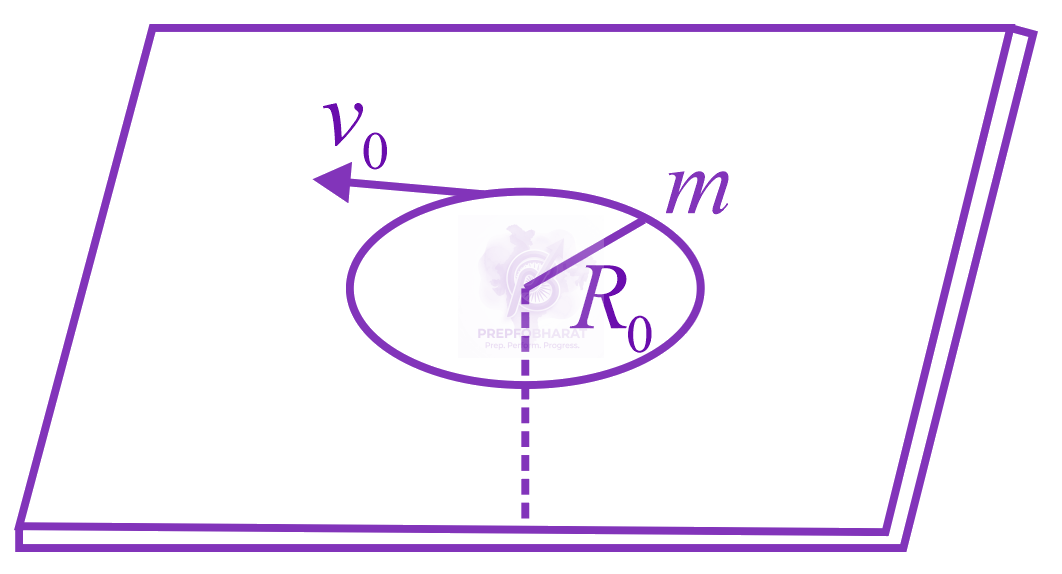 The tension in the string is increased gradually and finally $\text{m}$ moves in a circle of radius $\frac{{R}_{0}}{2}$. The final value of the kinetic energy is:
Two particles of masses ${m}_{1}, {m}_{2}$ move with initial velocities ${u}_{1}$ and ${u}_{2}$. On collision, one of the particles get excited to higher level, after absorbing energy $\epsilon .$ If final velocities of particles be ${v}_{1}$ and ${v}_{2}$ then we must have:
A force $\vec{F}=\alpha \hat{i}+3\hat{j}+6\hat{k}$ is acting at a point $\vec{r}=2\hat{i}-6\hat{j}-12\hat{k}$ . The value of $\alpha$ for which angular momentum about origin is conserved is:
Two particles A and B move with constant velocities ${\vec{v}}_{1}$ and ${\vec{v}}_{2}$. At the initial moment their position vectors are ${\vec{r}}_{1}$ and ${\vec{r}}_{2}$ respectively. The condition for particles A and B for their collision is:
Two similar springs $\text{P}$ and $\text{Q}$ have spring constants ${K}_{P}$ and ${K}_{Q}$, such that ${K}_{P}>{K}_{Q}$. They are stretched, first by the same amount (case a), then by the same force (case b). the work done by the springs ${W}_{P}$ and ${W}_{Q}$ are related as respectively, in case
Three identical spherical shells, each of mass $m$ and radius $r$ are placed as shown in the figure. Consider an axis $X{X}^{'}$ which is touching the two shells and passing through the diameter of the third shell. The moment of inertia of the system consisting of these three spherical shells about $X{X}^{'}$ axis is: 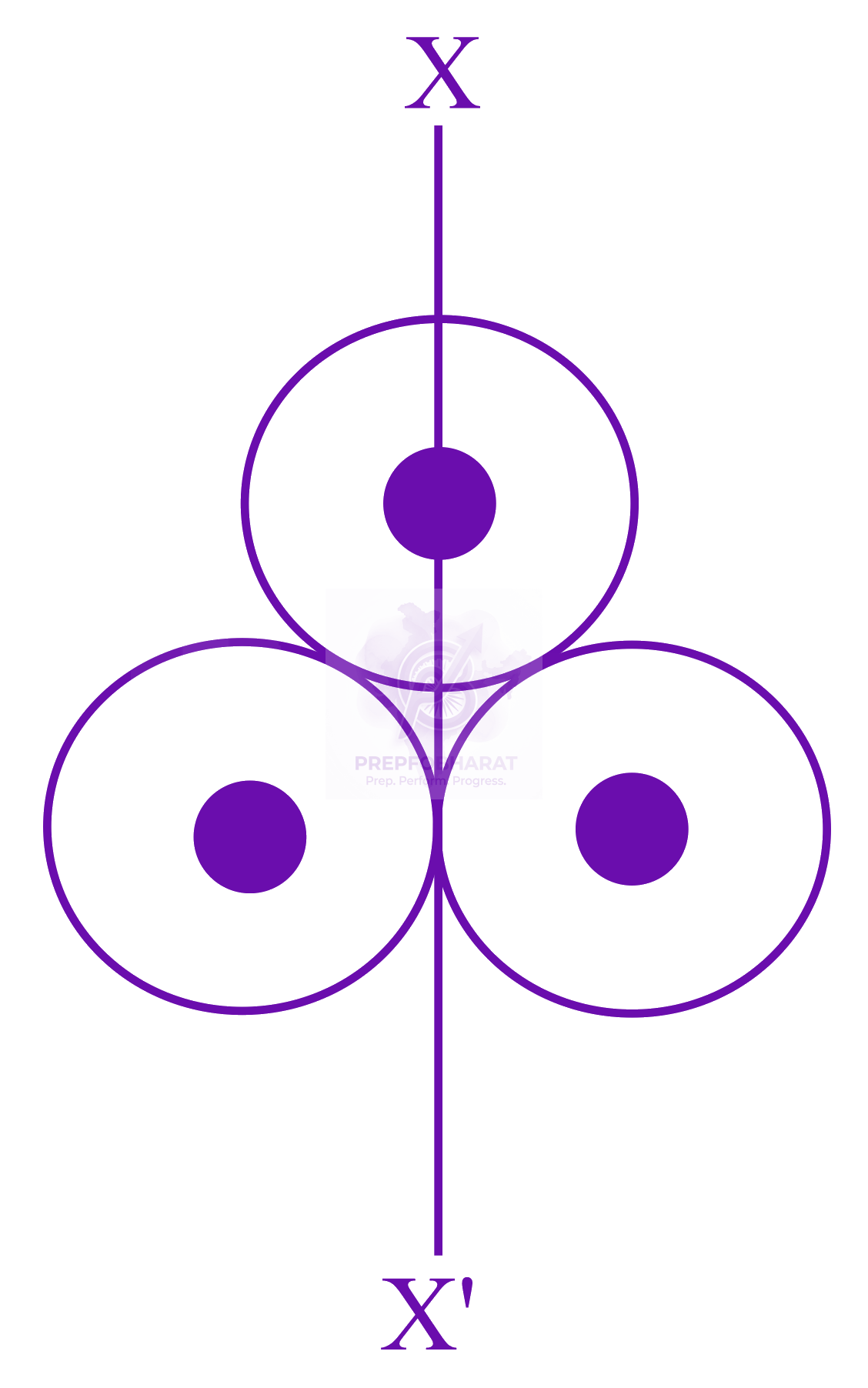
The Young's modulus of steel is twice that of brass. Two wires of same length and of same area of cross-section, one of steel and another of brass are suspended from the same roof. If we want the lower ends of the wires to be at the same level, then the weights added to the steel and brass wires must be in the ratio of:
A block $\text{A}$ of mass ${m}_{1}$ rests on a horizontal table. A light string connected to it passes over a frictionless pulley at the edge of table and from its other end another block $\text{B}$ of mass ${m}_{2}$ is suspended. The coefficient of kinetic friction between the block and the table is ${\mu }_{k}$. When the block $\text{B}$ is sliding on the table, the tension in string is:
Two spherical bodies of mass M and 5M and radii R and 2R released in free space with initial separation between their centres equal to 12R. If they attract each other due to gravitational force only, then the distance covered by the smaller body before collision is:
The value of coefficient of volume expansion of glycerin is $5\times {10}^{-4 }{K}^{-1}$. The fractional change in the density of glycerin for a rise of ${40 }^{o}C$ in its temperature is:
A ball is thrown vertically downwards from a height of $20 m$ with an initial velocity ${v}_{0}$. It collides with the ground, loses $50$ percent of its energy in collision and rebounds to the same height. The initial velocity ${v}_{0}$ is: (Take $g=10 m {s}^{-2}$)
Two stones of masses $m$ and $2m$ are whirled in horizontal circles, the heavier one in radius $\frac{r}{2}$ and the lighter one in radius $r$. The tangential speed of lighter stone is $n$ times that of the tangential speed of the heavier stone. They are reported to experience the same centripetal force. The value of $n$ is,
If energy $(E)$, velocity $(V)$ and time $(T)$ are chosen as the fundamental quantities, the dimensional formula of surface tension will be___(For surface tension, Force=Surface tension$\times$length)
If vectors $\vec{A}=\mathrm{cos}\omega t \hat{i}+sin\omega t \hat{j}$ and $\vec{B}=cos\frac{\omega t}{2 }\hat{i}+\mathrm{sin}\frac{\omega t}{2 }\hat{j}$ are functions of time, then the value of $t$ at which they are orthogonal to each other is:
A ship $\text{A}$ is moving Westwards with a speed of $10 km{h}^{-1}$ and a ship $\text{B}$ $\text{100 km}$ south of $\text{A}$, is moving Northwards with a speed of $10 km {h}^{-1}$ . The time after which the distance between them becomes shortest, is:
A plank with a box on it at one end is gradually raised about the other end. As the angle of inclination with the horizontal reaches $30^{\circ}$, the box starts to slip and slides $4.0m$ down the plank in $4.0s$. The coefficients of static and kinetic friction between the box and the plank will be, respectively: 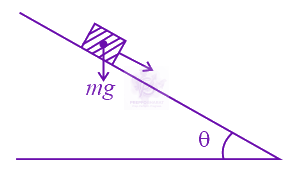
Water rises to a height 'h' in capillary tube. If the length of capillary tube above the surface of water is made less than 'h', then:
The position vector of a particle $\vec{R}$ as a function of time is given by: $\vec{R}=4\mathrm{sin}(2\pi t)\hat{i}+4cos(2\pi t)\hat{j}$ Where R is in meters, t is in seconds and $\hat{i}$ and $\hat{j}$ denote unit vectors along x- and y-directions, respectively. Which one of the following statements is wrong for the motion of particle?
A rod of weight $\text{W}$ is supported by two parallel knife edges $\text{A}$ and $\text{B}$ and is in equilibrium in a horizontal position. The knives are at a distance $\text{d}$ from each other. The centre of mass of the rod is at distance $\text{x}$ from $\text{A}$ . the normal reaction on $\text{A}$ is: