Mechanics PYQ — Page 12
NEET UG Physics — Mechanics previous year questions with solutions.
All Mechanics Questions (512)
An automobile moves on a road with a speed of $54 km {h}^{-1}$ . The radius of its wheels is $0.45 \text{m}$ and the moment of inertia of the wheel about its axis of rotation is $3 kg {m}^{2}$ . If the vehicle is brought to rest in $\text{15 s}$, the magnitude of average torque transmitted by its brakes to the wheel is:
Three blocks A, B and C, of masses $4\mathrm{kg},2\mathrm{kg}$ $1\mathrm{kg}$ and respectively, are in contact on a frictionless surface, as shown. If a force of $14N$ is applied on the$4\mathrm{kg}$ block, then the contact force between A and B is: 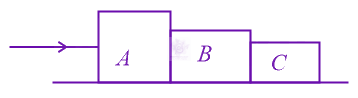
If dimensions of critical velocity, ${v}_{c}$ of a liquid flowing through a tube are expressed as $[{\eta }^{x}{\rho }^{y}{r}^{z}]$, where, $\eta , \rho$ and $r$ are the coefficient of viscosity of liquid, density of liquid and radius of the tube, respectively, then, the values of $x$, $y$ and $\text{z}$ are given by
A block of mass $10\mathrm{kg}$, moving in $x$ direction with a constant speed of $10 m {s}^{-1}$ , is subjected to a retarding force $F=[(0.1)x] J{m}^{-1}$ during its travel from $x=20m$ to $30m$ . Its final kinetic energy will be:
Point masses ${m}_{1}$ and ${m}_{2}$ are placed at the opposite ends of rigid rod of length $\text{L}$, and negligible mass. The rod is to be set rotating about an axis perpendicular to it. The position of point $\text{L}$ on this rod through which the axis should pass so that the work required to set the rod rotating with angular velocity ${\omega }_{0}$ is minimum, is given by: 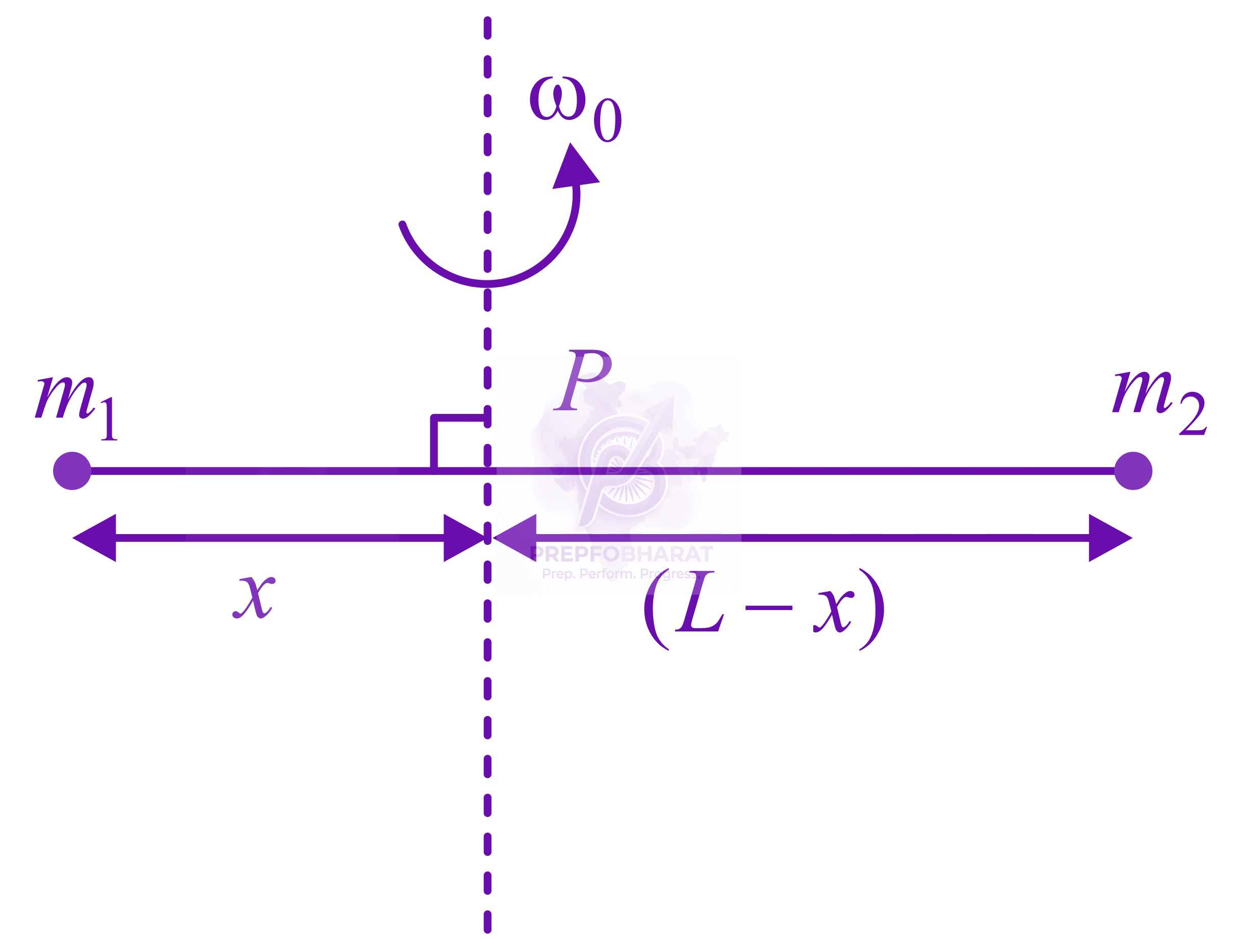
A body of mass $(4m)$ is lying in $x$ - $y$ plane at rest. It suddenly explodes into three pieces. Two pieces, each of mass $(m)$ move perpendicular to each other with equal speeds $(\upsilon ).$ The total kinetic energy generated due to explosion is:
A particle is moving such that its position coordinates $(x, y)$ are $(2m, 3m)$ at time $t=0,$ $(6m, 7m)$ at time $t=2s$ and $(13m, 14m)$ at time $t=5s$. The average velocity vector $({\vec{V}}_{av})$ from $t=0$ to $t=5 s$ is:
A solid cylinder of mass $50 kg$ and radius $0.5 m$ is free to rotate about horizontal axis. A massless string is wound round the cylinder with one end attached to it and other hanging freely. Tension in the string required to produce an angular acceleration of $2$ revolutions ${s}^{-2}$
Copper of fixed volume $V$ is drawn into wire of length $l$. When this wire is subjected to a constant force $F,$ the extension produced in the wire is $\Delta l.$ Which of the following graph is a straight line?
If force $(F),$velocity $(V)$ and time $(T)$ are taken as fundamental units, the dimensions of mass are
Dependence of intensity of gravitational field $(E)$ of earth with distance $(r)$ from centre of earth is correctly represented by:
The ratio of the acceleration for a solid sphere (mass $‘m'$ and radius $R)$ rolling down an incline of angle $‘\theta '$ without slipping and slipping down the incline without rolling is:
A black hole is an object whose gravitational field is so strong that even light cannot escape from it. To what approximate radius would earth $(mass=5.98\times {10}^{24}kg)$ have to be compressed to be a black hole?
A certain number of spherical drops of a liquid of radius $r$ coalesce to form a single drop of radius $R$ and volume $V.$ If $T$ is the surface tension of the liquid then:
A system consists of three masses ${m}_{1},{m}_{2}$ and ${m}_{3}$ connected by a string passing over a pulley $P.$ The mass ${m}_{3}$ hangs freely and ${m}_{2}$ and ${m}_{1}$ are on a rough horizontal table (the coefficient of friction $=\mu ).$ The pulley is frictionless and of negligible mass. The downward acceleration of mass ${m}_{3}$ is: (Assume ${m}_{1}={m}_{2}={m}_{3}=m)$ 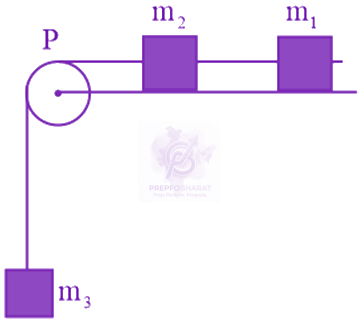
The force $‘F'$ acting on a particle of mass $‘m'$ is indicated by the force-time graph shown below. The change in momentum of the particle over the time interval from zero to $8 s$ is: 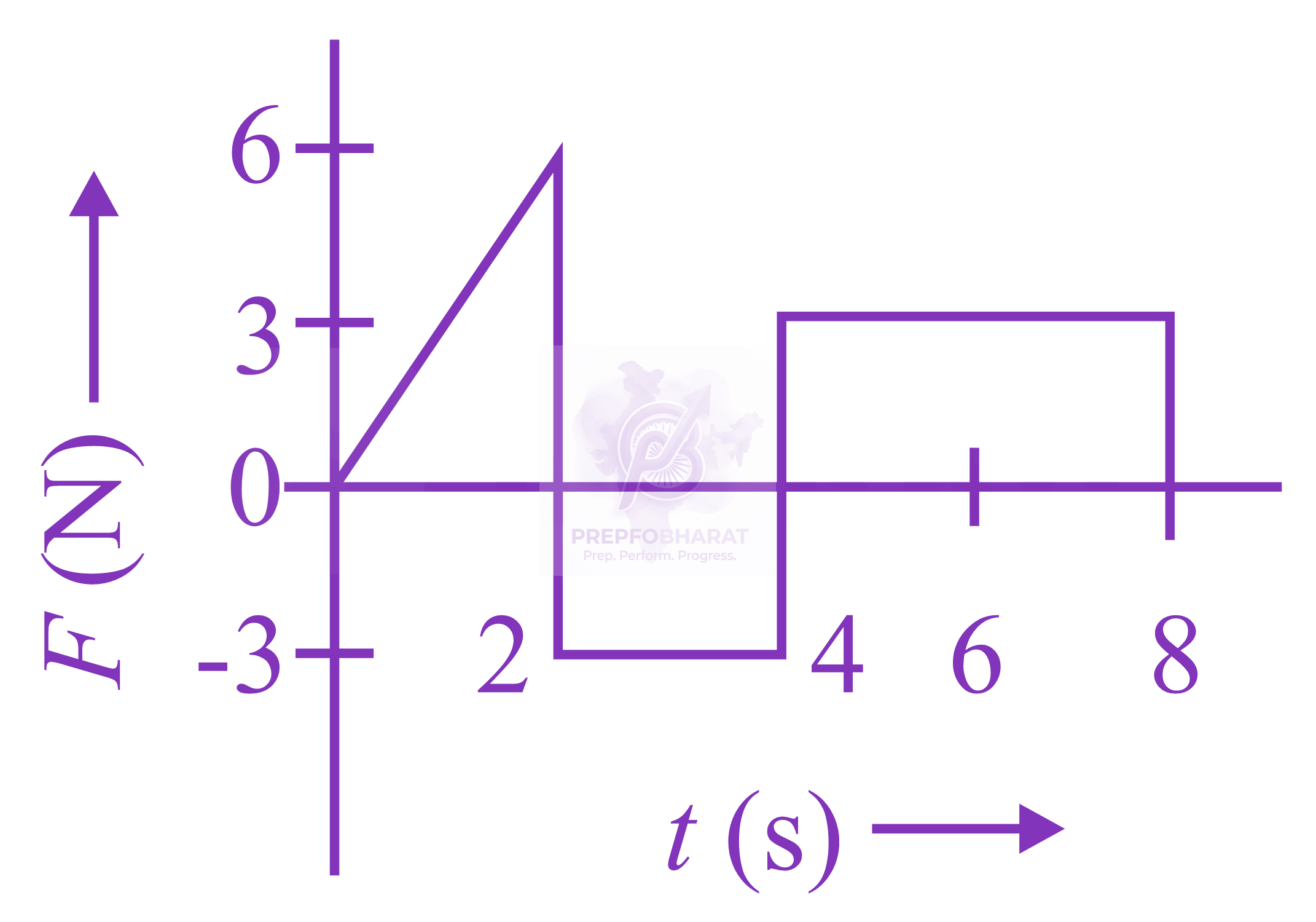
A projectile is fired from the surface of the earth with a velocity of $5 m{s}^{-1}$ and angle $\theta$ with the horizontal. Another projectile fired from another planet with a velocity of $3 {ms}^{-1}$ at the same angle follows a trajectory which is identical with the trajectory of the projectile fired from the earth. The value of the acceleration due to gravity on the planet is: (given $=9.8 m{s}^{-2}$)
A balloon with mass $m$ is descending down with an acceleration $a$ (where $a<g).$ How much mass should be removed from it so that it starts moving up with an acceleration $a$?
A particle of mass ' $m$ ' is kept at rest at a height $3 R$ from the surface of earth, where ' $R$ ' is radius of earth and ' $M$ ' is mass of earth. The minimum speed with which is should be projected, so that it does not return back, is $(g$ is acceleration due to gravity on the surface of earth)
A stone falls freely under gravity. It covers distances $h_1, h_2$ and $h_3$ in the first 5 seconds, the next 5 seconds and the next 5 seconds respectively. The relation between $h_1, h_2$ and $h_3$ is
The displacement ' $x$ ' (in meter) of a particle of mass ' $m$ ' (in kg) moving in one dimension under the action of a force, is related to time ' $t$ ' (in sec) by $t=\sqrt{x}+3$. The displacement of the particle when its velocity is zero will be:
Three blocks with masses $m, 2 m$ and $3 m$ are connected by strings, as shown in the figure. After an upward force $F$ is applied on block $m$, the masses move upward at constant speed $v$. What is the net force on the block of mass $2 m ?$ 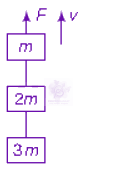
One coolie takes 1 minute to raise a suitcase through a height of $2 \mathrm{~m}$ but the second coolie takes $30 \mathrm{~s}$ to raise the same suitcase to the same height. The power two coolies are in the ratio
The following four wires are made of the same material. Which of these will have the largest extension when the same tension is applied?