Electromagnetism PYQ — Page 9
NEET UG Physics — Electromagnetism previous year questions with solutions.
All Electromagnetism Questions (503)
The meter bridge shown in the balance position with $\frac{\mathrm{P}}{\mathrm{Q}}=\frac{\mathrm{l}_1}{\mathrm{l}_2}$. If we now interchange the positions of galvanometer and cell, will the bridge work? If yes, that will be balanced condition? 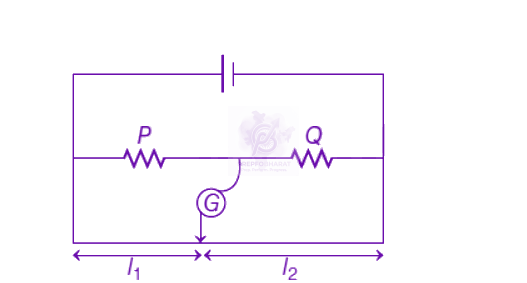
A cylindrical conductor of radius $R$ is carrying a constant current. The plot of the magnitude of the magnetic field $B$ with the distance $d$ from the centre of the conductor is correctly represented by the figure.
The variation of EMF with time for four types of generators are shown in the figures. Which amongst them can be called AC? (a) 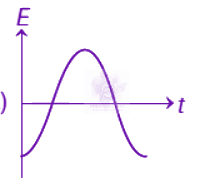 (b)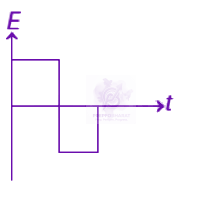 (c)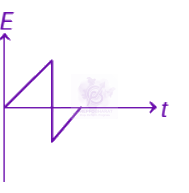 (d)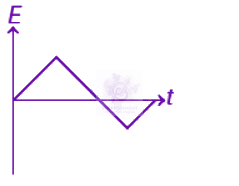
Two point charges A and B, having charges $+Q$ and $-Q$ respectively, are placed at certain distance apart and force acting between them is $F$. If $25%$ charge of $A$ is transferred to $B$, then the force between the charges becomes
Two parallel infinite line charges with linear charge densities $+\lambda C{m}^{-1}$ and $-\lambda C{m}^{-1}$ are placed at a distance of $2R$ in free space. What is the electric field mid-way between the two-line charges?
Current sensitivity of a moving coil galvanometer is $5 div/mA$ and its voltage sensitivity (angular deflection per unit voltage applied) is $20 div/V$. The resistance of the galvanometer is
The electrostatic force between the metal plates of an isolated parallel plate capacitor $C$ having a charge $Q$ and area $A$, is
A set of $n$ equal resistances, of value $R$ each, are connected in series to a battery of emf $E$ and internal resistances $R$. The current drawn is $I$. Now, the $n$ resistance are connected in parallel to the same battery. Then the current drawn from battery becomes $10I$. The value of $n$ is
An inductor $20 mH,$ capacitor $100 \mu F$ and a resistor $50 \Omega$ are connected in series across a source of emf, $V= 10\mathrm{sin}(314t)$. The power loss in the circuit is
An electron falls from rest through a vertical distance $h$ in a uniform and vertically upward directed electric field $E$. The direction of electric filed is now reversed, keeping its magnitude the same. A proton is allowed to fall from rest in it through the same vertical distance $h$. The time of fall of the electron, in comparison to the time of fall of the proton is
A metallic rod of mass per unit length $0.5 \mathrm{kg} {m}^{-1}$ is lying horizontally on a smooth inclined plane which makes an angle ${30}^{o}$ with the horizontal. The rod is not allowed to slide down by flowing a current through it when a magnetic field of induction $0.25T$ is acting on it in the vertical direction. The current flowing in the rod to keep it stationary is
The magnetic potential energy stored in a certain inductor is $25\mathrm{mJ}$, when the current in the inductor is $60\mathrm{mA}$ . This inductor is of inductance
A thin diamagnetic rod is placed vertically between the poles of an electromagnet. When the current in the electromagnet is switched on, then the diamagnetic rod is pushed up, out of the horizontal magnetic field. Hence, the rod gains gravitational potential energy. The work required to do this comes from
A battery consists of a variable number 'n' of identical cells (having internal resistance 'r' each) which are connected in series. The terminals of the battery are short-circuited and the current $I$ is measured. Which of the graphs shows the correct relationship between $I$ and n?
An EM wave is propagating in a medium with a velocity $\vec{V}=V\hat{i}$. The instantaneous oscillating electric field of this em wave is along $+y$ axis. Then the direction of oscillating magnetic field of the EM wave will be along
Suppose the charge of a proton and an electron differ slightly. One of them is $e$, the other is $(e+\Delta e)$. If the net electrostatic force and gravitational force between two hydrogen atoms placed at a distance $d$ (much greater than atomic size) apart is zero, then $\Delta e$ is of the order of [Given mass of hydrogen ${m}_{h}= 1.67\times {10}^{–27} \mathrm{kg}$]
A capacitor is charged by a battery. The battery is removed and another identical uncharged capacitor is connected in parallel. The total electrostatic energy of resulting system
The diagrams below show regions of equipotential. 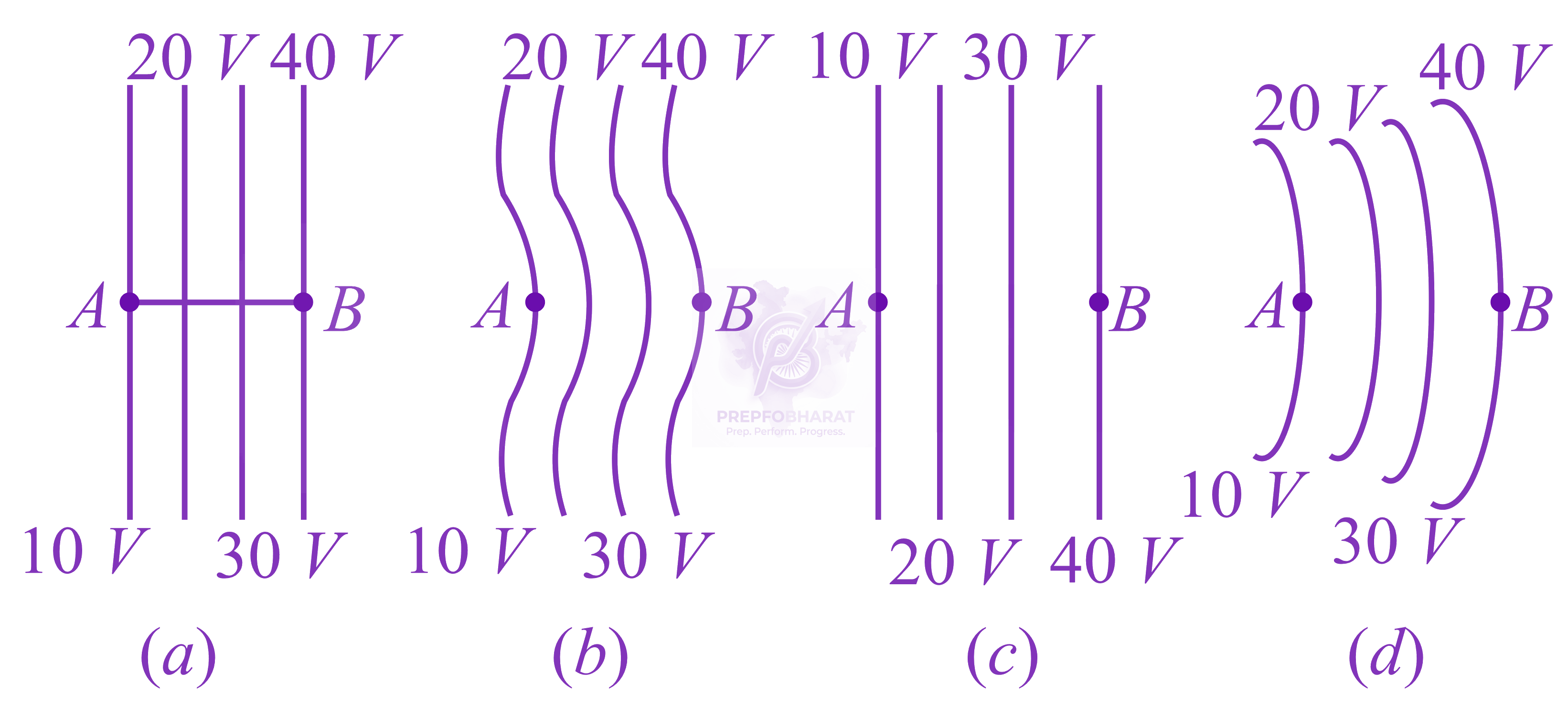 A positive charge is moved from $A$ to $B$ in each diagram.
In an electromagnetic wave in free space the root mean square value of the electric field is ${E}_{rms}=6V{m}^{-1}$. The peak value of the magnetic field is
A long solenoid of diameter $0.1m$ has $2\times {10}^{4}$ turns per meter. At the centre of the solenoid, a coil of $100$ turns and radius $0.01m$ is placed with its axis coinciding with the solenoid axis. The current in the solenoid reduces at a constant rate to $0A$ from $4A$ in $0.05s$. If the resistance of the coil is $10{\pi }^{2} \Omega ,$ the total charge flowing through the coil during this time is
Figure shows a circuit contains three identical resistors with resistance $R=9.0 \Omega$ each, two identical inductors with inductance $L=2.0\mathrm{mH}$ each, and an ideal battery with emf $\epsilon = 18 V$. The current $i$ through the battery just after the switch closed is: 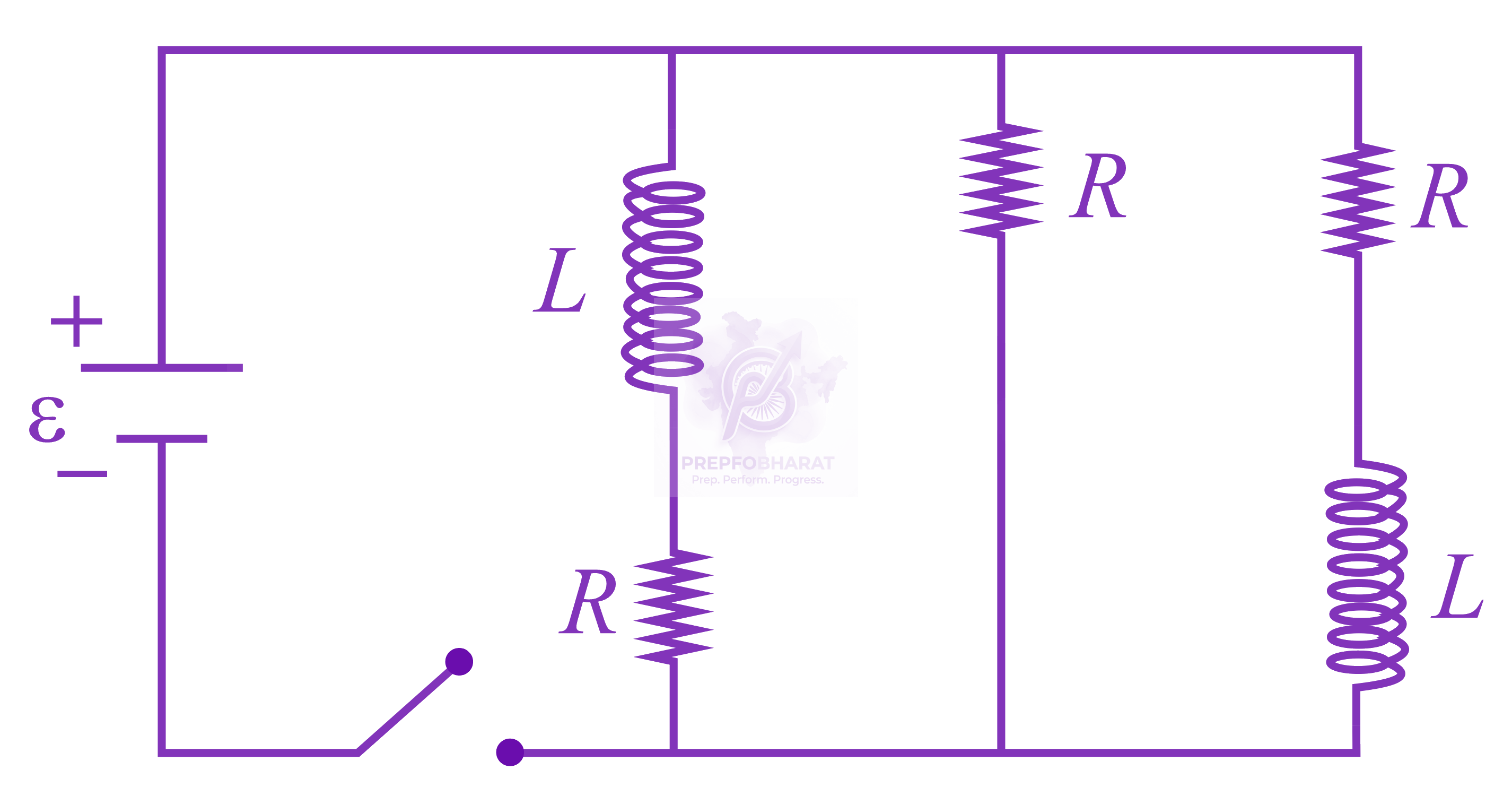
A potentiometer is an accurate and versatile device to make electrical measurements of E.M.F, because the method involves:
A $250$-Turn rectangular coil of length $2.1 cm$ and width $1.25 cm$ carries a current of $85 \mu A$ and subjected to a magnetic field of strength $0.85 T.$ Work done for rotating the coil by $180^{\circ}$ against the torque is:
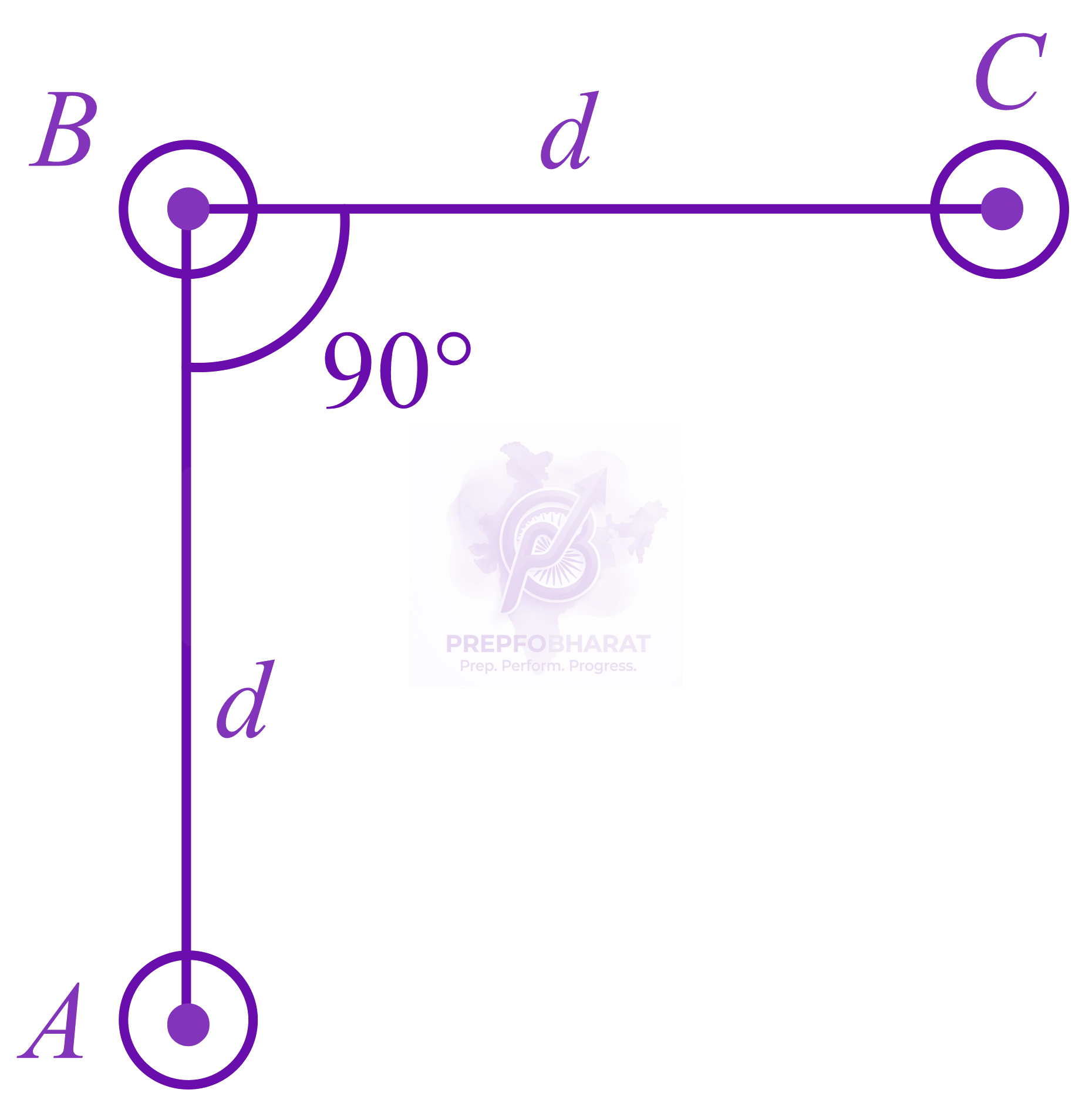
An arrangement of three parallel straight wires placed perpendicular to plane of paper carrying same current $I$ along the same direction is shown in Figure. Magnitude of force per unit length on the middle wire $B$ is given by