Electromagnetism PYQ — Page 10
NEET UG Physics — Electromagnetism previous year questions with solutions.
All Electromagnetism Questions (503)
The resistance of a wire is $R$ ohm. If it is melted and stretched to $n$ times its original length, its new resistance will be
A long solenoid has $1000$ turns. When a current of $4 A$ flows through it the magnetic flux linked with each turn of the solenoid is $4\times {10}^{-3} Wb.$ The self-inductance of the solenoid is:
A long wire carrying a steady current is bent into a circular loop of one turn. The magnetic field at the centre of the loop is $B.$ It is then bent into a circular coil of $n$ turns. The magnetic field at the centre of this coil of $n$ turns will be
The charge flowing through a resistance $\text{R}$ varies with time $t$ as $Q=at-b{t}^{2}$ where $\text{a}$ and $\text{b}$ are positive constants. The total heat produced in $\text{R}$ is:
A parallel-plate capacitor of area $A$, plate separation $d$ and capacitance $C$ is filled with four dielectric materials having dielectric constants${k}_{1}$, ${k}_{2}$, ${k}_{3}$ and ${k}_{4}$ as shown in the figure below. If a single dielectric material is to be used to have the same capacitance $C$ in this capacitor, then its dielectric constant $k$ is given by 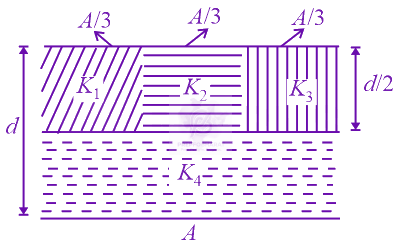
Which of the following combinations should be selected for better tuning of an LCR circuit used for communication?
A potentiometer wire is $100\mathrm{cm}$ long and a constant potential difference is maintained across it. Two cells are connected in series first to support one another and then in opposite direction. The balance points are obtained at $50\mathrm{cm}$ and $10\mathrm{cm}$ from the positive end of the wire in the two cases. The ratio of EMF's is :
The potential differences across the resistance, capacitance, and inductance are $80V,40V$ and $100V$, respectively in an LCR circuit. The power factor of this circuit is
A $100 \Omega$ resistance and a capacitor of $100 \Omega$ reactance are connected in series across a $220 V$ source. When the capacitor is $50%$ charged, the peak value of the displacement current is
The potential difference $({V}_{A}-{V}_{B})$ between the points $A$ and $B$ in the given figure is 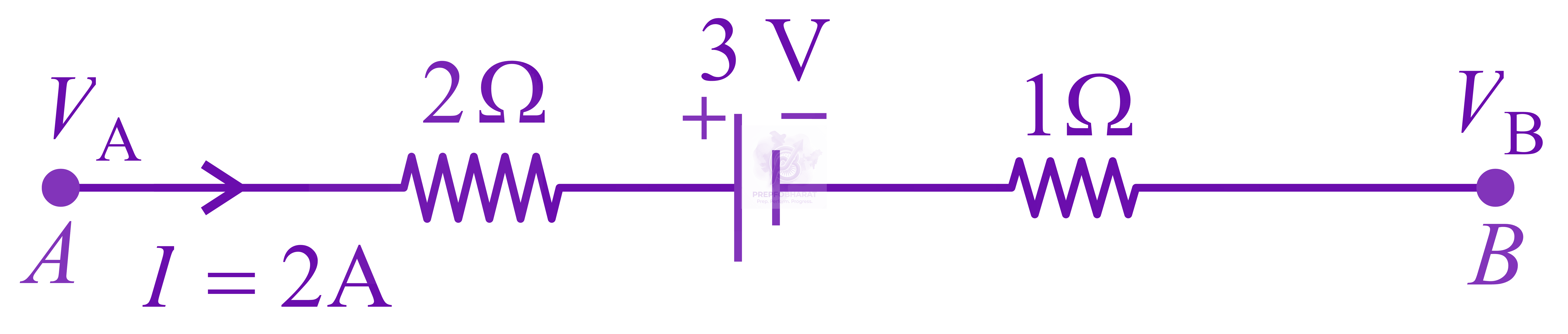
An electric dipole is placed at an angle of $30^{\circ}$ with an electric field intensity $2\times {10}^{5}{\text{ N C}}^{-1}$. It experiences a torque equal to $\text{4} \text{N} \text{m}$. The charge on the dipole, if the dipole length is $\text{2} \text{cm}$, is
A filament bulb $(500W,100V)$ is to be used in a $230V$ main supply. When a resistance, $R$ is connected in series, it works perfectly and the bulb consumes $500W$. The value of $R$ is
A small signal voltage $V(t)={V}_{0}\mathrm{sin}\omega t$ is applied across an ideal capacitor $\text{C}$:
A bar magnet is hung by a thin cotton thread in a uniform horizontal magnetic field and is in equilibrium state. The energy required to rotate it by ${60}^{o}$ is $W$. Now, the torque required to keep the magnet in this new position is
Out of the following options which one can be used to produce a propagating electromagnetic wave?
An electron is moving in a circular path under the influence of a transverse magnetic field of $3.57\times {10}^{-2} T$. If, the value of $\frac{e}{m}$ is $1.76\times {10}^{11}C{\mathrm{kg}}^{-1}$, the frequency of revolution of the electron is
Two identical charged spheres suspended from a common point by two massless strings of lengths $l$, are initially at a distance $d( d\ll l )$ apart because of their mutual repulsion. The charges begin to leak from both the spheres at a constant rate. As a result, the spheres approach each other with a velocity $\upsilon$. Then $\upsilon$ varies as a function of the distance $x$ between the spheres, as
The magnetic susceptibility is negative for:
A square loop $ABCD$ carrying a current $i$, is placed near and coplanar with a long straight conductor $XY$ carrying a current $I$, the net force on the loop will be: 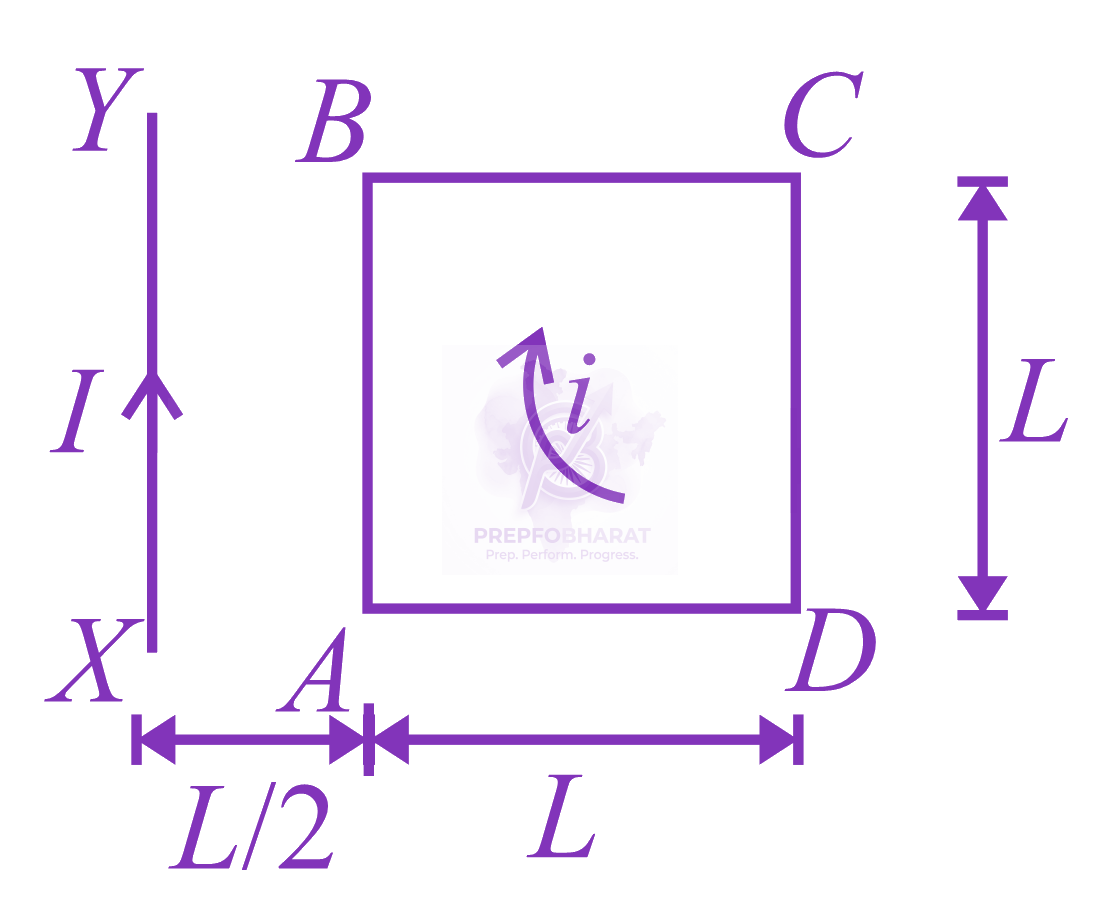
An inductor $20 \text{mH}$, a capacitor $50 \mu F$ and a resistor $40 \Omega$ are connected in series across a source of emf $V=10\mathrm{sin}340 t$. The power loss in $\text{AC}$. circuit is:
A capacitor of $2 \mu F$ is charged as shown in the diagram. When the switch $\text{S}$ is turned to position $2$, the percentage of its stored energy dissipated is 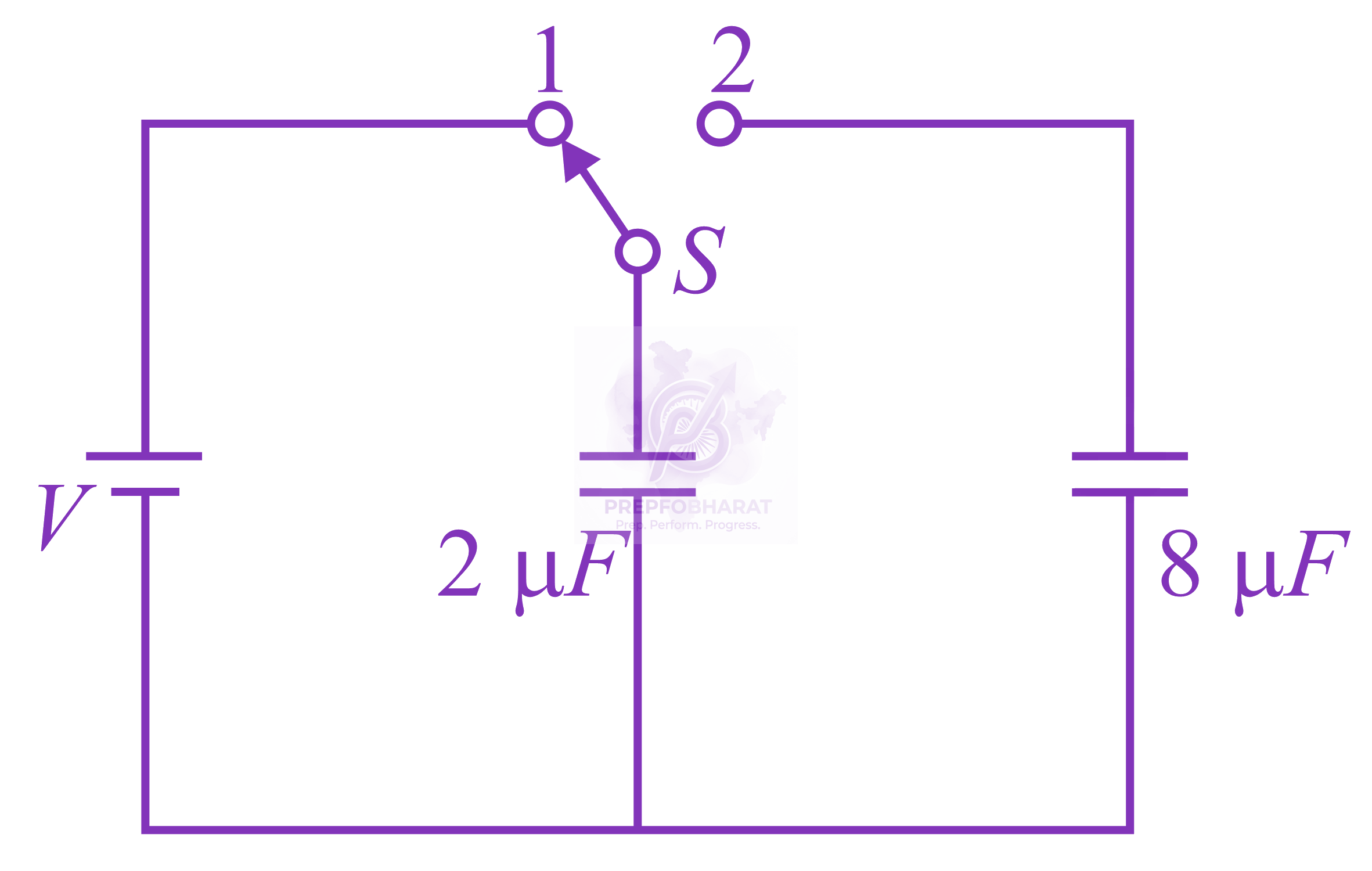
A uniform magnetic field is restricted within a region of radius, $r.$ The magnetic field changes with time at a rate, $\frac{d\vec{B}}{dt}$. Loop one of radius $R>r$ encloses the region, $r$ and loop two of radius, $R$ is outside the region of magnetic field as shown in the figure below. Then the emf generated is 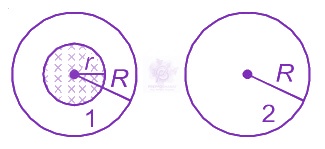
A long straight wire of radius $\text{a}$ carries a steady current $\text{I}$. the current is uniformly distributed over its cross-section. The ratio of the magnetic fields $\text{B}$ and $\text{B'}$, at radial distances $\frac{a}{2}$ and $2a$ respectively, from the axis of the wire is:
A proton and an alpha particle both enter a region of uniform magnetic field B, moving at right angles to the field B. if the radius of circular orbits for both the particles is equal and the kinetic energy acquired by proton is 1 MeV, the energy acquired by the alpha particle will be: