Physical Chemistry PYQ — Page 5
NEET UG Chemistry — Physical Chemistry previous year questions with solutions.
All Physical Chemistry Questions (571)
Find the emf of the cell in which the following reaction takes place at $298K$ $\mathrm{Ni}(s)+2{\mathrm{Ag}}^{+}(0.001M)\rightarrow {\mathrm{Ni}}^{2+}(0.001M)+2\mathrm{Ag}(s)$ (Given that $E{^{\circ}}_{\mathrm{cell}}=1.05V,\frac{2.303\mathrm{RT}}{F}=0.059$ at $298K$)
$3{O}_{2}(g)\rightleftharpoons 2{O}_{3}(g)$ for the above reaction at $298K,{K}_{c}$ is found to be $3.0\times {10}^{-59}$. If the concentration of ${O}_{2}$ at equilibrium is $0.040M$ then concentration of ${O}_{3}$ in $M$ is
Two half cell reactions are given below : $\mathrm{CO}^{3+}+\mathrm{e}^{-} \rightarrow \mathrm{Co}^{2+}, \mathrm{E}^{\circ} \mathrm{Co}^{2+} / \mathrm{Co}^{3+}=-1.81 \mathrm{~V}$ $2 \mathrm{Al}^{3+}+6 \mathrm{e}^{-} \rightarrow 2 \mathrm{Al}(\mathrm{s}), \mathrm{E}^{\mathrm{o}} \mathrm{Al} / \mathrm{Al}^{3+}=+1.66 \mathrm{~V}$ The standard EMF of a cell with feasible redox reaction will be :
$\mathrm{K}_{\mathrm{H}}$ value for some gases at the same temperature ' $\mathrm{T}$ ' are given: $\begin{array}{c|c} \text {gas } & \mathrm{K}_{\mathrm{H}} / \mathbf{k} \text { bar } \\ \hline \mathrm{Ar} & 40.3 \\ \mathrm{CO}_2 & 1.67 \\ \mathrm{HCHO} & 1.83 \times 10^{-5} \\ \mathrm{CH}_4 & 0.413 \end{array}$ where $\mathrm{K}_{\mathrm{H}}$ is Henry's Law constant in water. The order of their solubility in water is :
Given below are half cell reactions : ${\mathrm{MnO}}_{4}^{-}+8{H}^{+}+5{e}^{-}\rightarrow {\mathrm{Mn}}^{2+}+4{H}_{2}O$, ${E}_{{\mathrm{Mn}}^{2+}/{\mathrm{MnO}}_{4}^{-}}^{o}=-1.510V$ $\frac{1}{2}{O}_{2}+2{H}^{+}+2{e}^{-}\rightarrow {H}_{2}O$ ${E}_{{O}_{2}/{H}_{2}O}^{o}=+1.223V$ Will the permanganate ion, ${\mathrm{MnO}}_{4}^{-}$ liberate ${O}_{2}$ from water in the presence of an acid?
For a first order reaction $A\rightarrow$ Products, initial concentration of $A$ is $0.1M$, which becomes $0.001M$ after $5$ minutes. Rate constant for the reaction in ${\mathrm{min}}^{-1}$ is
The given graph is a representation of kinetics of a reaction. 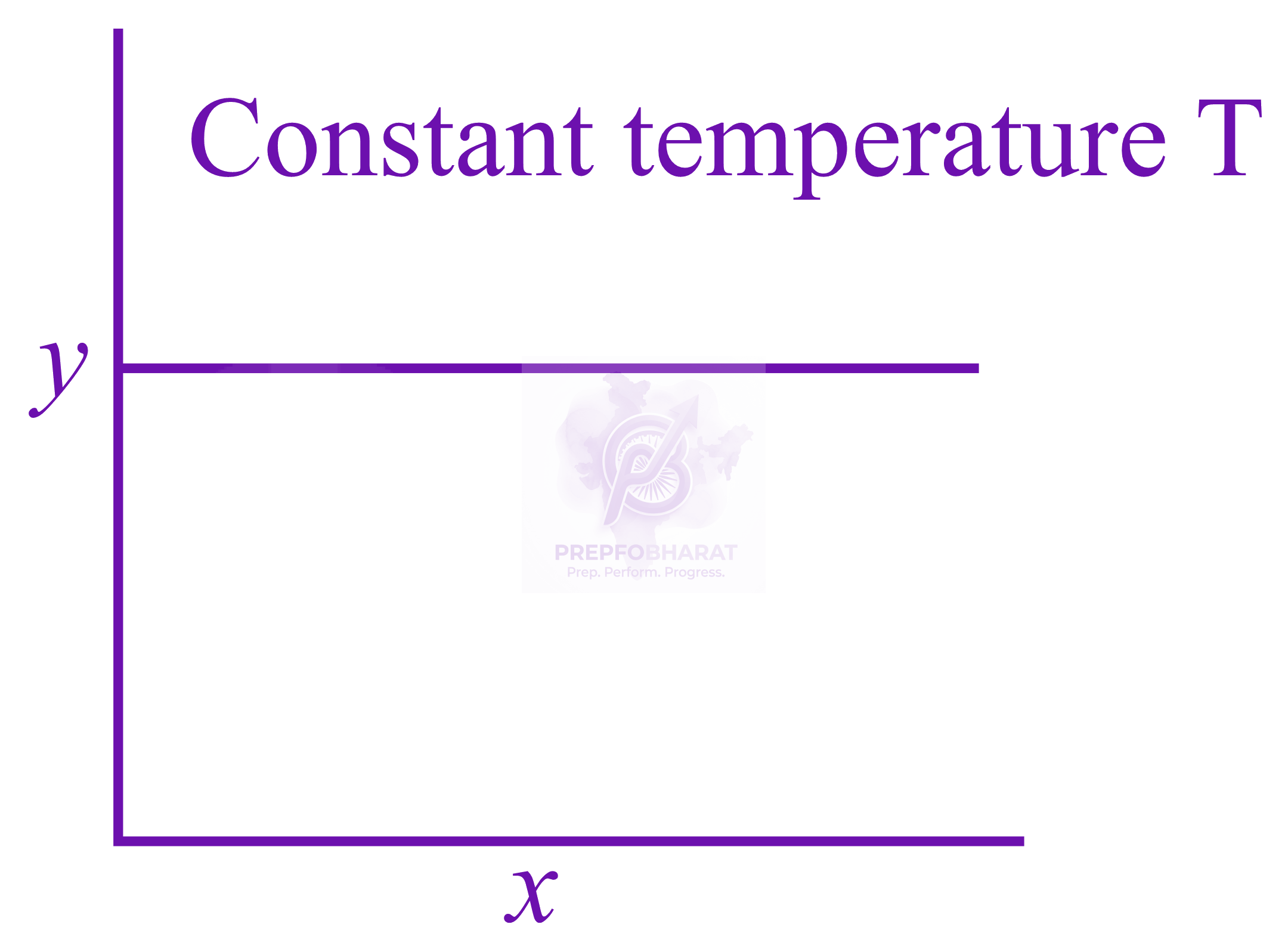 The $y$ and $x$ axes for zero and first order reactions, respectively are
Identify the incorrect statement from the following.
At $298K$, the standard electrode potentials of ${\mathrm{Cu}}^{2+}/\mathrm{Cu},{\mathrm{Zn}}^{2+}/\mathrm{Zn},{\mathrm{Fe}}^{2+}/\mathrm{Fe}$ and ${\mathrm{Ag}}^{+}/\mathrm{Ag}$ are $0.34V$, $-0.76V$, $-0.44V$ and $0.80V$, respectively. On the basis of standard electrode potential, predict which of the following reaction cannot occur?
Which of the following reactions is a decomposition redox reaction?
The rate of a first order reaction depends on
For a chemical reaction $4 \mathrm{~A}+3 \mathrm{~B} \rightarrow 6 \mathrm{C}+9 \mathrm{D}$ rate of formation of $\mathrm{C}$ is $6 \times 10^{-2} \mathrm{~mol} \mathrm{~L}^{-1} \mathrm{~s}^{-1}$ and rate of disappearance of $\mathrm{A}$ is $4 \times 10^{-2} \mathrm{~mol} \mathrm{~L}^{-1} \mathrm{~s}^{-1}$. The rate of reaction and amount of $B$ consumed in interval of 10 seconds, respectively will be:
Which of the following $p-V$ curve represents maximum work done?
$0.01 \mathrm{M}$ acetic acid solution is $1 \%$ ionised, then $\mathrm{pH}$ of this acetic acid solution is :
In one molal solution that contains $0.5$ mole of a solute, there is
The density of the solution is $2.15 \mathrm{~g} \mathrm{~mL}^{-1}$, then mass of $2.5 \mathrm{~mL}$ solution in correct significant figures is
A particular station of All India Radio, New Delhi, broadcasts on a frequency of $1,368\mathrm{kHz}$ (kilo Hertz). The wavelength of the electromagnetic radiation emitted by the transmitter is [speed of light, $c=3.0\times {10}^{8}{\mathrm{ms}}^{-1}$]
The slope of Arrhenius Plot $(\mathrm{lnk}\text{ v/s }\frac{1}{T})$ of first order reaction is $-5\times {10}^{3}K.$ The value of ${E}_{a}$ of the reaction is. Choose the correct option for your answer. [Given $R=8.314J{K}^{-1}{\mathrm{mol}}^{-1}$]
The molar conductance of $\mathrm{NaCl},\mathrm{HCl}$ and ${\mathrm{CH}}_{3}\mathrm{COONa}$ at infinite dilution are $126.45,426.16$ and $91.0{\mathrm{Scm}}^{2}{\mathrm{mol}}^{-1}$ respectively. The molar conductance of ${\mathrm{CH}}_{3}\mathrm{COOH}$ at infinite dilution is. Choose the right option for your answer.
An organic compound contains $80%$ (by wt.) carbon and remaining percentage of hydrogen. The right option for the empirical formula of this compound is: [Atomic wt. of $C$ is $12$ and of $H$ is $1$]
Which of the following reactions is the metal displacement reaction? Choose the right option.
Which one among the following is the correct option for right relationship between ${C}_{p}$ and ${C}_{v}$ for one mole of ideal gas?
The correct option for the value of vapour pressure of a solution at $45ºC$ with benzene to octane in molar ratio $3:2$ is: [At $45^{\circ}C$ vapour pressure of benzene is $280\mathrm{mm}\mathrm{Hg}$ and that of octane is $420\mathrm{mm}\mathrm{Hg}.$ Assume Ideal gas]
For a reaction $A\rightarrow B,$ enthalpy of reaction is $-4.2\mathrm{kJ}{\mathrm{mol}}^{-1}$ and enthalpy of activation is $9.6\mathrm{kJ}{\mathrm{mol}}^{-1}.$ The correct potential energy profile for the reaction is shown in the option.