Physical Chemistry PYQ — Page 4
NEET UG Chemistry — Physical Chemistry previous year questions with solutions.
All Physical Chemistry Questions (571)
The relation between ${n}_{m}$ (${n}_{m}=$the number of permissible values of magnetic quantum number $(m)$) for a given value of azimuthal quantum number $(l)$, is
The correct value of cell potential in volt for the reaction that occurs when the following two half cells are connected, is $\begin{aligned} & \mathrm{Fe}_{(\mathrm{aq})}^{2+}+2 \mathrm{e}^{-} \rightarrow \mathrm{Fe}(\mathrm{s}), \mathrm{E}^{\circ}=-0.44 \mathrm{~V} \\ & \mathrm{Cr}_2 \mathrm{O}_7^{2-}(\mathrm{aq})+14 \mathrm{H}^{+}+6 \mathrm{e}^{-} \rightarrow 2 \mathrm{Cr}^{3+}+7 \mathrm{H}_2 \mathrm{O}, \mathrm{E}^0=+1.33 \mathrm{~V} \\ & \end{aligned}$
On balancing the given redox reaction $a{\mathrm{Cr}}_{2}{O}_{7}^{2-}+{\mathrm{bSO}}_{3}^{2-}(\mathrm{aq})+{\mathrm{cH}}^{+}(\mathrm{aq})\overset{}{\rightarrow }2{\mathrm{aCr}}^{3+}(\mathrm{aq})+{\mathrm{bSO}}_{4}^{2-}(\mathrm{aq})+\frac{c}{2}{H}_{2}O(l)$ The coefficients $a,b,c$are found to be respectively
The conductivity of centimolar solution of $\mathrm{KCl}$ at $25^{\circ}C$ is $0.0210{\mathrm{ohm}}^{-1}{\mathrm{cm}}^{-1}$ and the resistance of the cell containing the solution at $25^{\circ}C$ is $60\mathrm{ohm}$. The value of cell constant is
Which amongst the following aqueous solutions of electrolytes will have minimum elevation in boiling point? Choose the correct option.
Which one of the following represents all isoelectronic species?
For a weak acid $\mathrm{HA}$, the percentage of dissociation is nearly $1 \%$ at equilibrium. If the concentration of acid is $0.1 \mathrm{~mol} \mathrm{~L}^{-1}$, then the correct option for its $\mathrm{K}_{\mathrm{a}}$ at the same temperature is
Select the correct statements from the following : A. Atoms of all elements are composed of two fundamental particles. B. The mass of the electron is $9.10939\times {10}^{-31}\mathrm{kg}$. C. All the isotopes of a given element show same chemical properties. D. Protons and electrons are collectively known as nucleons. E. Dalton's atomic theory, regarded the atom as an ultimate particle of matter. Choose the correct answer from the options given below:
The $E^{\ominus}$ values for $\begin{aligned} & \mathrm{Al}^{+} / \mathrm{Al}=+0.55 \mathrm{~V} \text { and } \mathrm{Tl}^{+} / \mathrm{TI}=-0.34 \mathrm{~V} \\ & \mathrm{Al}^{3+} / \mathrm{Al}=-1.66 \mathrm{~V} \text { and } \mathrm{Tl}^{3+} / \mathrm{TI}=+1.26 \mathrm{~V}\end{aligned}$ Identify the incorrect statement.
Which amongst the following options is the correct relation between change in enthalpy and change in internal energy?
The correct option for the rate law that corresponds to overall first order reaction is
Amongst the given options which of the following molecules/ion acts as a Lewis acid?
Molar conductance of an electrolyte increases with dilution according to the equation: $\Lambda_{\mathrm{m}}=\Lambda_{\mathrm{m}}^{\circ}-\mathrm{A} \sqrt{\mathrm{c}}$ Which of the following statements are true? (A) This equation applies to both strong and weak electrolytes. (B) Value of the constant A depends upon the nature of the solvent. (C) Value of constant $\mathrm{A}$ is same for both $\mathrm{BaCl}_2$ and $\mathrm{MgSO}_4$. (D) Value of constant $A$ is same for both $\mathrm{BaCl}_2$ and $\mathrm{Mg}(\mathrm{OH})_2$. Choose the most appropriate answer from the options given below.
The correct option for a redox couple is
For a certain reaction, the rate $=k[A{]}^{2}[B]$, when the initial concentration of A is tripled keeping concentration of B constant, the initial rate would
The half life of a first order reaction is 2000 years. If the concentration after 8000 years is $0.02 \mathrm{M}$, then the initial concentration was :
What mass of $95%$ pure ${\mathrm{CaCO}}_{3}$ will be required to neutralise $50\mathrm{mL}$ of $0.5M\mathrm{HCl}$ solution according to the following reaction? ${\mathrm{CaCO}}_{3(s)}+2{\mathrm{HCl}}_{(\mathrm{aq})}\rightarrow {\mathrm{CaCl}}_{2(\mathrm{aq})}+{\mathrm{CO}}_{2(g)}+2{H}_{2}{O}_{(l)}$ [Calculate upto second place of decimal point]
One mole of an ideal gas at $300 \mathrm{~K}$ is expanded isothermally from $1 \mathrm{~L}$ to $10 \mathrm{~L}$ volume. $\Delta \mathrm{U}$ for this process is (Use $\mathrm{R}=8.314 \mathrm{~J} \mathrm{~K}^{-1} \mathrm{~mol}^{-1}$ )
Match List-I with List-II: 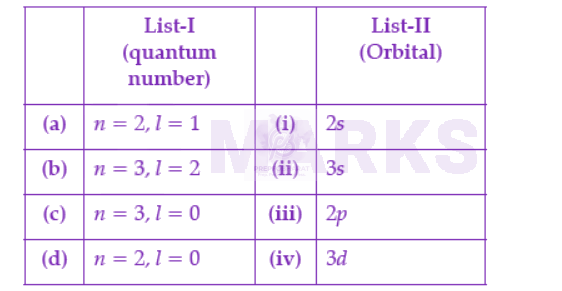 Choose the correct answer from the options given below :
If radius of second Bohr orbit of the ${\mathrm{He}}^{+}$ ion is $105.8\mathrm{pm}$, what is the radius of third Bohr orbit of ${\mathrm{Li}}^{2+}$ ion?
The $\mathrm{pH}$ of the solution containing $50\mathrm{mL}$ each of $0.10M$ sodium acetate and $0.01M$ acetic acid is [Given ${\mathrm{pK}}_{a}$ of ${\mathrm{CH}}_{3}\mathrm{COOH}=4.57$]
When electromagnetic radiation of wavelength $300 \mathrm{~nm}$ falls on the surface of a metal, electrons are emitted with the kinetic energy of $1.68 \times 10^5$ $\mathrm{J} \mathrm{mol}^{-1}$. What is the minimum energy needed to remove an electron from the metal? $\begin{aligned} & \left(h=6.626 \times 10^{-34} \mathrm{Js}, \mathrm{c}=3 \times 10^8 \mathrm{~ms}^{-1},\right. \\ & \mathrm{N}_{\mathrm{A}}=6.022 \times 10^{23} \mathrm{~mol}^{-1} \end{aligned}$
Standard electrode potential for the cell with cell reaction $\mathrm{Zn}(\mathrm{s})+\mathrm{Cu}^{2+}(\mathrm{aq}) \longrightarrow \mathrm{Zn}^{2+}(\mathrm{aq})+\mathrm{Cu}(\mathrm{s})$ is $1.1 \mathrm{~V}$. Calculate the standard gibbs energy change for the cell reaction. (Given $\mathrm{F}=96487 \mathrm{C} \mathrm{mol}^{-1}$ )
$K_P$ for the following reaction is 3.0 at $1000 \mathrm{~K}$. $\mathrm{CO}_2(\mathrm{~g})+\mathrm{C}(\mathrm{s}) \rightleftharpoons 2 \mathrm{CO}(\mathrm{g})$ What will be the value of $\mathrm{K}_C$ for the reaction at the same temperature? (Given: $\mathrm{R}=0.083 \mathrm{~L} \mathrm{bar} \mathrm{K}^{-1} \mathrm{~mol}^{-1}$ )