Physical Chemistry PYQ — Page 3
NEET UG Chemistry — Physical Chemistry previous year questions with solutions.
All Physical Chemistry Questions (571)
Mass in grams of copper deposited by passing 9.6487 A current through a voltmeter containing copper sulphate solution for 100 seconds is (Given : Molar mass of $\mathrm{Cu}: 63 \mathrm{~g} \mathrm{~mol}^{-1}, 1 \mathrm{~F}=96487 \mathrm{C}$ )
Match List I with List II 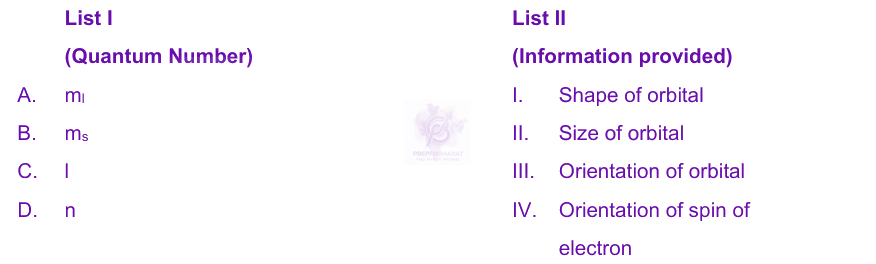 Choose the correct answer from the options given below :
At a given temperature and pressure, the equilibrium constant values for the equilibria are given below: $3 \mathrm{~A}_2+\mathrm{B}_2 \rightleftharpoons 2 \mathrm{~A}_3 \mathrm{~B}, \mathrm{~K}_1$ $\mathrm{A}_3 \mathrm{~B} \rightleftharpoons \frac{3}{2} \mathrm{~A}_2+\frac{1}{2} \mathrm{~B}_2, \mathrm{~K}_2$ The relation between $\mathrm{K}_1$ and $\mathrm{K}_2$ is :
From the following select the one which is not an example of corrosion.
The Henry's law constant $\left(\mathrm{K}_H\right)$ values of three gases $(\mathrm{A}, \mathrm{B}, \mathrm{C})$ in water are $145,2 \times 10^{-5}$ and 35 kbar , respectively. The solubility of these gases in water follow the order:
In which of the following equilibria, $\mathrm{K}_{\mathrm{p}}$ and $\mathrm{K}_{\mathrm{c}}$ are NOT equal?
In which of the following processes entropy increases? A. A liquid evaporates to vapour. B. Temperature of a crystalline solid lowered from 130 K to 0 K . C. $2 \mathrm{NaHCO}_{3(\mathrm{~s})} \rightarrow \mathrm{Na}_2 \mathrm{CO}_{3(\mathrm{~s})}+\mathrm{CO}_{2(\mathrm{~g})}+\mathrm{H}_2 \mathrm{O}_{(\mathrm{g})}$ D. $\mathrm{Cl}_{2(\mathrm{~g})} \rightarrow 2 \mathrm{Cl}_{(\mathrm{g})}$ Choose the correct answer from the options given below:
The energy of an electron in the ground state $(n=1)$ for $\mathrm{He}^{+}$ion is $-x J$, then that for an electron in $n=2$ state for $\mathrm{Be}^{3+}$ ion in J is
Which plot of $\ln k$ vs $\frac{1}{\mathrm{~T}}$ is consistent with Arrhenius equation?
For the reaction in equilibrium $\mathrm{N}_2(\mathrm{~g})+3 \mathrm{H}_2(\mathrm{~g}) \rightleftharpoons 2 \mathrm{NH}_3(\mathrm{~g}), \Delta \mathrm{H}=-\mathrm{Q}$ Reaction is favoured in forward direction by:
The equilibrium concentrations of the species in the reaction $A+B\rightleftharpoons C+D$ are $2,3,10\mathrm{and}6\mathrm{mol}{L}^{-1}$ respectively at $300K$. $\Delta {G}^{\circ }$ for the reaction is $(R=2\mathrm{cal}/\mathrm{mol}K)$
Given below are two statements : Statement I : The value of wave function, $\psi$ depends upon the coordinates of the electron in the atom. Statement II : The probability of finding an electron at a point within an atom is proportional to the orbital wave function. In the light of the above statements, choose the correct answer from the options given below.
The density of $1 \mathrm{M}$ solution of a compound ' $X$ ' is $1.25 \mathrm{~g} \mathrm{~mL}^{-1}$. The correct option for the molality of solution is (Molar mass of compound $X=85 \mathrm{~g}$ )
Avogadros number is
Incorrect set of quantum numbers from the following is
For a reaction $3 \mathrm{~A} \rightarrow 2 \mathrm{~B}$ The average rate of appearance of $B$ is given by $\frac{\Delta[B]}{\Delta t}$. The correct relation between the average rate of appearance of $B$ with the average rate of disappearance of $A$ is given in option
Given below are two statements: one is labelled as Assertion A and the other is labelled as Reason R: Assertion A: Helium is used to dilute oxygen in diving apparatus. Reasons R: Helium has high solubility in ${O}_{2}$ In the light of the above statements, choose the correct answer from the options given below:
Consider the following reaction: $2 \mathrm{H}_2(\mathrm{~g})+\mathrm{O}_2(\mathrm{~g}) \rightarrow 2 \mathrm{H}_2 \mathrm{O}(\mathrm{g}) \Delta_{\mathrm{r}} \mathrm{H}^{\circ}=-483.64 \mathrm{~kJ}$. What is the enthalpy change for decomposition of one mole of water? (Choose the right option).
The right option for the mass of ${\mathrm{CO}}_{2}$ produced by heating $20g$ of $20%$ pure limestone is (Atomic mass of $\mathrm{Ca}=40$) $[{\mathrm{CaCO}}_{3}\overset{1200K}{\rightarrow }\mathrm{CaO}+{\mathrm{CO}}_{2}]$
The pH of a neutral solution at 25°C is
The element expected to form largest ion to achieve the nearest noble gas configuration is :
An acidic buffer is prepared by mixing:
Given below are two statements: one labelled as Assertion A and other is labelled as Reason R: Assertion A: A reaction can have zero activation energy Reason R: The minimum extra amount of energy absorbed by reactant molecules so that their energy becomes equal to threshold value, is called activation energy.
Given below are two statements: one is labelled as Assertion A and the other is labelled as Reason R: Assertion A: In equation ${\Delta }_{r}G=-{\mathrm{nFE}}_{\mathrm{cell}}$ value of ${\Delta }_{r}G$ depends on $n$. Reasons R: ${E}_{\mathrm{cell}}$ is an intensive property and ${\Delta }_{r}G$ is an extensive property. In the light of the above statements, choose the correct answer from the options given below: