Physical Chemistry PYQ — Page 6
NEET UG Chemistry — Physical Chemistry previous year questions with solutions.
All Physical Chemistry Questions (571)
From the following pairs of ions which one is not an iso-electronic pair?
For irreversible expansion of an ideal gas under isothermal condition, the correct option is:
The following solutions were prepared by dissolving $10g$ of glucose $({C}_{6}{H}_{12}{O}_{6})$ in $250\mathrm{mL}$ of water $({P}_{1}),10g$ of urea $({\mathrm{CH}}_{4}{N}_{2}O)$ in $250\mathrm{mL}$ of water $({P}_{2})$ and $10g$ of sucrose $({C}_{12}{H}_{22}{O}_{11})$ in $250\mathrm{mL}$ of water $({P}_{3}).$ The right option for the decreasing order of osmotic pressure of these solutions is:
The ${\mathrm{pK}}_{b}$ of dimethylamine and ${\mathrm{pK}}_{a}$ of acetic acid are $3.27$and $4.77$ respectively at $T(K).$ The correct option for the $\mathrm{pH}$ of dimethylammonium acetate solution is:
The molar conductivity of $0.007M$ acetic acid is $20S{\mathrm{cm}}^{2}{\mathrm{mol}}^{-1}.$ What is the dissociation constant of acetic acid? Choose the correct option. ${\lambda }_{{H}^{+}}^{\circ }=350S{\mathrm{cm}}^{2}{\mathrm{mol}}^{-1} {\lambda }_{{\mathrm{CH}}_{3}{\mathrm{COO}}^{-}}^{\circ }=50S{\mathrm{cm}}^{2}{\mathrm{mol}}^{-1}$
The unit of rate constant for zero order reaction is
An increase in the concentration of the reactants of a reaction leads to change in
Hydrolysis of sucrose is given by the following reaction. Sucrose $+{H}_{2}O\rightleftharpoons$ Glucose $+$ Fructose If the equilibrium constant $({K}_{C})$ is $2\times {10}^{13}$ at $300 K$, the value of ${\Delta }_{r}{G}^{\ominus }$ at the same temperature will be:
At standard conditions, if the change in the enthalpy for the following reaction is $-109{\mathrm{kJmol}}^{-1}$ ${H}_{2(g)}+{\mathrm{Br}}_{2(g)}\rightarrow 2{\mathrm{HBr}}_{(g)}$ Given that bond energy of ${H}_{2}$ and ${\mathrm{Br}}_{2}$ is $435{\mathrm{kJmol}}^{-1}$ and $192{\mathrm{kJmol}}^{-1}$, respectively, what is the bond energy (in $\mathrm{kJ}{\mathrm{mol}}^{-1}$) of $\mathrm{HBr}?$
The mixture which shows positive deviation from Raoult’s law is
The number of Faradays(F) required to produce $20 g$ of calcium from molten ${\mathrm{CaCl}}_{2}$ (Atomic mass of $\mathrm{Ca}=40 g{\mathrm{mol}}^{–1}$) is
The solubility product for a salt of the type $\mathrm{AB}$ is $4\times {10}^{-8}.$ What is the molarity of its saturated solution?
$\mathrm{HCl}$ was passed through a solution of ${\mathrm{CaCl}}_{2}$, ${\mathrm{MgCl}}_{2}$ and $\mathrm{NaCl}$. Which of the following compound(s) crystallise(s)?
Find out the solubility of $\mathrm{Ni}{(\mathrm{OH})}_{2}$ in $0.1 M\mathrm{NaOH}$. Given that the ionic product of $\mathrm{Ni}{(\mathrm{OH})}_{2}$ is $2\times {10}^{–15}$.
Isotonic solutions have same
The potential energy $(y)$ curve for ${H}_{2}$ formation as a function of internuclear distance $(x)$ of the $H$ atoms is shown below. 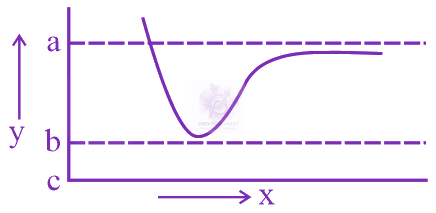 The bond energy of ${H}_{2}$ is :
The half-life for a zero order reaction having $0.02M$ initial concentration of reactant is $100s$. The rate constant (in $\mathrm{mol}{L}^{-1}{s}^{-1}$) for the reaction is
Which one of the followings has maximum number of atoms?
One mole of carbon atom weighs $12g$, the number of atoms in it is equal to, (Mass of carbon $-12$ is $1.9926\times {10}^{-23}g)$
If for a certain reaction ${\Delta }_{r}H$ is $30{\mathrm{kJmol}}^{-1}$ at $450K,$ the value of ${\Delta }_{r}S$ (in ${\mathrm{JK}}^{-1}{\mathrm{mol}}^{-1}$) for which the same reaction will be spontaneous at the same temperature is
The freezing point depression constant $({K}_{f})$ of benzene is $5.12 K \mathrm{kg} {\mathrm{mol}}^{–1}$. The freezing point depression for the solution of molality $0.078 m$ containing a non-electrolyte solute in benzene is (rounded off upto two decimal places):
The number of protons, neutrons and electrons in ${}_{71}^{175}\mathrm{Lu}$, respectively, are
In a typical fuel cell, the reactants (R) and product (P) are :-
What is the change in oxidation number of carbon in the following reaction? ${\mathrm{CH}}_{4}(g)+4{\mathrm{Cl}}_{2}(g)\rightarrow {\mathrm{CCl}}_{4}+4\mathrm{HCl}(g)$