Physical Chemistry PYQ — Page 16
NEET UG Chemistry — Physical Chemistry previous year questions with solutions.
All Physical Chemistry Questions (571)
For an endothermic reaction, energy of activation is $E_a$ and enthalpy of reaction is $\Delta H$ (both of these in $\mathrm{kJ} / \mathrm{mol}$ ). Minimum value of $E_a$ will be
Which of the following species is not electrophilic in nature?
Which one of the following molecular hydrides acts as a Lewis acid ?
Which of the following pairs has the same size?
For the reduction of silver ions with copper metal, the standard cell potential was found to be $+0.46 \mathrm{~V}$ at $25^{\circ} \mathrm{C}$. The value of standard Gibbs energy, $\Delta \mathrm{G}^{\circ}$ will be $\left(\mathrm{F}=96500 \mathrm{C} \mathrm{mol}^{-1}\right)$
Three moles of an ideal gas expanded spontaneously into vacuum. The work done will be
An increase in equivalent conductance of a strong electrolyte with dilution is mainly due to
Consider the following relations for emf of a electrochemical cell (A) Emf of cell = (oxidation potential of anode) - (reduction potential of cathode) (B) Emf of cell = (oxidation potential of anode) + (reduction potential of cathode) (C) Emf of cell = (reduction potential of anode) + (reduction potential of cathode) (D) Emf of cell = (oxidation potential of anode)-(Oxidation potential of cathode) Which of the above relations are correct?
The correct order of the decreasing ionic radii among the following isoelectronic species is
$A B$ crystallizes in a body centred cubic lattice with edge length ' $a$ ' equal to $387 \mathrm{pm}$. The distance between two oppositively charged ions in the lattice is
$25.3 \mathrm{~g}$ of sodium carbonate, $\mathrm{Na}_2 \mathrm{CO}_3$ is dissolved in enough water to make $250 \mathrm{~mL}$ of solution. If sodium carbonate dissociates completely, molar concentration of sodium ion, $\mathrm{Na}^{+}$and carbonate ion, $\mathrm{CO}_3^{2-}$ are respectively (Molar mass of $\mathrm{Na}_2 \mathrm{CO}_3=106 \mathrm{~g} \mathrm{~mol}^{-1}$ )
Match List I (equations) with List II (types of process) and select the correct OPTION. 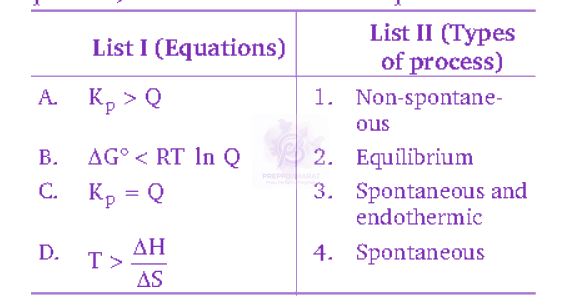 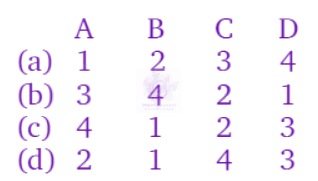
Which one of the following ions has electronic configuration $[\mathrm{Ar}] 3 \mathrm{~d}^6$ ? (At. no: $\mathrm{Mn}=25, \mathrm{Fe}=26, \mathrm{Co}=27, \mathrm{Ni}=28$ )
The reaction, \(2 \mathrm{~A}_{(\mathrm{g})}+\mathrm{B}_{(\mathrm{g})} \leftrightharpoons 3 \mathrm{C}_{(\mathrm{g})}+\mathrm{D}_{(\mathrm{g})}\) is begun with the concentrations of \(A\) and \(B\) both at an initial value of 1.00 M When equilibrium is reached, the concentration of \(D\) is measured and found to be 0.25 M. The value for the equilibrium constant for this reaction is given by the expression
The number of atoms in 0.1 mole of a triatomic gas is $\left(\mathrm{N}_{\mathrm{A}}=6.02 \times 10^{23} \mathrm{~mol}^{-1}\right)$
For vaporisation of water at $1 \mathrm{~atm}$ pressure, the values of $\Delta \mathrm{H}$ and $\Delta S$ are $40.63 \mathrm{~kJ} \mathrm{~mol}^{-1}$ and $108.8 \mathrm{JK}^{-1} \mathrm{~mol}^{-1}$, respectively. The temperature when Gibbs energy change $(\Delta G)$ for this transformation will be zero, is
In a buffer solution containing equal concentration of $\mathrm{B}^{-}$and $\mathrm{HB}$, the $\mathrm{K}_{\mathrm{b}}$ for $\mathrm{B}^{-}$is $10^{-10}$. The $\mathrm{pH}$ of buffer solution is
In which of the following equilibrium $\mathrm{K}_C$ and $\mathrm{K}_{\mathrm{P}}$ are not equal ?
For the reaction \(\mathrm{N}_2 \mathrm{O}_5(\mathrm{g}) \rightarrow 2 \mathrm{NO}_2(\mathrm{g})+(1 / 2) \mathrm{O}_2(\mathrm{g})\) the value of rate of disappearance of \(\mathrm{N}_2 \mathrm{O}_5\) is given as \(6.25 \times 10^{-3} \mathrm{~mol} \mathrm{~L}^{-1} \mathrm{~s}^{-1}\). The rate of formation of \(\mathrm{NO}_2\) and \(\mathrm{O}_2\) is given respectively as
A $0.66 \mathrm{~kg}$ ball is moving with a speed of $100 \mathrm{~m} / \mathrm{s}$. The associated wavelength will be (h $\left.=6.6 \times 10^{-34} \mathrm{Js}\right)$
What is $\left[\mathrm{H}^{+}\right]$in $\mathrm{mol} / \mathrm{L}$ of a solution that is $0.20 \mathrm{M}$ in $\mathrm{CH}_3 \mathrm{COONa}$ and $0.10 \mathrm{M}$ in $\mathrm{CH}_3 \mathrm{COOH}$ ? $\left(\mathrm{K}_{\mathrm{a}}\right.$ for $\mathrm{CH}_3 \mathrm{COOH}=1.8 \times 10^{-5}$ )
In producing chlorine by electrolysis $100 \mathrm{~kW}$ power at $125 \mathrm{~V}$ is being consumed. How much chlorine per minute is liberated (ECE of chlorine is $0.367 \times 10^{-6} \mathrm{kgC}^{-1}$ )
Standard entropies of $\mathrm{X}_2, \mathrm{Y}_2$ and $\mathrm{XY}_3$ are 60,40 and $50 \mathrm{~J} \mathrm{~K} \mathrm{~K}^{-1} \mathrm{~mol}^{-1}$ respectively. For the reaction $\frac{1}{2} \mathrm{X}_2+\frac{3}{2} \mathrm{Y}_2 \rightleftharpoons \mathrm{XY}_3 ; \Delta \mathrm{H}=-30 \mathrm{~kJ}$, to be at equilibrium, the temperature should be
What is the $\left[\mathrm{OH}^{-}\right]$in the final solution prepared by mixing $20.0 \mathrm{~mL}$ of $0.050 \mathrm{M} \mathrm{HCl}$ with $30.0 \mathrm{~mL}$ of $0.10 \mathrm{M} \mathrm{Ba}(\mathrm{OH})_2$ ?