Physical Chemistry PYQ — Page 17
NEET UG Chemistry — Physical Chemistry previous year questions with solutions.
All Physical Chemistry Questions (571)
Given : (i) $\mathrm{Cu}^{2+}+2 \mathrm{e}^{-} \rightarrow \mathrm{Cu}_{,} \mathrm{E}^{\circ}=0.337 \mathrm{~V}$ (i) $\mathrm{Cu}^{2+}+\mathrm{e}^{-} \rightarrow \mathrm{Cu}^{+}, \mathrm{E}^{\circ}=0.153 \mathrm{~V}$ Electrode potential $\mathrm{E}^{\circ}$ for the reaction, $\mathrm{Cu}^{+}+\mathrm{e}^{-} \rightarrow \mathrm{Cu}$, will be :
Among the following which is the strongest oxidizing agent ? -
Oxidation number of $\mathrm{P}$ in $\mathrm{PO}_4^{3-}$, of $\mathrm{S}$ in $\mathrm{SO}_4^{2-}$ and that of $\mathrm{Cr}$ in $\mathrm{Cr}_2 \mathrm{O}_7^{2-}$ are respectively :
The ionisation constant of ammonium hydroxide is $1.77 \times 10^{-5}$ at $298 \mathrm{~K}$. Hydrolysis constant of ammonium chloride is
For the reaction $\mathrm{A}+\mathrm{B} \rightarrow$ products, it is observed that : A. On doubling the initial concentration of $A$ only, the rate of reaction is also doubled and B. On doubling the initial concentration of both $A$ and $B$, there is a change by a factor of 8 in the rate of the reaction. The rate of this reaction is given by :
Lithium metal crystallizes in a body centred cubic crystal. If the length of the side of the unit cell of lithium is $351 \mathrm{pm}$, the atomic radius of lithium will be :
Half-life period of a first order reaction is $1386 \mathrm{~s}$. The specific rate constant of the reaction is
What is the $\left[\mathrm{OH}^{-}\right]$in the final solution prepared by mixing $20.0 \mathrm{~mL}$ of $0.050 \mathrm{M} \mathrm{HCl}$ with 30.0 $\mathrm{mL}$ of $0.10 \mathrm{M} \mathrm{Ba}(\mathrm{OH})_2$ ? -
$10 \mathrm{~g}$ of hydrogen and 64 of oxygen were filled in a steel vessel and exploded. Amount of water produced in this reaction will be
The dissociation constants for acetic acid and $\mathrm{HCN}$ at $25^{\circ} \mathrm{C}$ are $1.5 \times 10^{-5}$ and $4.5 \times 10^{-10}$, respectively. The equilibrium constant for the equilibrium - $$ \mathrm{CN}^{-}+\mathrm{CH}_3 \mathrm{COOH} \rightleftharpoons \mathrm{HCN}+\mathrm{CH}_3 \mathrm{COO}^{-} $$ would be :
$\mathrm{Al}_2 \mathrm{O}_3$ is reduced by electrolysis at low potentials and high currents. If $4.5 \times 10^4 \mathrm{~A}$ of current is passed through molten $\mathrm{Al}_2 \mathrm{O}_3$ for $6 \mathrm{~h}$, what mass of aluminium is produced? (Assume 100\% current efficiency, at. mass of $\mathrm{Al}=27 \mathrm{~g} \mathrm{~mol}^{-1}$ )
From the following bond energies : $\mathrm{H}-\mathrm{H}$ bond energy : $431.37 \mathrm{~kJ} \mathrm{~mol}^{-1}$ $\mathrm{C}=\mathrm{C}$ bond energy : $606.10 \mathrm{~kJ} \mathrm{~mol}^{-1}$ $\mathrm{C}$ - $\mathrm{C}$ bond energy : $336.49 \mathrm{~kJ} \mathrm{~mol}^{-1}$ $\mathrm{C}-\mathrm{H}$ bond energy : $410.50 \mathrm{~kJ} \mathrm{~mol}^{-1}$ Enthalpy for the reaction, 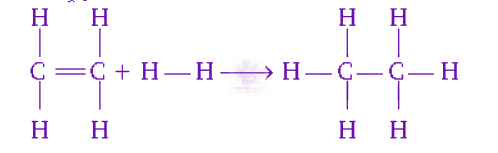 will be
Oxidation numbers of $\mathrm{P}$ in $\mathrm{PO}_4^{3-}$, of $\mathrm{S}$ in $\mathrm{SO}_4^{2-}$ and that of $\mathrm{Cr}$ in $\mathrm{Cr}_2 \mathrm{O}_7^{2-}$ are respectively,
The dissociation constants for acetic acid and $\mathrm{HCN}$ at $25^{\circ} \mathrm{C}$ are $1.5 \times 10^{-5}$ and $4.5 \times 10^{-10}$, respectively. The equilibrium constant for the equilibrium, $\mathrm{CN}^{-}+\mathrm{CH}_3 \mathrm{COOH} \quad \mathrm{HCN}+\mathrm{CH}_3 \mathrm{COO}^{-}$ would be
Which of the following is not permissible arrangement of electrons in an atom ?
The values of $\Delta \mathrm{H}$ and $\Delta \mathrm{S}$ for the reaction, $\mathrm{C}$ (graphite) $+\mathrm{CO}_2(\mathrm{~g}) \rightarrow 2 \mathrm{CO}(\mathrm{g})$ are $170 \mathrm{~kJ}$ and $170 \mathrm{JK}^{-1}$ respectively. This reaction will be spontaneous at -
Amongst the element with following electronic configurations, which one of them may have the highest ionization energy ?
Which of the following molecules acts as a Lewis acid?
Sodium has body centred packing. Distance between two nearest atoms is $3.7 Å$. The lattice parameter is :
Given, (i) $\mathrm{Cu}^{2+}+2 \mathrm{e}^{-} \longrightarrow \mathrm{Cu}$, $\mathrm{E}^{\circ}=0.337 \mathrm{~V}$ (ii) $\mathrm{Cu}^{2+}+\mathrm{e}^{-} \longrightarrow \mathrm{Cu}^{+}$, $\mathrm{E}^{\circ}=0.153 \mathrm{~V}$ Electrode potential, $\mathrm{E}^{\circ}$ for the reaction, $\mathrm{Cu}+\mathrm{e}^{-} \longrightarrow \mathrm{Cu}$, will be
Copper crystallizes in a face-centred cubic lattice with a unit cell length of $361 \mathrm{pm}$. What is the radius of copper atom in pm?
The values of $\Delta H$ and $\Delta S$ for the reaction, $\mathrm{C}_{\text {(graphite) }}+\mathrm{CO}_2(\mathrm{~g}) \longrightarrow 2 \mathrm{CO}(\mathrm{g})$ are $170 \mathrm{~kJ}$ and $170 \mathrm{JK}^{-1}$, respectively. This reaction will be spontaneous at
Sodium has body centred packing. Distance between two nearest atoms is $3.7 Å$. The lattice parameter is
From the following bond energies : $\mathrm{H}-\mathrm{H}$ bond energy : $431.37 \mathrm{~kJ} \mathrm{~mol}^{-1}$ $\mathrm{C}=\mathrm{C}$ bond energy : $606.10 \mathrm{~kJ} \mathrm{~mol}^{-1}$ $\mathrm{C}-\mathrm{C}$ bond energy : $336.49 \mathrm{~kJ} \mathrm{~mol}^{-1}$ $\mathrm{C}-\mathrm{H}$ bond energy : $410.50 \mathrm{~kJ} \mathrm{~mol}^{-1}$ Enthalpy for the reaction, 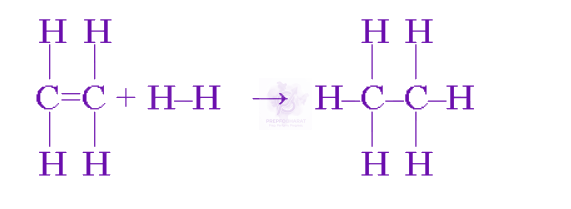 will be :