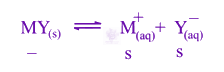
MY insoluble salt Ksp=s2
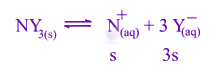
NY3 salt Ksp=s(3s)3
=27s4
S=(27ksp)n1
SNY3 =(27Ksp)41 =(276.2×10⁻¹³)41
∴S(MY)=6.2×10−13=7.8×10⁻⁷
Solubility values
∴S(MY)<S(NY3)
NEET UG 2016 — Chemistry Physical Chemistry
MY and NY3 , two nearly insoluble salts, have the same Ksp values of 6.2×10⁻¹³ at room temperature. Which statement would be true in regard to MY and NY3 ?
Held on 30 Apr 2016 · Verified 9 Jul 2026.
The molar solubilities of MY and NY3 in water are identical.
The molar solubility of MY in water is less than that of NY3 .
The salts MY and NY3 are more soluble in 0.5 M KY than in pure water.
The addition of the salt of KY to solution of MY and NY3 will have no effect on their solubilities.
Sign in to track your attempts and accuracy.
Sign in to keep a private note on this question. Nothing you write is ever public.
For the reaction 2SO₂(g) + O₂(g) ⇌ 2SO₃(g), ΔH = -198 kJ. Which condition favours forward reaction?
The unit of rate constant for a first-order reaction is:
Among the following choose the ones with equal number of atoms. A. 212 g of $\mathrm{Na}_2 \mathrm{CO}_3(\mathrm{~s})$ [molar mass $=106 \mathrm{~g}$ ] B. 248 g of $\mathrm{Na}_2 \mathrm{O}$ (s) [molar mass $=62 \mathrm{~g}$ ] C. 240 g of $\mathrm{NaOH}(\mathrm{s})$ [molar mass $=40 \mathrm{~g}]$ D. 12 g of $\mathrm{H}_2(\mathrm{~g})$ [molar mass $=2 \mathrm{~g}$ ] E. 220 q of $\mathrm{CO}_2(\mathrm{q})$ [molar mass $\left.=44 \mathrm{~g}\right]$ Choose the correct answer from the options given below:
For the reaction $\mathrm{A}(\mathrm{g}) \rightleftharpoons 2 \mathrm{~B}(\mathrm{~g})$, the backward reaction rate constant is higher than the forward reaction rate constant by a factor of 2500 , at 1000 K . [Given : $\mathrm{R}=0.0831 \mathrm{~L} \mathrm{~atm} \mathrm{~mol}^{-1} \mathrm{~K}^{-1}$ ] $\mathrm{K}_{\mathrm{p}}$ for the reaction at 1000 K is
The standard heat of formation, in $\mathrm{kcal} / \mathrm{mol}^{\text {of }} \mathrm{Ba}^{2+}$ is : [Given : standard heat of formation of $\mathrm{SO}_4^{2-}$ ion (aq) $=-216 \mathrm{kcal} / \mathrm{mol}$, Standard heat of crystallisation of $\mathrm{BaSO}_4(\mathrm{~s})=-4.5 \mathrm{kcal} / \mathrm{mol}$, standard heat of formation of $\left.\mathrm{BaSO}_4(\mathrm{~s})=-349 \mathrm{kcal} / \mathrm{mol}\right]$
Work through every NEET UG Physical Chemistry PYQ, year by year.