Raoult's law is valid for ideal solution only. These two components A and B follows the condition of Raoult's law if the force of attraction between A and B is equal to the force of attraction between A-A and B-B Positive non-ideal behavior of the vapor pressure of a solution follows Henry's Law at low concentrations and Raoult's Law at high concentrations (pure). 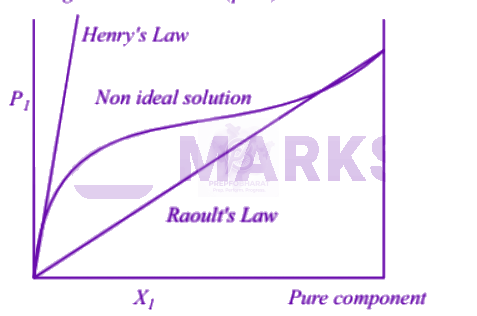
A solution containing components A and B follows Raoult's law if:
NEET UG 2002 — Chemistry Physical Chemistry
2002mcqmedium
A solution containing components A and B follows Raoult's law if:
Official previous-year question
Held on 30 Apr 2002 · Verified 9 Jul 2026.
Options
- A
A−B attraction force is greater than A−A and B−B
- B
A−B attraction force is less than A−A and B−B.
- C
attraction force remains same as in A−A and B−B
- D
volume of the solution is different from the sum of volume of the solute and the solvent.
Did you get this right?
Sign in to track your attempts and accuracy.
Your note
Sign in to keep a private note on this question. Nothing you write is ever public.
NEET UG Physical Chemistry in other years
More NEET UG Physical Chemistry questions
For the reaction 2SO₂(g) + O₂(g) ⇌ 2SO₃(g), ΔH = -198 kJ. Which condition favours forward reaction?
2026medium
The unit of rate constant for a first-order reaction is:
2026easy
Among the following choose the ones with equal number of atoms. A. 212 g of $\mathrm{Na}_2 \mathrm{CO}_3(\mathrm{~s})$ [molar mass $=106 \mathrm{~g}$ ] B. 248 g of $\mathrm{Na}_2 \mathrm{O}$ (s) [molar mass $=62 \mathrm{~g}$ ] C. 240 g of $\mathrm{NaOH}(\mathrm{s})$ [molar mass $=40 \mathrm{~g}]$ D. 12 g of $\mathrm{H}_2(\mathrm{~g})$ [molar mass $=2 \mathrm{~g}$ ] E. 220 q of $\mathrm{CO}_2(\mathrm{q})$ [molar mass $\left.=44 \mathrm{~g}\right]$ Choose the correct answer from the options given below:
2025medium
For the reaction $\mathrm{A}(\mathrm{g}) \rightleftharpoons 2 \mathrm{~B}(\mathrm{~g})$, the backward reaction rate constant is higher than the forward reaction rate constant by a factor of 2500 , at 1000 K . [Given : $\mathrm{R}=0.0831 \mathrm{~L} \mathrm{~atm} \mathrm{~mol}^{-1} \mathrm{~K}^{-1}$ ] $\mathrm{K}_{\mathrm{p}}$ for the reaction at 1000 K is
2025medium
The standard heat of formation, in $\mathrm{kcal} / \mathrm{mol}^{\text {of }} \mathrm{Ba}^{2+}$ is : [Given : standard heat of formation of $\mathrm{SO}_4^{2-}$ ion (aq) $=-216 \mathrm{kcal} / \mathrm{mol}$, Standard heat of crystallisation of $\mathrm{BaSO}_4(\mathrm{~s})=-4.5 \mathrm{kcal} / \mathrm{mol}$, standard heat of formation of $\left.\mathrm{BaSO}_4(\mathrm{~s})=-349 \mathrm{kcal} / \mathrm{mol}\right]$
2025medium
Other Chemistry topics for NEET UG
Keep practicing Physical Chemistry
Work through every NEET UG Physical Chemistry PYQ, year by year.