JEE Main 2012 — Waves & Oscillations
Physics Waves & Oscillations questions from JEE Main 2012.
Other Years
10 Waves & Oscillations Questions from 2012
The disturbance $y(x, t)$ of a wave propagating in the positive $x$-direction is given by $y=\frac{1}{1+x^2}$ at time $t=0$ and by $y=\frac{1}{\left[1+\left(x-1^2\right)\right]}$ at $t=2 \mathrm{~s}$, where $x$ and $y$ are in meters. The shape of the wave disturbance does not change during the propagation. The velocity of wave in $\mathrm{m} / \mathrm{s}$ is
A uniform tube of length $60.5 \mathrm{~cm}$ is held vertically with its lower end dipped in water. A sound source of frequency $500 \mathrm{~Hz}$ sends sound waves into the tube. When the length of tube above water is $16 \mathrm{~cm}$ and again when it is $50 \mathrm{~cm}$, the tube resonates with the source of sound. Two lowest frequencies (in $\mathrm{Hz}$ ), to which tube will resonate when it is taken out of water, are (approximately).
This question has Statement 1and Statement 2. Of the four choices given after the Statements, choose the one that best describes the two Statements. Statement 1: In the resonance tube experiment, if the tuning fork is replaced by another identical turning fork but with its arm having been filled, the length of the air column should be increased to obtain resonance again. Statement 2: On filling the arms, the frequency of a tuning fork increases.
The displacement $y(t)=A \sin (\omega t+\phi)$ of a pendulum for $\phi=\frac{2 \pi}{3}$ is correctly represented by
A cylindrical tube, open at both ends, has a fundamental frequency, $\mathrm{f}$, in air. The tube is dipped vertically in water so that half of it is in water. The fundamental frequency of the air-column is now
A wave represented by the equation $y_1=a \cos$ $(k x-\omega t)$ is superimposed with another wave to form a stationary wave such that the point $x-0$ is node. The equation for the other wave is
Following are expressions for four plane simple harmonic waves (i) $\quad y_1=A \cos 2 \pi\left(n_1 t+\frac{x}{\lambda_1}\right)$ (ii) $y_2=A \cos 2 \pi\left(n_1 t+\frac{x}{\lambda_1}+\pi\right)$ (iii) $y_3=A \cos 2 \pi\left(n_2 t+\frac{x}{\lambda_2}\right)$ (iv) $y_4=A \cos 2 \pi\left(n_2 t-\frac{x}{\lambda_2}\right)$ The pairs of waves which will produce destructive interference and stationary waves respectively in a medium, are
A ring is suspended from a point $S$ on its rim as shown in the figure. When displaced from equilibrium, it oscillates with time period of 1 second. The radius of the ring is (take $g=\pi^2$ ) 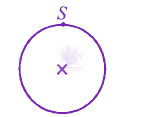
If a simple pendulum has significant amplitude (up to a factor of $1 / e$ of original) only in the period between $t=0s$ to $t=\tau s$, then $\tau$ may be called the average life of the pendulum. When the spherical bob of the pendulum suffers a retardation (due to viscous drag) proportional to its velocity, with '$b$' as the constant of proportionality, the average life time of the pendulum is (assuming damping is small) in seconds:
An air column in a pipe, which is closed at one end, will be in resonance wtih a vibrating tuning fork of frequency $264 \mathrm{~Hz}$ if the length of the column in $\mathrm{cm}$ is (velocity of sound $=330 \mathrm{~m} / \mathrm{s}$ )