Optics PYQ — Page 9
JEE Main Physics — Optics previous year questions with solutions.
All Optics Questions (489)
In a Young’s double slit experiment, two slits are illuminated with a light of wavelength $800\mathrm{nm}$. The line joining ${A}_{1}P$ is perpendicular to ${A}_{1}{A}_{2}$ as shown in the figure. If the first minimum is detected at $P$, the value of slits separation $a$ will be : 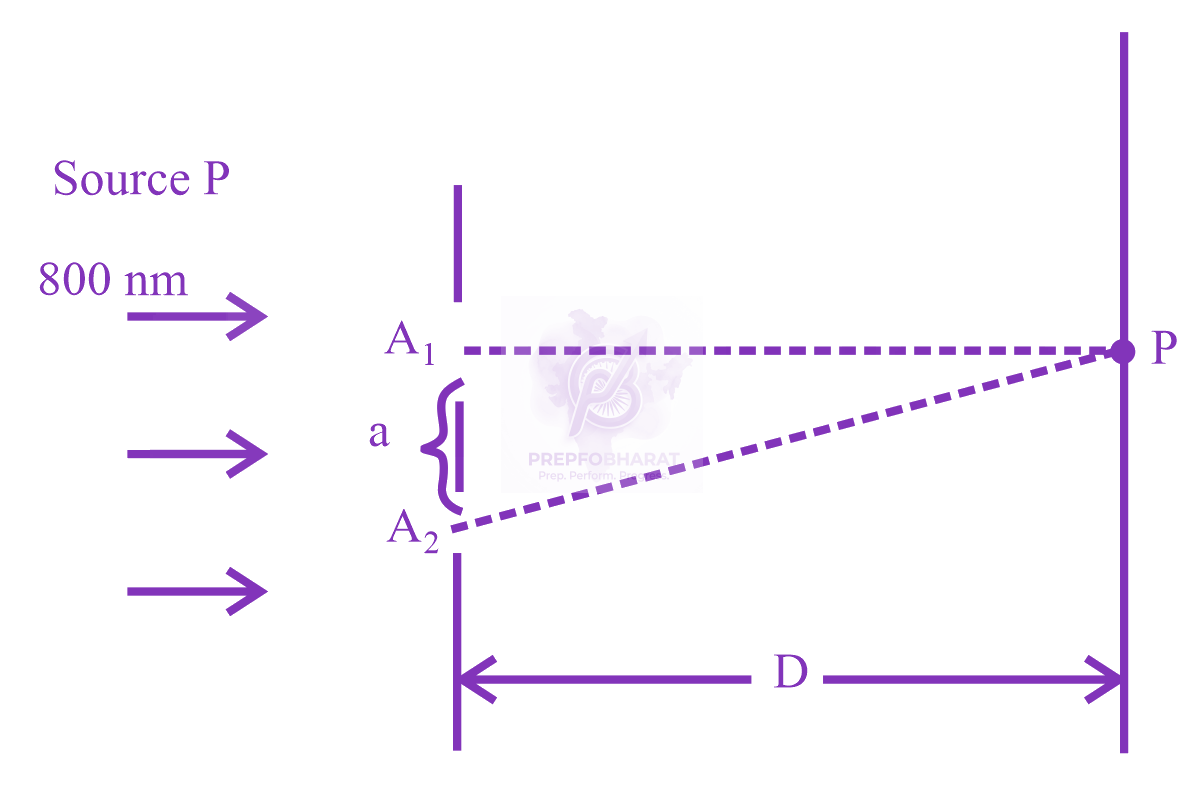 The distance of screen from slits $D=5\mathrm{cm}$.
Two polaroids $A\text{and}B$ are placed in such a way that the pass-axis of polaroids are perpendicular to each other. Now, another polaroid $C$ is placed between $A\text{and}B$ bisecting angle between them. If intensity of unpolarised light is ${I}_{0}$ then intensity of transmitted light after passing through polaroid $B$ will be :
A $2$ meter long scale with least count of $0.2\mathrm{cm}$ is used to measure the locations of objects on an optical bench. While measuring the focal length of a convex lens, the object pin and the convex lens are placed at $80\mathrm{cm}$ mark and $1m$ mark, respectively. The image of the object pin on the other side of lens coincides with image pin that is kept at $180\mathrm{cm}$ mark. The $%$ error in the estimation of focal length is:
Two light waves of wavelengths $800$ and $600\mathrm{nm}$ are used in Young's double slit experiment to obtain interference fringes on a screen placed $7m$ away from plane of slits. If the two slits are separated by $0.35\mathrm{mm}$, then shortest distance from the central bright maximum to the point where the bright fringes of the two wavelength coincide will be ______ $\mathrm{mm}$.
The width of fringe is $2\mathrm{mm}$ on the screen in a double slit experiment for the light of wavelength of $400\mathrm{nm}$. The width of the fringe for the light of wavelength $600\mathrm{nm}$ will be:
The radius of curvature of each surface of a convex lens having refractive index $1.8$ is $20\mathrm{cm}$. The lens is now immersed in a liquid of refractive index $1.5$. The ratio of power of lens in air to its power in the liquid will be $x:1$. The value of $x$ is
A convex lens of refractive index $1.5$ and focal length $18\mathrm{cm}$ in air is immersed in water. The change in focal length of the lens will be_____$\mathrm{cm}$. (Given refractive index of water$=\frac{4}{3}$)
A bi convex lens of focal length $10\mathrm{cm}$ is cut in two identical parts along a plane perpendicular to the principal axis. The power of each lens after cut is _____ $D$.
As shown in the figure, a combination of a thin plano-concave lens and a thin plano-convex lens is used to image an object placed at infinity. The radius of curvature of both the lenses is $30\mathrm{cm}$ and refraction index of the material for both the lenses is $1.75$. Both the lenses are placed at distance of $40\mathrm{cm}$ from each other. Due to the combination, the image of the object is formed at distance $x=$ ______ $\mathrm{cm}$, from concave lens. 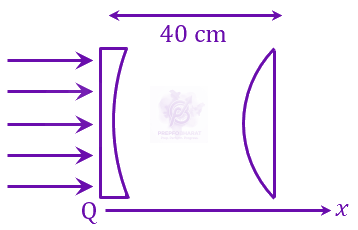
When one light ray is reflected from a plane mirror with $30^{\circ}$ angle of reflection, the angle of deviation of the ray after reflection is:
Unpolarised light of intensity $32W{m}^{-2}$ passes through the combination of three polaroids such that the pass axis of the last polaroids is perpendicular to that of the pass axis of first polaroids. If intensity of emerging light is $3W{m}^{-2}$, then the angle between pass axis of first two polaroids is _________$^{\circ}$.
When a beam of white light is allowed to pass through convex lens parallel to principal axis, the different colours of light converge at different point on the principle axis after refraction. This is called :
A person has been using spectacles of power $-1.0$ diopter for distant vision and a separate reading glass of power $2.0$ diopters. What is the least distance of distinct vision for this person:
Two transparent media having refractive indices $1.0$ and $1.5$ are separated by a spherical refracting surface of radius of curvature $30\mathrm{cm}$. The centre of curvature of surface is towards denser medium and a point object is placed on the principal axis in rarer medium at a distance of $15\mathrm{cm}$ from the pole of the surface. The distance of image from the pole of the surface is $\mathrm{cm}$.
An ice cube has a bubble inside. When viewed from one side the apparent distance of the bubble is $12\mathrm{cm}$. When viewed from the opposite side, the apparent distance of the bubble is observed as $4\mathrm{cm}$. If the side of the ice cube is $24\mathrm{cm}$, the refractive index of the ice cube is
A beam of light consisting of two wavelengths $7000\overset{o}{A}$ and $5500\overset{o}{A}$ is used to obtain interference pattern in Young's double slit experiment. The distance between the slits is $2.5\mathrm{mm}$ and the distance between the plane of slits and the screen is $150\mathrm{cm}$. The least distance from the central fringe, where the bright fringes due to both the wavelengths coincide, is $n\times {10}^{–5}m$. The value of $n$ is _____.
Given below are two statements: One is labelled as Assertion A and the other is labelled as Reason R Assertion A : The beam of electrons shows wave nature and exhibit interference and diffraction. Reason R : Davisson Germer Experimentally verified the wave nature of electrons. In the light of the above statements. Choose the most appropriate answer from the options given below :
As shown in figures, three identical polaroids ${P}_{1}$, ${P}_{2}$ and ${P}_{3}$ are placed one after another. The pass axis of ${P}_{2}$ and ${P}_{3}$ are inclined at angle of $60º$ and $90º$ with respect to axis of ${P}_{1}$. The source $S$ has an intensity of $256W{m}^{-2}$. The intensity of light at point $O$ is _____$W{m}^{-2}$. 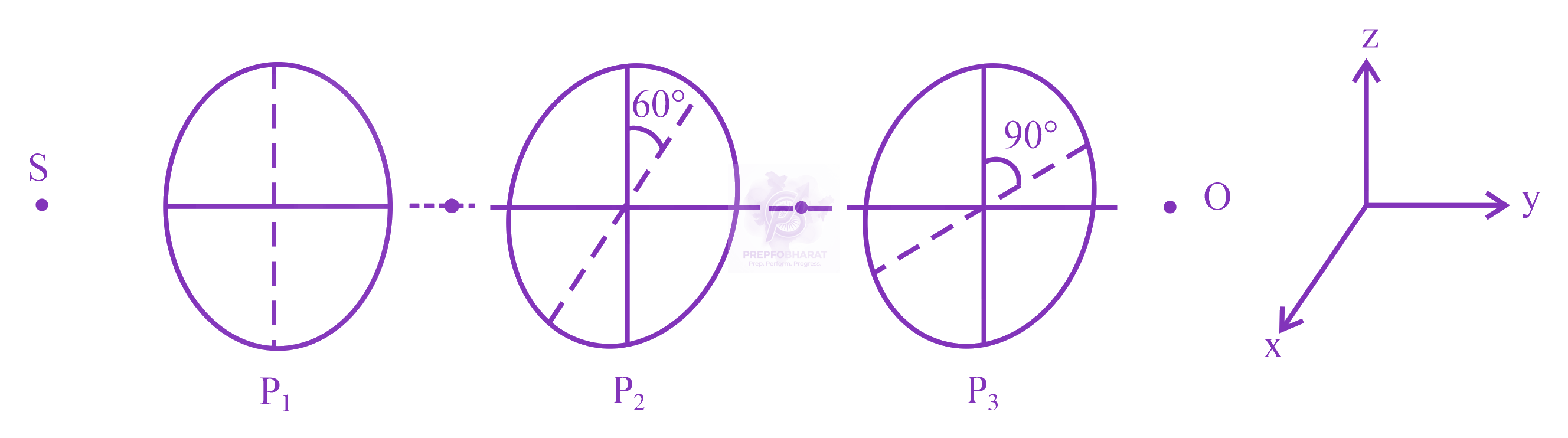
An object is placed at a distance of $12\mathrm{cm}$ in front of a plane mirror. The virtual and erect image is formed by the mirror. Now the mirror is moved by $4\mathrm{cm}$ towards the stationary object. The distance by which the position of image would be shifted, will be
In Young’s double slit experiment, two slits ${S}_{1}$ and ${S}_{2}$ are $d$ distance apart and the separation from slits to screen is $D$ (as shown in figure). Now if two transparent slabs of equal thickness $0.1\mathrm{mm}$ but refractive index $1.51$ and $1.55$ are introduced in the path of beam $(\lambda =4000Å)$ from ${S}_{1}$ and ${S}_{2}$ respectively. The central bright fringe spot will shift by ________ number of fringes. 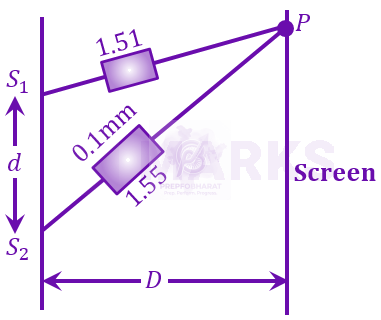
A monochromatic light wave with wavelength ${\lambda }_{1}$ and frequency ${\nu }_{1}$ in air enters another medium. If the angle of incidence and angle of refraction at the interface are $45^{\circ}$ and $30^{\circ}$ respectively, then the wavelength ${\lambda }_{2}$ and frequency ${\nu }_{2}$ of the refracted wave are:
Two objects $AandB$ are placed at $15\mathrm{cm}\mathrm{and}25\mathrm{cm}$ from the pole in front of a concave mirror having radius of curvature $40\mathrm{cm}$. The distance between images formed by the mirror is:
A pole is vertically submerged in swimming pool, such that it gives a length of shadow $2.15m$ within water when sunlight is incident at an angle of $30^{\circ}$ with the surface of water. If swimming pool is filled to a height of $1.5m,$ then the height of the pole above the water surface in centimeters is $({n}_{w}=\frac{4}{3})________.$
A ray of light is incident from air on a glass plate having thickness $\sqrt{3}\mathrm{cm}$ and refractive index $\sqrt{2}$. The angle of incidence of a ray is equal to the critical angle for glass-air interface. The lateral displacement of the ray when it passes through the plate is $____\times {{10}^{-}}^{2}\mathrm{cm}$ . (given $\mathrm{sin}15^{\circ}=0.26$)