Optics PYQ — Page 8
JEE Main Physics — Optics previous year questions with solutions.
All Optics Questions (489)
The light rays from an object have been reflected towards an observer from a standard flat mirror, the image observed by the observer are :- A. Real B. Erect C. Smaller in size than object D. Laterally inverted Choose the most appropriate answer from the options given below:
Two vertical parallel mirrors $A$ and $B$ are separated by $10$ cm. $A$ point object $O$ is placed at a distance of $2\mathrm{cm}$ from mirror $A.$ The distance of the second nearest image behind mirror $A$ from the mirror $A$ is $_______\mathrm{cm}.$ 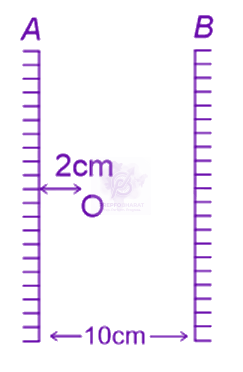
As shown in the figure, in Young's double slit experiment, a thin plate of thickness $t=10\mu m$ and refractive index $\mu =1.2$ is inserted infront of slit ${S}_{1}$. The experiment is conducted in air ($\mu =1$) and uses a monochromatic light of wavelength $\lambda =500\mathrm{nm}$. Due to the insertion of the plate, central maxima is shifted by a distance of $x{\beta }_{0}$. ${\beta }_{0}$ is the fringe-width before the insertion of the plate. The value of the $x$ is ______. 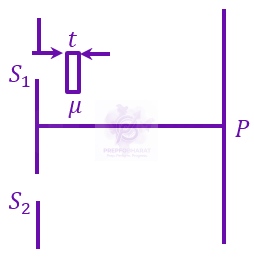
A fish rising vertically upward with a uniform velocity of $8m{s}^{–1},$ observes that a bird is diving vertically downward towards the fish with the velocity of $12m{s}^{–1}.$ If the refractive index of water is $\frac{4}{3},$ then the actual velocity of the diving bird to pick the fish, will be$__________m{s}^{-1}.$ 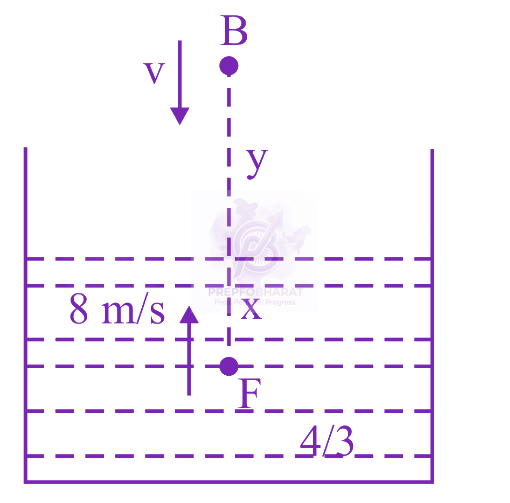
In a single slit diffraction pattern the angular width of the central maximum is 0.1 rad...
In a medium the speed of light wave decreases to $0.2$ times to its speed in free space. The ratio of relative permittivity to the refractive index of the medium is $x:1$. The value of $x$ is ______. (Given speed of light in free space $=3\times {10}^{8}m{s}^{-1}$ and for the given medium ${\mu }_{r}=1$)
The ratio of intensities at two points $P$ and $Q$ on the screen in a Young's double slit experiment where phase difference between two waves of same amplitude are $\frac{\pi }{3}$ and $\frac{\pi }{2}$, respectively are
An object is placed on the principal axis of convex lens of focal length $10\mathrm{cm}$ as shown. A plane mirror is placed on the other side of lens at a distance of $20\mathrm{cm}$. The image produced by the plane mirror is $5\mathrm{cm}$ inside the mirror. The distance of the object from the lens is ____ $\mathrm{cm}$. 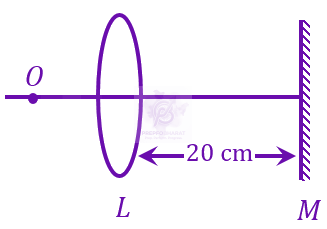
Unpolarised light is incident on the boundary between two dielectric media, whose dielectric constants are $2.8$ (medium –$1$) and $6.8$ (medium – $2$), respectively. To satisfy the condition, so that the reflected and refracted rays are perpendicular to each other, the angle of incidence should be ${\mathrm{tan}}^{-1}{(1+\frac{10}{\theta })}^{\frac{1}{2}}$, the value of $\theta$ is ______. (Given for dielectric media, ${\mu }_{r}=1$)
In Young's double slits experiment, the position of 5$^{th}$ bright fringe from the central maximum is $5\mathrm{cm}$. The distance between slits and screen is $1m$ and wavelength of used monochromatic light is $600\mathrm{nm}$. The separation between the slits is:
In a Young’s double slit experiment, the intensities at two points, for the path difference $\frac{\lambda }{4}$ and $\frac{\lambda }{3}$ ($\lambda$ being the wavelength of light used) are ${I}_{1}$ and ${I}_{2}$ respectively. If ${I}_{0}$ denotes the intensity produced by each one of the individual slits, then $\frac{{I}_{1}+{I}_{2}}{{I}_{0}}=______$.
A single slit of width $a$ is illuminated by a monochromatic light of wavelength $600\mathrm{nm}$. The value of $a$ for which first minimum appears at $\theta ={30}^{o}$ on the screen will be :
A thin prism ${P}_{1}$ with an angle $6^{\circ}$ and made of glass of refractive index $1.54$ is combined with another prism ${P}_{2}$ made from glass of refractive index $1.72$ to produce dispersion without average deviation. The angle of prism ${P}_{2}$ is :
In an experiment for estimating the value of focal length of converging mirror, image of an object placed at $40\mathrm{cm}$ from the pole of the mirror is formed at distance $120\mathrm{cm}$ from the pole of the mirror. These distances are measured with a modified scale in which there are $20$ small divisions in $1\mathrm{cm}$. The value of error in measurement of focal length of the mirror is $\frac{1}{K}\mathrm{cm}$. The value of $K$ is ______.
In a reflecting telescope, a secondary mirror is used to:
A thin cylindrical rod of length $10\mathrm{cm}$ is placed horizontally on the principle axis of a concave mirror of focal length $20\mathrm{cm}$. The rod is placed in a such a way that mid point of the rod is at $40\mathrm{cm}$ from the pole of mirror. The length of the image formed by the mirror will be $\frac{x}{3}\mathrm{cm}$. The value of $x$ is ______.
‘$n$’ polarizing sheets are arranged such that each makes an angle $45^{\circ}$ with the proceeding sheet. An unpolarized light of intensity $I$ is incident into this arrangement. The output intensity is found to be $\frac{I}{64}$ . The value of $n$ will be:
In a Young’s double slit experiment, the ratio of amplitude of light coming from slits is $2:1$. The ratio of the maximum to minimum intensity in the interference pattern is
The refractive index of a transparent liquid filled in an equilateral hollow prism is $\sqrt{2}$. The angle of minimum deviation for the liquid will be _______$^{\circ}$.
As shown in the figure, a plane mirror is fixed at a height of $50\mathrm{cm}$ from the bottom of tank containing water $(\mu =\frac{4}{3})$. The height of water in the tank is $8\mathrm{cm}$. A small bulb is placed at the bottom of the water tank. The distance of image of the bulb formed by mirror from the bottom of the tank is ______ $\mathrm{cm}$. 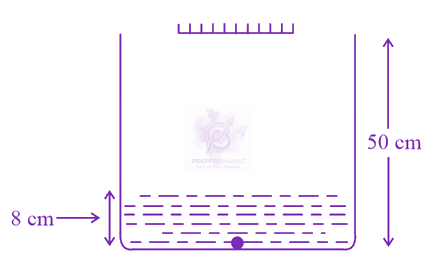
A vessel of depth $d$ is half filled with oil of refractive index ${n}_{1}$ and the other half is filled with water of refractive index ${n}_{2}.$ The apparent depth of this vessel when viewed from above will be-
Given below are two statements: one is labelled as Assertion A and the other is labelled as Reason R Assertion A: The phase difference of two light waves change if they travel through different media having same thickness, but different indices of refraction. Reason R: The wavelengths of waves are different in different media. In the light of the above statements, choose the most appropriate answer from the options given below
Given below are two statements : Statement I : If the Brewster's angle for the light propagating from air to glass is ${\theta }_{B}$, then Brewster's angle for the light propagating from glass to air is $\frac{\pi }{2}-{\theta }_{B}$. Statement II : The Brewster's angle for the light propagating from glass to air is ${\mathrm{tan}}^{-1}({\mu }_{g})$, where ${\mu }_{g}$ is the refractive index of glass. In the light of the above statements, choose the correct answer from the options given below :
The critical angle for a denser-rarer interface is $45^{\circ}$. The speed of light in rarer medium is $3\times {10}^{8}m{s}^{-1}$. The speed of light in the denser medium is: