Optics PYQ — Page 10
JEE Main Physics — Optics previous year questions with solutions.
All Optics Questions (489)
Two convex lenses of focal length $20\mathrm{cm}$ each are placed coaxially with a separation of $60\mathrm{cm}$ between them. The image of the distant object formed by the combination is at _____ $\mathrm{cm}$ from the first lens.
The graph between $\frac{1}{u}$ and $\frac{1}{v}$ for a thin convex lens in order to determine its focal length is plotted as shown in the figure. The refractive index of lens is $1.5$ and its both the surfaces have same radius of curvatures $R$. The value of $R$ will be _____ $\mathrm{cm}$. (Where $u=$ object distance, $v=$ image distance) 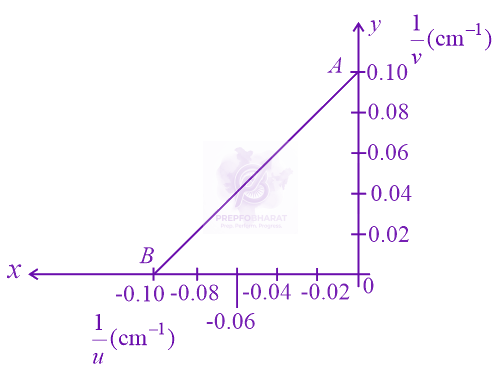
The interference pattern is obtained with two coherent light sources of intensity ratio $4:1$. And the ratio $\frac{{I}_{\mathrm{max}}+{I}_{\mathrm{min}}}{{I}_{\mathrm{max}}-{I}_{\mathrm{min}}}$ is $\frac{5}{x}$. Then, the value of $x$ will be equal to :
The difference of speed of light in the two media $A$ and $B({v}_{A}-{v}_{B})$ is $2.6\times {10}^{7}m{s}^{-1}$. If the refractive index of medium $B$ is $1.47$, then the ratio of refractive index of medium $B$ to medium $A$ is: (Given : speed of light in vacuum $c=3\times {10}^{8}{ms}^{-1}$)
The speed of light in media $'A'$ and $'B'$ are $2.0\times {10}^{10}\mathrm{cm}{s}^{-1}$ and $1.5\times {10}^{10}\mathrm{cm}{s}^{-1}$ respectively. A ray of light enters from the medium $B$ to $A$ at an incident angle$'\theta '$. If the ray suffers total internal reflection, then
A ray of light is incident at an angle of incidence $60^{\circ}$ on the glass slab of refractive index $\sqrt{3}$. After refraction, the light ray emerges out from other parallel faces and lateral shift between incident ray and emergent ray is $4\sqrt{3}\mathrm{cm}$. The thickness of the glass slab is _____ $\mathrm{cm}$.
A convex lens of focal length $20\mathrm{cm}$ is placed in front of convex mirror with principal axis coinciding each other. The distance between the lens and mirror is $10\mathrm{cm}$. A point object is placed on principal axis at a distance of $60\mathrm{cm}$ from the convex lens. The image formed by combination coincides the object itself. The focal length of the convex mirror is _____ $\mathrm{cm}$.
Two coherent sources of light interfere. The intensity ratio of two sources is $1:4$. For this interference pattern if the value of $\frac{{I}_{\mathrm{max}}+{I}_{\mathrm{min}}}{{I}_{\mathrm{max}}-{I}_{\mathrm{min}}}$ is equal to $\frac{2\alpha +1}{\beta +3}$, then $\frac{\alpha }{\beta }$ will be
In Youngs double slit experiment, fringe width is proportional to
The two light beams having intensities $I$ and $9I$ interfere to produce a fringe pattern on a screen. The phase difference between the beams is $\frac{\pi }{2}$ at point $P$ and $\pi$ at point $Q$. Then the difference between the resultant intensities at $P$ and $Q$ will be :
A light whose electric field vectors are completely removed by using a good polaroid, allowed to incident on the surface of the prism at Brewster's angle. Choose the most suitable option for the phenomenon related to the prism.
For an object placed at a distance $2.4m$ from a lens, a sharp focused image is observed on a screen placed at a distance $12\mathrm{cm}$ from the lens. A glass plate of refractive index $1.5$ and thickness $1\mathrm{cm}$ is introduced between lens and screen such that the glass plate plane faces parallel to the screen. By what distance should the object be shifted so that a sharp focused image is observed again on the screen?
Which of the following statement is correct?
In a double slit experiment with monochromatic light, fringes are obtained on a screen placed at some distance from the plane of slits. If the screen is moved by $5\times {10}^{-2}m$ towards the slits, the change in fringe width is $3\times {10}^{-3}\mathrm{cm}$. If the distance between the slits is $1\mathrm{mm}$, then the wavelength of the light will be____$\mathrm{nm}$.
A light ray is incident, at an incident angle ${\theta }_{1}$, on the system of two plane mirrors ${M}_{1}$ and ${M}_{2}$ having an inclination angle $75^{\circ}$ between them (as shown in figure). After reflecting from mirror ${M}_{1}$ it gets reflected back by the mirror ${M}_{2}$ with an angle of reflection $30^{\circ}$. The total deviation of the ray will be _____ degree. 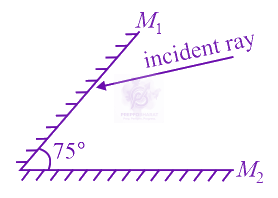
A thin prism of angle $6^{\circ}$ and refractive index for yellow light $({n}_{Y})1.5$ is combined with another prism of angle $5^{\circ}$ and ${n}_{Y}=1.55$. The combination produces no dispersion. The net average deviation $(\delta )$ produced by the combination is ${(\frac{1}{x})}^{^{\circ}}$. The value of $x$ is _____ . 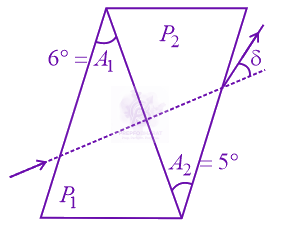
An object '$O$' is placed at a distance of $100\mathrm{cm}$ in front of a concave mirror of radius of curvature $200\mathrm{cm}$ as shown in the figure. The object starts moving towards the mirror at a speed $2\mathrm{cm}{s}^{-1}$. The position of the image from the mirror after $10s$ will be at _____ $\mathrm{cm}$. 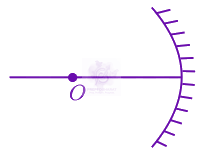
In an experiment with a convex lens. The plot of the image distance $({v}^{'})$ against the object distance $({\mu }^{'})$ measured from the focus gives a curve ${v}^{'}{\mu }^{'}=225$. If all the distances are measured in $\mathrm{cm}$. The magnitude of the focal length of the lens is _____ $\mathrm{cm}$.
In the given figure, the face $AC$ of the equilateral prism is immersed in a liquid of refractive index $n$. For incident angle $60^{\circ}$ at the side $AC$, the refracted light beam just grazes along face $AC$. The refractive index of the liquid $n=\frac{\sqrt{x}}{4}$. The value of $x$ is _____ . (Given refractive index of glass $=1.5$) 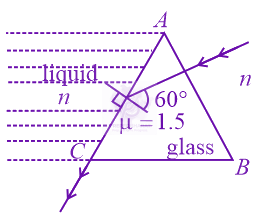
Two identical thin biconvex lenses of focal length $15\mathrm{cm}$ and refractive index $1.5$ are in contact with each other. The space between the lenses is filled with a liquid of refractive index $1.25$. The focal length of the combination is _____ $\mathrm{cm}.$
The refracting angle of a prism is $A$ and refractive index of the material of the prism is $\mathrm{cot}(\frac{A}{2})$. Then the angle of minimum deviation will be
A thin prism of angle 6° and refractive index 1.5 is combined with another prism of angle 4° and refractive index 1.75...
Using Young's double slit experiment, a monochromatic light of wavelength $5000Å$ produces fringes of fringe width $0.5\mathrm{mm}$. If another monochromatic light of wavelength $6000Å$ is used and the separation between the slits is doubled, then the new fringe width will be
Two beams of light having intensities $I$ and $4I$ interfere to produce a fringe pattern on a screen. The phase difference between the two beams are $\frac{\pi }{2}$ and $\frac{\pi }{3}$ at points $A$ and $B$ respectively. The difference between the resultant intensities at the two points is $xI$. The value of $x$ will be _____ .