Optics PYQ — Page 11
JEE Main Physics — Optics previous year questions with solutions.
All Optics Questions (489)
A wave of frequency $=3\mathrm{GHz}$, strikes a particle of size ${(\frac{1}{100})}^{th}$ of $\lambda$, then this phenomenon is called as
In young's double slit experiment performed using a monochromatic light of wavelength $\lambda$, when a glass plate $(\mu =1.5)$ of thickness $x\lambda$ is introduced in the path of the one of the interfering beams, the intensity at the position where the central maximum occurred previously remains unchanged. The value of $x$ will be
In normal adjustment, for a refracting telescope, the distance between objective and eye piece is $30\mathrm{cm}$. The focal length of the objective, when the angular magnification of the telescope is $2$, will be:
An unpolarised light beam of intensity $2{I}_{0}$ is passed through a polaroid $P$ and then through another polaroid $Q$ which is oriented in such a way that its passing axis makes an angle of $30^{\circ}$ relative to that of $P$. The intensity of the emergent light is
A convex lens has power $P$. It is cut into two halves along its principal axis. Further one piece (out of the two halves) is cut into two halves perpendicular to the principal axis (as shown in figures). Choose the incorrect option for the reported pieces. 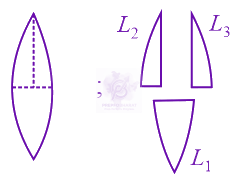
In a Young's double slit experiment, a laser light of $560\mathrm{nm}$ produces an interference pattern with consecutive bright fringes' separation of $7.2\mathrm{mm}$. Now another light is used to produce an interference pattern with consecutive bright fringes' separation of $8.1\mathrm{mm}$. The wavelength of second light is _____ $\mathrm{nm}.$
Light travels in two media ${M}_{1}$ and ${M}_{2}$ with speeds $1.5\times {10}^{8}m{s}^{-1}$ and $2.0\times {10}^{8}m{s}^{-1}$ respectively. The critical angle between them is
Sodium light of wavelengths $650\mathrm{nm}$ and $655\mathrm{nm}$ is used to study diffraction at a single slit of aperture $0.5\mathrm{mm}$. The distance between the slit and the screen is $2.0m$. The separation between the positions of the first maxima of diffraction pattern obtained in the two cases is _____ $\times {10}^{-5}m$
Time taken by light to travel in two different materials $A$ and $B$ of refractive indices ${\mu }_{A}$ and ${\mu }_{B}$ of same thickness is ${t}_{1}$ and ${t}_{2}$ respectively. If ${t}_{2}-{t}_{1}=5\times {10}^{-10}s$ and the ratio of ${\mu }_{A}$ to ${\mu }_{B}$ is $1:2$. Then the thickness of material, in meter is: (Given ${v}_{A}$ and ${v}_{B}$ are velocities of light in $A$ and $B$ materials respectively).
Light enters from air into a given medium at an angle of $45^{\circ}$ with interface of the air-medium surface. After refraction, the light ray is deviated through an angle of $15^{\circ}$ from its original direction. The refractive index of the medium is :
In young's double slit experiment, the fringe width is $12\mathrm{mm}$. If the entire arrangement is placed in water of refractive index $\frac{4}{3}$, then the fringe width becomes (in $\mathrm{mm}$)
Consider a light ray travelling in air is incident into a medium of refractive index $\sqrt{2n}$. The incident angle is twice that of refracting angle. Then, the angle of incidence will be
A small bulb is placed at the bottom of a tank containing water to a depth of $\sqrt{7}m$. The refractive index of water is $\frac{4}{3}$. The area of the surface of water through which light from the bulb can emerge out is $x\pi {m}^{2}$. The value of $x$ is _____ .
As shown in the figure, after passing through the medium $1$. The speed of light ${v}_{2}$ in medium $2$ will be : (Given $c=3\times {10}^{8}m{s}^{-1}$) 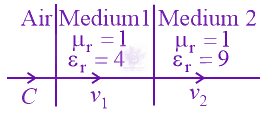
In a Young's double slit experiment, an angular width of the fringe is $0.35^{\circ}$ on a screen placed at $2m$ away for particular wavelength of $450\mathrm{nm}$. The angular width of the fringe, when whole system is immersed in a medium of refractive index $\frac{7}{5}$, is $\frac{1}{\alpha }$. The value of $\alpha$ is _____ .
In Young's double slit experiment the two slits are $0.6\mathrm{mm}$ distance apart. Interference pattern is observed on a screen at a distance $80\mathrm{cm}$ from the slits. The first dark fringe is observed on the screen directly opposite to one of the slits. The wavelength of light will be _____ $\mathrm{nm}$.
A light wave travelling linearly in a medium of dielectric constant $4$, incidents on the horizontal interface separating medium with air. The angle of incidence for which the total intensity of incident wave will be reflected back into the same medium will be : (Given : relative permeability of medium ${\mu }_{r}=1$)
The $X-Y$ plane be taken as the boundary between two transparent media ${M}_{1}$ and ${M}_{2}$. ${M}_{1}$ in $Z\geq 0$ has a refractive index of $\sqrt{2}$ and ${M}_{2}$ with $Z<0$ has a refractive index of $\sqrt{3}$. A ray of light travelling in ${M}_{1}$ along the direction given by the vector $\vec{A}=4\sqrt{3i}-3\sqrt{3}j-5\hat{k}$, is incident on the plane of separation. The value of difference between the angle of incident in ${M}_{1}$ and the angle of refraction in ${M}_{2}$ will be _____ degree.
A parallel beam of light is allowed to fall on a transparent spherical globe of diameter $30\mathrm{cm}$ and refractive index $1.5$. The distance from the centre of the globe at which beam of light can converge is _____ $\mathrm{mm}$.
The power of a lens (biconvex) is $1.25{m}^{-1}$ in particular medium. Refractive index of the lens is $1.5$ and radii of curvature are $20\mathrm{cm}$ and $40\mathrm{cm}$ respectively. The refractive index of surrounding medium:
A ray of light passes from a denser medium to a rarer medium at an angle of incidence $i.$ The reflected and refracted rays make an angle of $90^{\circ}$ with each other. The angle of reflection and refraction are respectively $r$ and ${r}^{'}.$ The critical angle is given by, 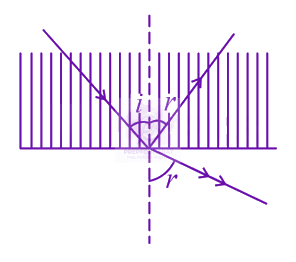
In a Young's double slit experiment two slits are separated by $2\mathrm{mm}$ and the screen is placed one meter away. When a light of wavelength $500\mathrm{nm}$ is used, the fringe separation will be :
The incident ray, reflected ray and the outward drawn normal are denoted by the unitvectors $\vec{a},\vec{b}$and $\vec{c}$ respectively. Then choose the correct relation for these vectors.
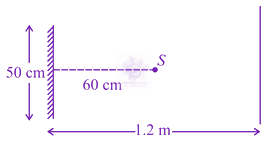
A point source of light $S$, placed at a distance $60\mathrm{cm}$ infront of the centre of a plane mirror of width $50\mathrm{cm}$, hangs vertically on a wall. A man walks infront of the mirror along a line parallel to the mirror at a distance $1.2m$ from it (see in the figure). The distance between the extreme points where he can see the image of the light source in the mirror is__$\mathrm{cm}$