JEE Main Physics — Modern Physics previous year questions with solutions.
$\frac{x}{x+4}$ is the ratio of energies of photons produced due to transition of an electron of hydrogen atom from its (i) third permitted energy level to the second level and (ii) the highest permitted energy level to the second permitted level. The value of $x$ will be
Choose the correct option from the following options given below :
Hydrogen atom from excited state comes to the ground by emitting a photon of wavelength $\lambda$. The value of principal quantum number $n$ of the excited state will be : ( $R:$ Rydberg constant)
For using a multimeter to identify diode from electrical components, choose the correct statement out of the following about the diode
Nucleus $A$ is having mass number $220$ and its binding energy per nucleon is $5.6\mathrm{MeV}$. It splits in two fragments $B$ and $C$ of mass numbers $105$ and $115$. The binding energy of nucleons in $B$ and $C$ is $6.4\mathrm{MeV}$ per nucleon. The energy $Q$ released per fission will be:
A Zener of breakdown voltage ${V}_{Z}=8V$ and maximum Zener current, ${I}_{\mathrm{ZM}}=10\mathrm{mA}$ is subjected to an input voltage ${V}_{i}=10V$ with series resistance $R=100\Omega$. In the given circuit ${R}_{L}$ represents the variable load resistance. The ratio of maximum and minimum value of ${R}_{L}$ is _____ . 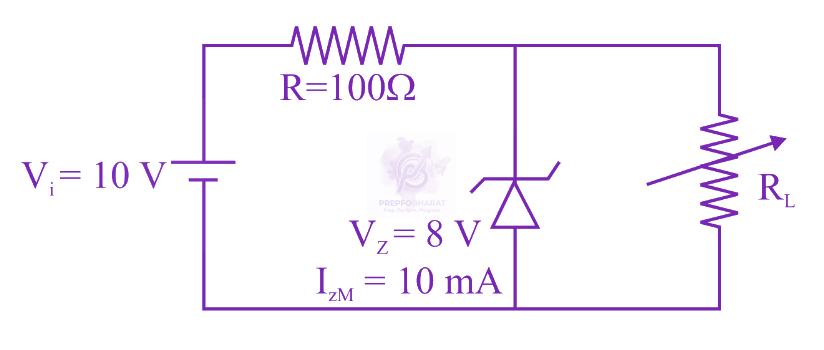
In hydrogen atom, the ratio of radii of first and second orbit is:
The de Broglie wavelength of a particle with momentum p is
The work function of a metal is 4.2 eV. The maximum kinetic energy of photoelectrons when light of wavelength 200 nm falls on it is:
Given below are two statements Statement I: In hydrogen atom, the frequency of radiation emitted when an electron jumps from lower energy orbit $({E}_{1})$ to higher energy orbit $({E}_{2})$, is given as $hf={E}_{1}-{E}_{2}$ Statement II: The jumping of electron from higher energy orbit $({E}_{2})$ to lower energy orbit $({E}_{1})$ is associated with frequency of radiation given as $f=\frac{({E}_{2}-{E}_{1})}{h}$. This condition is Bohr's frequency condition. In the light of the above statements, choose the correct answer from the options given below:
Let ${K}_{1}$ and ${K}_{2}$ be the maximum kinetic energies of photo-electrons emitted when two monochromatic beams of wavelength ${\lambda }_{1}$ and ${\lambda }_{2}$, respectively are incident on a metallic surface. If ${\lambda }_{1}=3{\lambda }_{2}$ then :
A proton, a neutron, an electron and an $\alpha$-particle have same energy. If ${\lambda }_{p},{\lambda }_{n},{\lambda }_{e}$ and ${\lambda }_{\alpha }$ are the de Broglie's wavelengths of proton, neutron, electron and $\alpha$ particle respectively, then choose the correct relation from the following
Two streams of photons, possessing energies to five and ten times the work function of metal are incident on the metal surface successively. The ratio of the maximum velocities of the photoelectron emitted, in the two cases respectively, will be
The ratio of wavelengths of proton and deuteron accelerated by potential ${V}_{p}$ and ${V}_{d}$ is $1:\sqrt{2}$. Then, the ratio of ${V}_{p}$ to ${V}_{d}$ will be
A $8V$ Zener diode along with a series resistance $R$ is connected across a $20V$ supply (as shown in the figure). If the maximum Zener current is $25\mathrm{mA}$, then the minimum value of $R$ will be _____ $\Omega$. 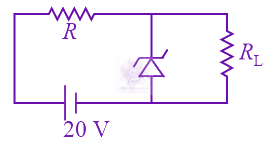
The momentum of an electron revolving in ${n}^{th}$ orbit is given by : (Symbols have their usual meanings)
In Bohr's atomic model of hydrogen, let $K,P$ and $E$ are the kinetic energy, potential energy and total energy of the electron respectively. Choose the correct option when the electron undergoes transitions to a higher level :
Mass numbers of two nuclei are in the ratio of $4:3$. Their nuclear densities will be in the ratio of
In the circuit, the logical value of $A=1$ or $B=1$ when potential at $A$ or $B$ is $5V$ and the logical value of $A=0$ or $B=0$ when potential at $A$ or $B$ is $0V$. 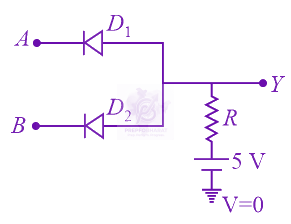 The truth table of the given circuit will be :
A potential barrier of $0.4V$ exists across a p-n junction. An electron enters the junction from the $n$-side with a speed of $6.0\times {10}^{5}{ms}^{-1}$. The speed with which electron enters the $p$ side will be $\frac{x}{3}\times {10}^{5}{ms}^{-1}$, then the value of $x$ is _____.: (Given mass of electron $=9\times {10}^{-31}\mathrm{kg}$, charge on electron $=1.6\times {10}^{-19}C$.)
The cut-off voltage of the diodes (shown in figure) in forward bias is $0.6V$. The current through the resister of $40\Omega$ is _____ $\mathrm{mA}$. 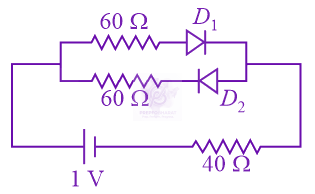
Identify the correct Logic Gate for the following output $(Y)$ of two inputs $A$ and $B$. 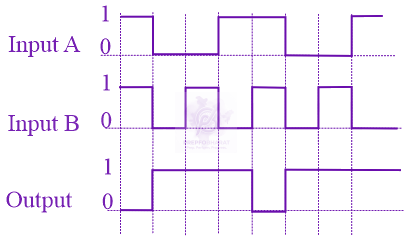
Identify the logic operation performed by the given circuit 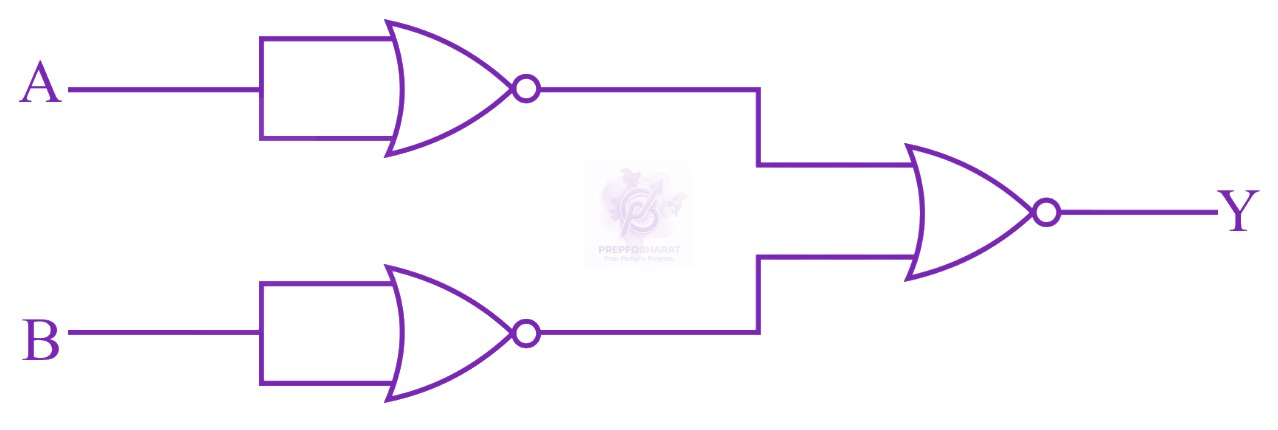
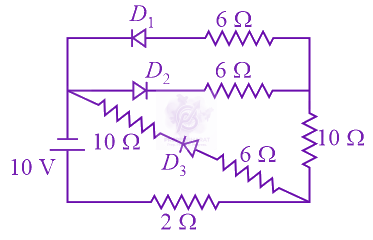
As per the given circuit, the value of current through the battery will be _____ A.