JEE Main Physics — Modern Physics previous year questions with solutions.
The $I-V$ characteristics of a $p-n$ junction diode in forward bias is shown in the figure. The ratio of dynamic resistance, corresponding to forward bias voltage of $2V$ and $4V$ respective is 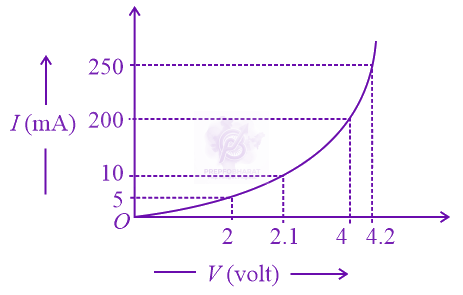
An electron with speed $v$ and a photon with speed $c$ have the same de-Broglie wavelength. If the kinetic energy and momentum of electron are ${E}_{e}$ and ${P}_{e}$ and that of photon are ${E}_{ph}$ and ${P}_{ph}$ respectively. Which of the following is correct?
A beam of monochromatic light is used to excite the electron in ${\mathrm{Li}}^{++}$ from the first orbit to the third orbit. The wavelength of monochromatic light is found to be $x\times {10}^{-10}m$. The value of $x$ is _____ . [Given $hc=1242\mathrm{eV}\mathrm{nm}$]
Two ideal diodes are connected in the network as shown in figure. The equivalent resistance between $A$ and $B$ is _____ $\Omega .$ 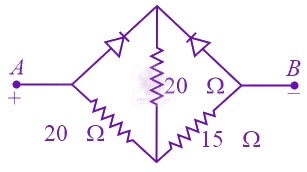
An electron (mass $m$) with an initial velocity $\vec{v}={v}_{0}\hat{i}({v}_{0}>0)$ is moving in an electric field $\vec{E}=-{E}_{0}\hat{i}({E}_{0}>0)$ where ${E}_{0}$ is constant. If at $t=0$, de-Broglie wavelength is ${\lambda }_{0}=\frac{h}{m{v}_{0}}$, then its de-Broglie wavelength after time $t$ is given by
If the potential barrier across a $p-n$ junction is $0.6V$. Then the electric field intensity, in the depletion region having the width of $6\times {10}^{-6}m$, will be _____ $\times {10}^{5}N{C}^{-1}$
An $\alpha$ particle and a proton are accelerated from rest through the same potential difference. The ratio of linear momenta acquired by above two particals will be :
The equation $\lambda =\frac{1.227}{x}\mathrm{nm}$ can be used to find the de-Broglie wavelength of an electron. In this equation $x$ stands for : Where, $m=$ mass of electron $P=$ momentum of electron $K=$ Kinetic energy of electron $V=$ Accelerating potential in volts for electron
The de Broglie wavelengths for an electron and a photon are ${\lambda }_{e}$ and ${\lambda }_{p}$ respectively. For the same kinetic energy of electron and photon, which of the following presents the correct relation between the de Broglie wavelengths of two?
With reference to the observations in photo-electric effect, identify the correct statements from below: A. The square of maximum velocity of photoelectrons varies linearly with frequency of incident light. B. The value of saturation current increases on moving the source of light away from the metal surface. C. The maximum kinetic energy of photo-electrons decreases on decreasing the power of LED (light emitting diode) source of light. D. The immediate emission of photo-electrons out of metal surface can not be explained by particle nature of light/electromagnetic waves. E. Existence of threshold wavelength can not be explained by wave nature of light/electromagnetic waves. Choose the correct answer from the options given below:
A hydrogen atom in its ground state absorbs $10.2\mathrm{eV}$ of energy. The angular momentum of electron of the hydrogen atom will increase by the value of (Given, Planck's constant $=6.6\times {10}^{-34}\mathrm{Js}$).
In the given circuit, the value of current ${I}_{L}$ will be _____ $\mathrm{mA}.$ (When ${R}_{L}=1k\Omega$) 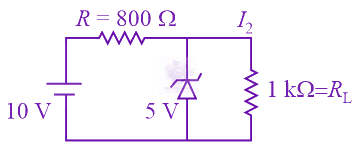
In a hydrogen spectrum $\lambda$ be the wavelength of first transition line of Lyman series. The wavelength difference will be "$a\lambda$" between the wavelength of ${3}^{\mathrm{rd}}$ transition line of Paschen series and that of ${2}^{\mathrm{nd}}$ transition line of Balmer Series where $a=$ _____.
The stopping potential for photoelectrons emitted from a surface illuminated by light of wavelength $6630Å$ is $0.42V$. If the threshold frequency is $x\times {10}^{13}s$, where $x$ is (nearest integer): (Given, speed light $=3\times {10}^{8}m{s}^{-1}$. Planck's constant $=6.63\times {10}^{-34}Js$)
The energy band gap of semiconducting material to produce violet (wavelength $=4000Å$) LED is _____ $\mathrm{eV}$. (Round off to the nearest integer).
Given below are two statements: one is labelled as Assertion A and the other is labelled as Reason R. Assertion A : The photoelectric effect does not take place, if the energy of the incident radiation is less than the work function of a metal. Reason R : Kinetic energy of the photoelectrons is zero, if the energy of the incident radiation is equal to the work function of a metal.
Identify the solar cell characteristics from the following options :
The ratio for the speed of the electron in the ${3}^{\mathrm{rd}}$ orbit of ${\mathrm{He}}^{+}$ to the speed of the electron in the ${3}^{\mathrm{rd}}$ orbit of hydrogen atom will be :
In the circuit shown below, maximum Zener diode current will be _____ $\mathrm{mA}$. 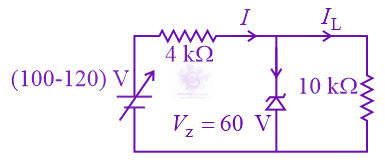
The light of two different frequencies whose photons have energies $3.8\mathrm{eV}$ and $1.4\mathrm{eV}$ respectively, illuminate a metallic surface whose work function is $0.6\mathrm{eV}$ successively. The ratio of maximum speeds of emitted electrons for the two frequencies respectively will be :
Find the ratio of energies of photons produced due to transition of an election of hydrogen atom from its(i) second permitted energy level to the first level, and (ii) the highest permitted energy level to the first permitted level.
In the following nuclear reaction, $D\overset{\alpha }{\rightarrow }{D}_{1}\overset{{\beta }^{-}}{\rightarrow }{D}_{2}\overset{\alpha }{\rightarrow }{D}_{3}\overset{\gamma }{\rightarrow }{D}_{4}$ Mass number of $D$ is $182$ and atomic number is $74$ . Mass number and atomic number of ${D}_{4}$ respectively will be
Two lighter nuclei combine to form a comparatively heavier nucleus by the relation given below: $X12+X12=Y24$ The binding energies per nucleon $X12$ and $Y24$ are $1.1\mathrm{MeV}$ and $7.6\mathrm{MeV}$ respectively. The energy released in this process is_____ $\mathrm{MeV}$.
The $Q$-value of a nuclear reaction and kinetic energy of the projectile particle, ${K}_{p}$ are related as