Modern Physics PYQ — Page 15
JEE Main Physics — Modern Physics previous year questions with solutions.
All Modern Physics Questions (652)
Choose the correct option from the following options given below :
$\frac{x}{x+4}$ is the ratio of energies of photons produced due to transition of an electron of hydrogen atom from its (i) third permitted energy level to the second level and (ii) the highest permitted energy level to the second permitted level. The value of $x$ will be
An electron (mass $m$) with an initial velocity $\vec{v}={v}_{0}\hat{i}({v}_{0}>0)$ is moving in an electric field $\vec{E}=-{E}_{0}\hat{i}({E}_{0}>0)$ where ${E}_{0}$ is constant. If at $t=0$, de-Broglie wavelength is ${\lambda }_{0}=\frac{h}{m{v}_{0}}$, then its de-Broglie wavelength after time $t$ is given by
A metal exposed to light of wavelength $800\mathrm{nm}$ and emits photoelectrons with a certain kinetic energy. The maximum kinetic energy of photo-electron doubles when light of wavelength $500\mathrm{nm}$ is used. The work function of the metal is (Take $hc=1230\mathrm{eV}-\mathrm{nm}$).
Find the ratio of energies of photons produced due to transition of an election of hydrogen atom from its(i) second permitted energy level to the first level, and (ii) the highest permitted energy level to the first permitted level.
A logic gate circuit has two inputs $A$ and $B$ and output $Y$. The voltage waveforms of $A,B$ and $Y$ are shown below 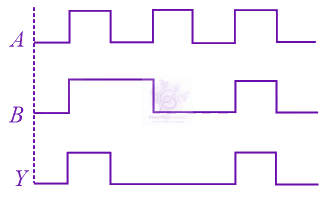 The logic gate circuit is
In Bohr's atomic model of hydrogen, let $K,P$ and $E$ are the kinetic energy, potential energy and total energy of the electron respectively. Choose the correct option when the electron undergoes transitions to a higher level :
In the given circuit, the value of current ${I}_{L}$ will be _____ $\mathrm{mA}.$ (When ${R}_{L}=1k\Omega$) 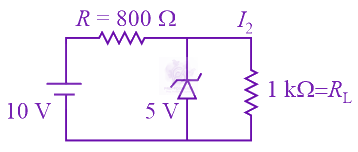
The value of power dissipated across the zener diode $({V}_{z}=15V)$ connected in the circuit as shown in the figure is $x\times {10}^{-1}W$. 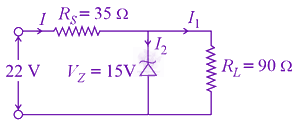 The value of $x$ to the nearest integer is _______.
In Bohr's atomic model, the electron is assumed to revolve in a circular orbit of radius $0.5\overset{\circ }{A}.$ If the speed of electron is $2.2\times {10}^{6}m{s}^{-1}.$ Then the current associated with the electron will be__________ $\times {10}^{-2}\mathrm{mA}.$ [Take $\pi$ as $\frac{22}{7}]$
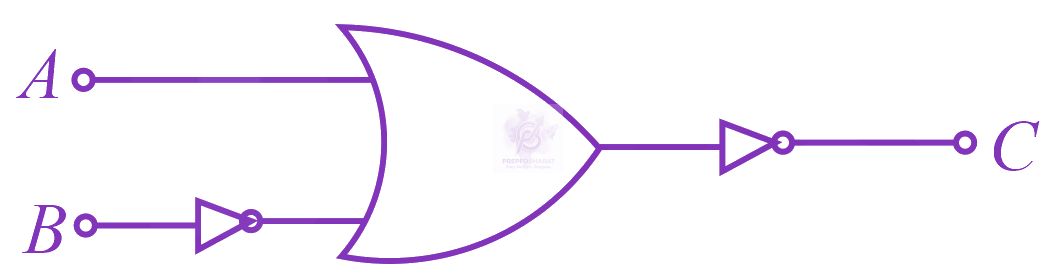 The logic circuit shown above is equivalent to :
The output of the given combination gates represents: 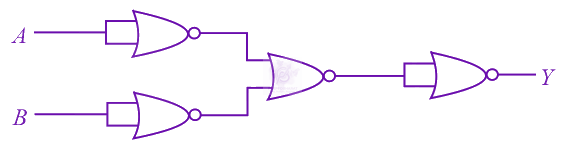
The binding energy per nucleon is maximum for:
The stopping potential in the context of photoelectric effect depends on the following property of incident electromagnetic radiation:
For the given circuit, the power across zener diode is _____ $\mathrm{mW}$. 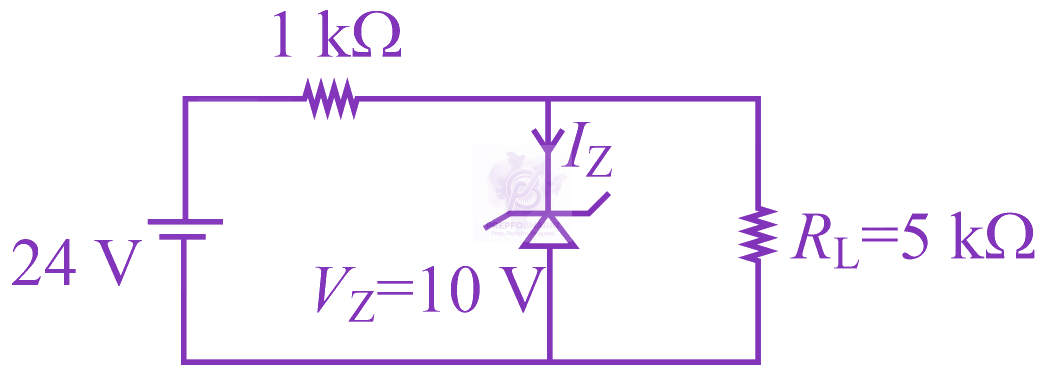
Draw the output signal $Y$ in the given combination of gates. 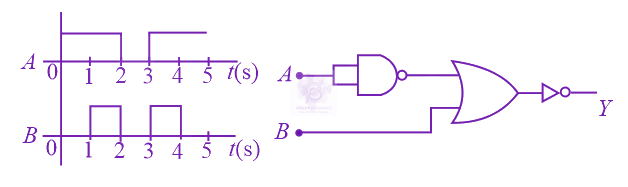
An electron of mass ${m}_{e}$ and a proton of mass ${m}_{p}=1836{m}_{e}$ are moving with the same speed. The ratio of their de Broglie wavelength $\frac{{\lambda }_{electron}}{{\lambda }_{proton}}$ will be :
Given below are two statements: Statement I : $p-n$ junction diodes can be used to function as a transistor, simply by connecting two diodes, back to back, which acts as the base terminal Statement II: In the study of transistors, the amplification factor $\beta$ indicates ratio of the collector current to the base current. In the light of the above statements, choose the correct answer from the options given below.
The temperature of an ideal gas in three dimensions is $300K.$ The corresponding de-Broglie wavelength of the electron approximately at $300K$ is: $[{m}_{e}=$mass of electron $=9\times {10}^{-31}\mathrm{kg}$, $h=$Planck constant $=6.6\times {10}^{-34}Js$, ${k}_{B}=$Boltzmann constant$=1.38\times {10}^{-23}J{K}^{-1}]$
From the given data, the amount of energy required to break the nucleus of aluminium $\mathrm{Al}1327$ is __________$x\times {10}^{-3}J$ Mass of neutron $=1.00866u$ Mass of proton $=1.00726u$ Mass of Aluminium nucleus $=27.18846u$ (Assume $1u$ corresponds to $xJ$ of energy) (Round off to the nearest integer)
Two identical photocathodes receive the light of frequencies ${f}_{1}$ and ${f}_{2}$ respectively. If the velocities of the photo-electrons coming out are ${v}_{1}$ and ${v}_{2}$ respectively, then
A monochromatic neon lamp with wavelength of $670.5\mathrm{nm}$ illuminates a photo-sensitive material which has a stopping voltage of $0.48V$. What will be the stopping voltage if the source light is changed with another source of wavelength of $474.6\mathrm{nm}$ ?
An electron of mass ${m}_{e}$ and a proton of mass ${m}_{P}$ are accelerated through the same potential difference. The ratio of the de-Broglie wavelength associated with the electron to that with the proton is
A particle of mass $4M$ at rest disintegrates into two particles of mass $M$ and $3M$, respectively, having non zero velocities. The ratio of de-Broglie wavelength of particle of mass $M$ to that of mass $3M$ will be: