JEE Main Physics — Modern Physics previous year questions with solutions.
If each diode has a forward bias resistance of $25\Omega$ in the below circuit, 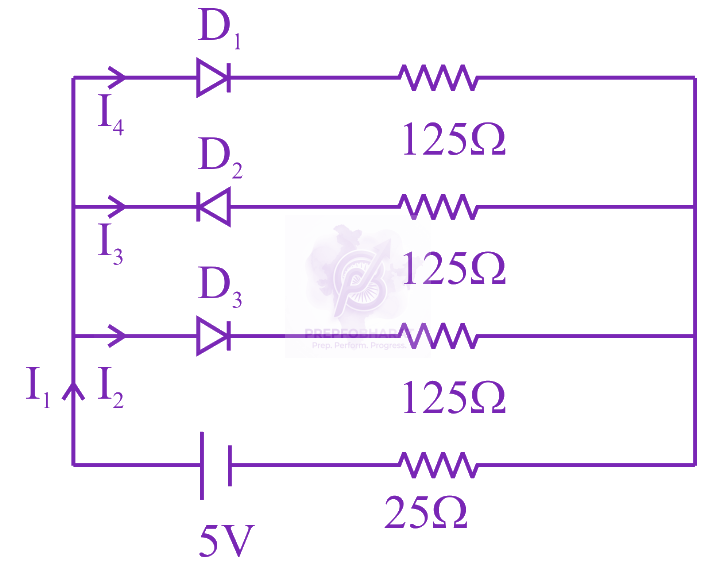 Which of the following options is correct?
The de Broglie wavelength of a molecule in a gas at room temperature $(300K)$ is ${\lambda }_{1}$. If the temperature of the gas is increased to $600K$, then the de Broglie wavelength of the same gas molecule becomes
The output $Y$ for the inputs $A$ and $B$ of circuit is given by 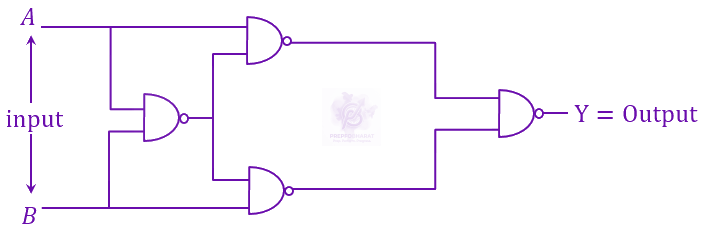 Truth table of the shown circuit is :
If the two metals $A$ and $B$ are exposed to radiation of wavelength $350\mathrm{nm}$. The work functions of metals $A$ and $B$ are $4.8\mathrm{eV}\text{and}2.2\mathrm{eV}$. Then choose the correct option
Given below are two statements : one is labelled as Assertion A and the other is labelled as Reason R Assertion A : The nuclear density of nuclides $B510,L36i,F2656e,N1020e\text{and}B83209i$ can be arranged as ${\rho }_{Bi}^{N}>{\rho }_{Fe}^{N}>{\rho }_{Ne}^{N}>{\rho }_{B}^{N}>{\rho }_{Li}^{N}$ Reason R : The radius $R$ of nucleus is related to its mass number $A$ as $R={R}_{0}{A}^{\frac{1}{3}}$, where ${R}_{0}$ is a constant. In the light of the above statement, choose the correct answer from the options given below :
From the photoelectric effect experiment, following observations are made. Identify which of these are correct A. The stopping potential depends only on the work function of the metal. B. The saturation current increases as the intensity of incident light increases. C. The maximum kinetic energy of a photo electron depends on the intensity of the incident light. D. Photoelectric effect can be explained using wave theory of light. Choose the correct answer from the options given below:
The kinetic energy of an electron, $\alpha -$particle and a proton are given as $4K,2K$ and $K$ respectively. The de-Broglie wavelength associated with electron $({\lambda }_{e}),\alpha -$particle $({\lambda }_{\alpha })$ and the proton $({\lambda }_{p})$ are as follows:
The radius of fifth orbit of ${\mathrm{Li}}^{++}$ is$_______\times {10}^{-12}m.$ Take: radius of hydrogen atom$=0.51\overset{\circ }{A}$
For a nucleus $XZA$ having mass number A and atomic number $Z$ A. The surface energy per nucleon$({b}_{s})=–{a}_{1}{A}^{\frac{2}{3}}.$ B. The Coulomb contribution to the binding energy ${b}_{c}=-{a}_{2}\frac{Z(Z-1)}{{A}^{\frac{4}{3}}}$. C. The volume energy ${b}_{v}={a}_{3}A$ D. Decrease in the binding energy is proportional to surface area. E. While estimating the surface energy, it is assumed that each nucleon interacts with 12 nucleons. (${a}_{1},{a}_{2}$ and ${a}_{3}$ are constants) Choose the most appropriate answer from the options given below:
The angular momentum for the electron in Bohr’s orbit is $L$. If the electron is assumed to revolve in second orbit of hydrogen atom, then the change in angular momentum will be
The ratio of de-Broglie wavelength of an $\alpha$-particle and a proton accelerated from rest by the same potential is $\frac{1}{\sqrt{m}}$ , the value of $m$ is:
Speed of an electron in Bohr’s ${7}^{\mathrm{th}}$ orbit for Hydrogen atom is $3.6\times {10}^{6}m{s}^{-1}$. The corresponding speed of the electron in ${3}^{\mathrm{rd}}$ orbit, in $m{s}^{-1}$ is :
Given below are two statements: one is labelled as Assertion A and the other is labelled as Reason R. Assertion A: Photodiodes are preferably operated in reverse bias condition for light intensity measurement. Reason R: The current in the forward bias is more than the current in the reverse bias for a $p-n$ junction diode. In the light of the above statement, choose the correct answer from the options given below :
Nucleus a having $Z=17$ and equal number of protons and neutrons has $1.2\mathrm{MeV}$ binding energy per nucleon. Another nucleus $B$ of $Z=12$ has total $26$ nucleons and $1.8\mathrm{MeV}$ binding energy per nucleons. The difference of binding energy of $B$ and $A$ will be ______ $\mathrm{MeV}$.
The energy levels of an hydrogen atom are shown below. The transition corresponding to emission of shortest wavelength is 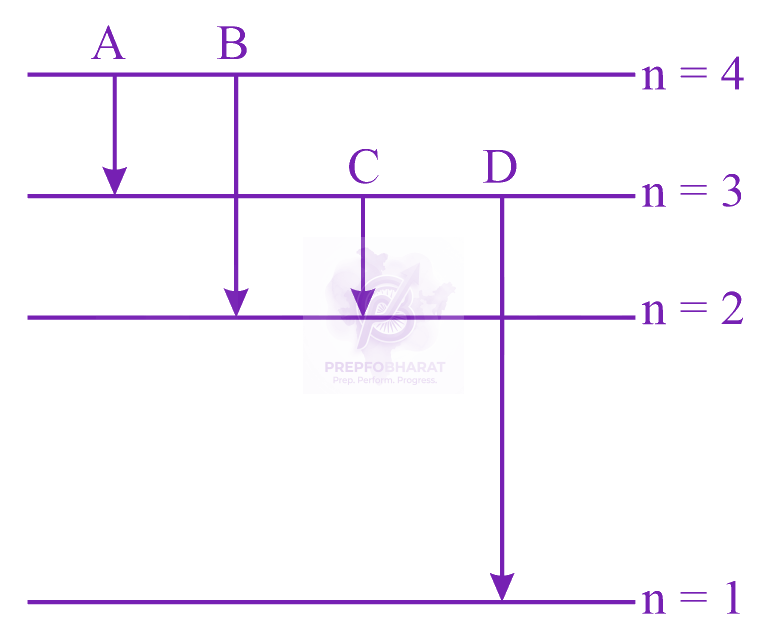
The mass of proton, neutron and helium nucleus are respectively $1.0073u,1.0087u\mathrm{and}4.0015u$. The binding energy of helium nucleus is:
The threshold frequency of metal is ${f}_{0}$. When the light of frequency $2{f}_{0}$ is incident on the metal plate, the maximum velocity of photoelectron is ${v}_{1}$. When the frequency of incident radiation is increased to $5{f}_{0}$. the maximum velocity of photoelectrons emitted is ${v}_{2}$. The ratio of ${v}_{1}$ to ${v}_{2}$ is:
A free neutron decays into a proton but a free proton does not decay into neutron. This is because
Which of the following statement is not correct in the case of light emitting diodes? A. It is a heavily doped p-n junction. B. It emits light only when it is forward biased. C. It emits light only when it is reverse biased. D. The energy of the light emitted is equal to or slightly less than the energy gap of the semiconductor used. Choose the correct answer from the options given below :
An $\alpha$ particle and a carbon $12$ atom has same kinetic energy $K$. The ratio of their de-Broglie wavelengths $({\lambda }_{\alpha }:{\lambda }_{C12})$ is
A metal exposed to light of wavelength $800\mathrm{nm}$ and emits photoelectrons with a certain kinetic energy. The maximum kinetic energy of photo-electron doubles when light of wavelength $500\mathrm{nm}$ is used. The work function of the metal is (Take $hc=1230\mathrm{eV}-\mathrm{nm}$).
Which of the following figure represents the variation of $\mathrm{ln}(\frac{R}{{R}_{0}})$ with $\mathrm{ln}A$ (if $R=$ radius of a nucleus and $A=$ its mass number)
In the given circuit the input voltage ${V}_{\mathrm{in}}$ is shown in figure. The cut-in voltage of $p-n$ junction diode (${D}_{1}$ or ${D}_{2}$) is $0.6V$. Which of the following output voltage $({V}_{0})$ waveform across the diode is correct? 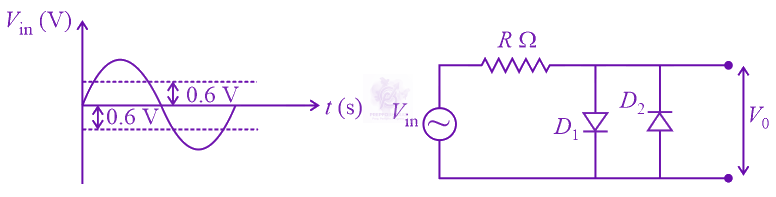
Read the following statements: (A) Volume of the nucleus is directly proportional to the mass number. (B) Volume of the nucleus is independent of mass number. (C) Density of the nucleus is directly proportional to the mass number. (D) Density of the nucleus is directly proportional to the cube root of the mass number. (E) Density of the nucleus is independent of the mass number. Choose the correct option from the following options.