JEE Main Physics — Modern Physics previous year questions with solutions.
Name the logic gate equivalent to the diagram attached 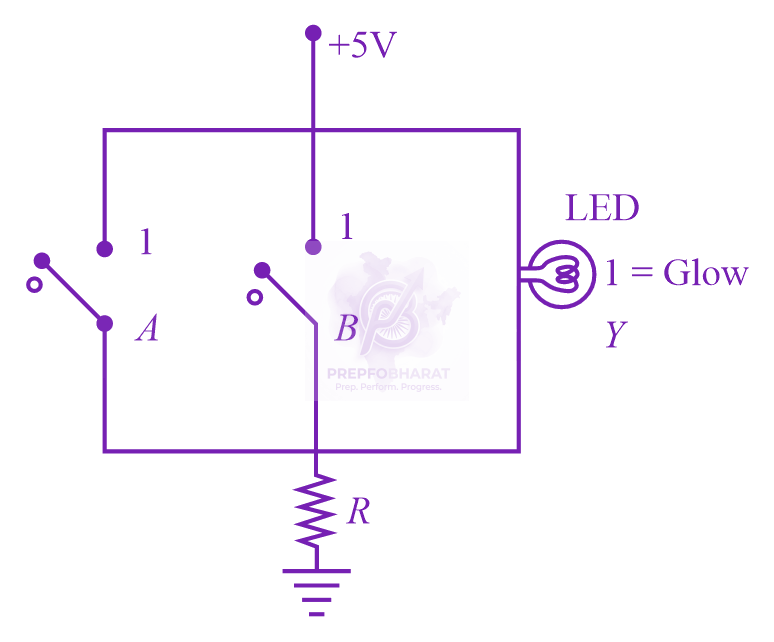
Match the List I with List II <table class="pyq-table"><tbody><tr><td></td><td>List I</td><td></td><td>List II</td></tr><tr><td>A</td><td>Intrinsic Semiconductor</td><td>I</td><td>Fermi-level near valence band</td></tr><tr><td>B</td><td>n-type semiconductor</td><td>II</td><td>Fermi-level at middle of valence and conduction band</td></tr><tr><td>C</td><td>p-type semiconductor</td><td>III</td><td>Fermi-level near conduction band</td></tr><tr><td>D</td><td>Metals</td><td>IV</td><td>Fermi-level inside conduction band</td></tr></tbody></table>Choose the correct answer from the options given below:
In Bohrs model the ratio of the kinetic energy to the total energy of the electron in nth orbit is:
$92238A\rightarrow 90234B+D24+Q$ In the given nuclear reaction, the approximate amount of energy released will be: [Given, mass of $92238A=238.05079\times 931.5\mathrm{MeV}{c}^{-2}$, mass of $B90234=234.04363\times 931.5\mathrm{MeV}{c}^{-2}$, mass of $D24=4.00260\times 931.5\mathrm{Me}V{c}^{-2}$ ]
In photoelectric effect A. The photocurrent is proportional to the intensity of the incident radiation. B. Maximum kinetic energy with which photoelectrons are emitted depends on the intensity of incident light. C. Max K.E. with which photoelectrons are emitted depends on the frequency of incident light. D. The emission of photoelectrons require a minimum threshold intensity of incident radiation. E. Max K.E. of the photoelectrons is independent of the frequency of the incident light. Choose the correct answer from the options given below:
If the two metals $A$ and $B$ are exposed to radiation of wavelength $350\mathrm{nm}$. The work functions of metals $A$ and $B$ are $4.8\mathrm{eV}\text{and}2.2\mathrm{eV}$. Then choose the correct option
If the binding energy of ground state electron in a hydrogen atom is $13.6\mathrm{eV}$, then, the energy required to remove the electron from the second excited state of $\mathrm{Li}{}^{2+}$ will be: $x\times {10}^{-1}\mathrm{eV}$. The value of $x$ is _____.
If each diode has a forward bias resistance of $25\Omega$ in the below circuit, 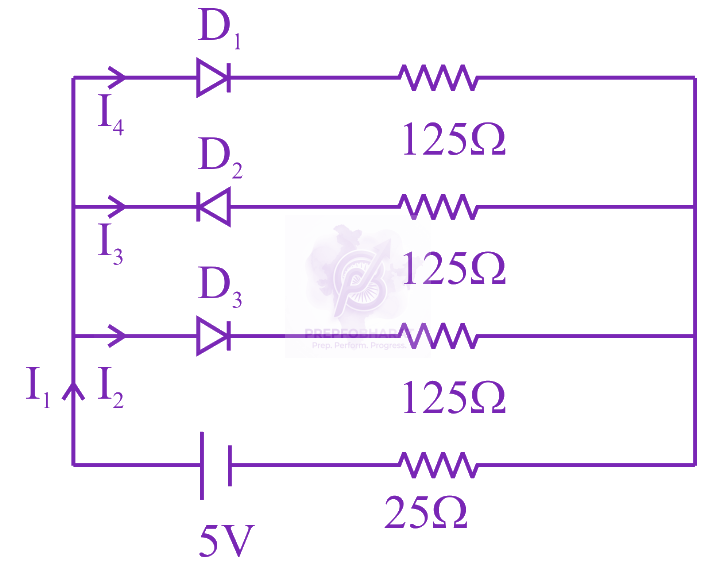 Which of the following options is correct?
If $917Å$ be the lowest wavelength of Lyman series then the lowest wavelength of Balmer series will be $Å$.
If a source of electromagnetic radiation having power $15\mathrm{kW}$ produces ${10}^{16}$ photons per second, the radiation belongs to a part of spectrum is : (Take Planck constant $h=6\times {10}^{-34}Js)$
Given below are two statements : Statement I : Stopping potential in photoelectric effect does not depend on the power of the light source. Statement II : For a given metal, the maximum kinetic energy of the photoelectron depends on the wavelength of the incident light. In the light of above statements, choose the most appropriate answer from the options given below.
Given below are two statements: one is labelled as Assertion A and the other is labelled as Reason R. Assertion A: Photodiodes are preferably operated in reverse bias condition for light intensity measurement. Reason R: The current in the forward bias is more than the current in the reverse bias for a $p-n$ junction diode. In the light of the above statement, choose the correct answer from the options given below :
Given below are two statements : one is labelled as Assertion A and the other is labelled as Reason R Assertion A: Photodiodes are used in forward bias usually for measuring the light intensity. Reason R: For a $p-n$ junction diode, at applied voltage $V$ the current in the forward bias is more than the current in the reverse bias for $|{V}_{z}|>\pm V\geq |{V}_{0}|$ where ${V}_{0}$ is the threshold voltage and ${V}_{z}$ is the breakdown voltage. In the light of the above statements, choose the correct answer from the options given below
Given below are two statements : one is labelled as Assertion A and the other is labelled as Reason R Assertion A : The nuclear density of nuclides $B510,L36i,F2656e,N1020e\text{and}B83209i$ can be arranged as ${\rho }_{Bi}^{N}>{\rho }_{Fe}^{N}>{\rho }_{Ne}^{N}>{\rho }_{B}^{N}>{\rho }_{Li}^{N}$ Reason R : The radius $R$ of nucleus is related to its mass number $A$ as $R={R}_{0}{A}^{\frac{1}{3}}$, where ${R}_{0}$ is a constant. In the light of the above statement, choose the correct answer from the options given below :
Given below are two statements: one is labelled as Assertion A and the other is labelled as Reason R Assertion A : The binding energy per nucleon is practically independent of the atomic number for nuclei of mass number in the range $30$ to $170$. Reason R : Nuclear force is short ranged. In the light of the above statements, choose the correct answer from the options given below
Given below are two statements: one is labelled as Assertion A and the other is labelled as Reason R Assertion A: Diffusion current in a $p-n$ junction is greater than the drift current in magnitude if the junction is forward biased. Reason R: Diffusion current in a $p-n$ junction is form the $n$-side to the $p$-side if the junction is forward biased. In the light of the above statements, choose the most appropriate answer from the options given below.
From the photoelectric effect experiment, following observations are made. Identify which of these are correct A. The stopping potential depends only on the work function of the metal. B. The saturation current increases as the intensity of incident light increases. C. The maximum kinetic energy of a photo electron depends on the intensity of the incident light. D. Photoelectric effect can be explained using wave theory of light. Choose the correct answer from the options given below:
For the logic circuit shown, the output waveform at $Y$ is 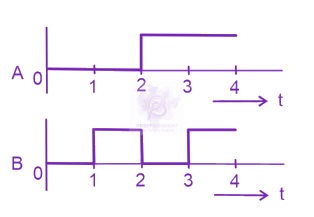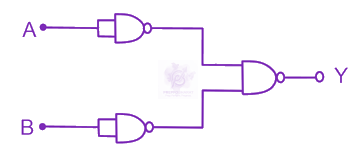
For the given logic gates combination, the correct truth table will be 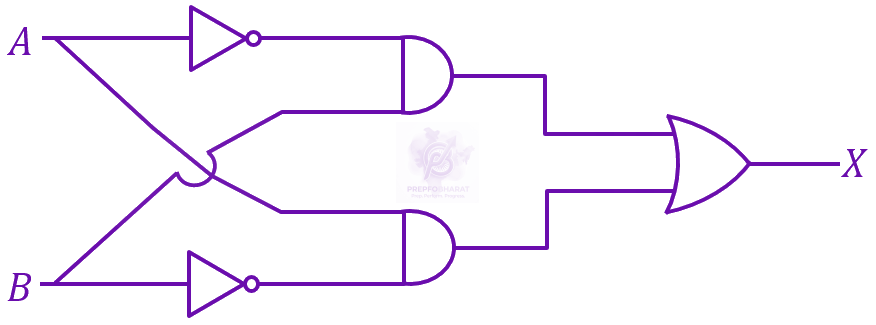
For the following circuit and given inputs $A$ and $B,$ choose the correct option for output $‘Y’$ 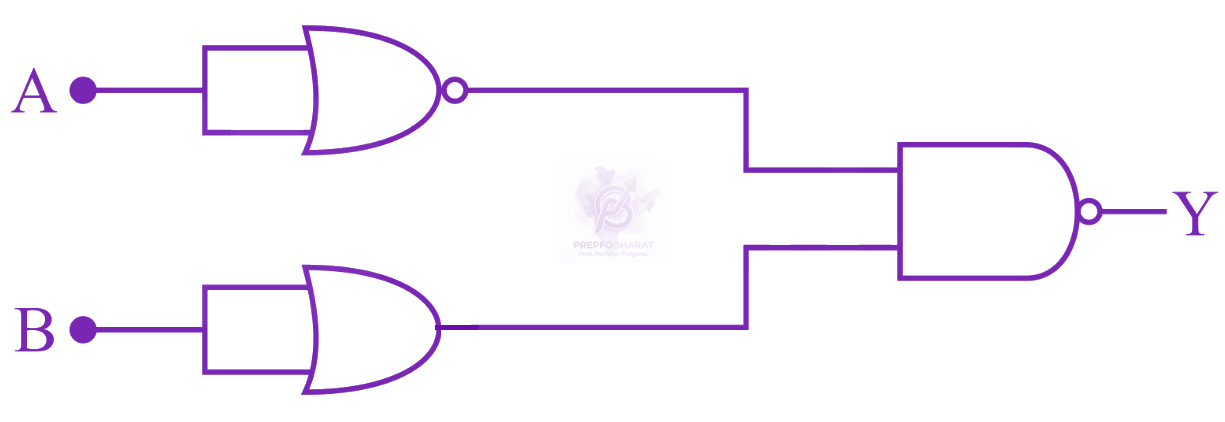 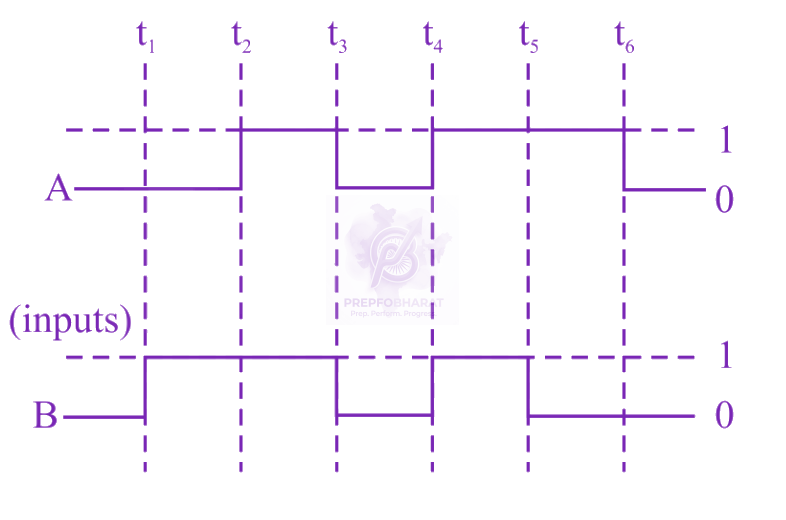
For hydrogen atom, ${\lambda }_{1}$ and ${\lambda }_{2}$ are the wavelengths corresponding to the transitions $1$ and $2$ respectively as shown in figure. The ratio of ${\lambda }_{1}$ and ${\lambda }_{2}$ is $\frac{x}{32}$. The value of $x$ is ______. 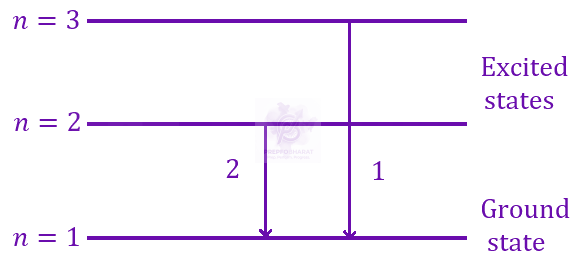
For a nucleus $XZA$ having mass number A and atomic number $Z$ A. The surface energy per nucleon$({b}_{s})=–{a}_{1}{A}^{\frac{2}{3}}.$ B. The Coulomb contribution to the binding energy ${b}_{c}=-{a}_{2}\frac{Z(Z-1)}{{A}^{\frac{4}{3}}}$. C. The volume energy ${b}_{v}={a}_{3}A$ D. Decrease in the binding energy is proportional to surface area. E. While estimating the surface energy, it is assumed that each nucleon interacts with 12 nucleons. (${a}_{1},{a}_{2}$ and ${a}_{3}$ are constants) Choose the most appropriate answer from the options given below:
Electron beam used in an electron microscope, when accelerated by a voltage of $20\mathrm{kV}$ has a de-Broglie wavelength of ${\lambda }_{0}$. If the voltage is increased to $40\mathrm{kV}$ then the de-Broglie wavelength associated with the electron beam would be:
Choose the correct statement about Zener diode: