JEE Main Physics — Modern Physics previous year questions with solutions.
In photoelectric effect A. The photocurrent is proportional to the intensity of the incident radiation. B. Maximum kinetic energy with which photoelectrons are emitted depends on the intensity of incident light. C. Max K.E. with which photoelectrons are emitted depends on the frequency of incident light. D. The emission of photoelectrons require a minimum threshold intensity of incident radiation. E. Max K.E. of the photoelectrons is independent of the frequency of the incident light. Choose the correct answer from the options given below:
A metallic surface is illuminated with radiation of wavelength $\lambda$, the stopping potential is ${V}_{0}$. If the same surface is illuminated with radiation of wavelength $2\lambda$, the stopping potential becomes $\frac{{V}_{0}}{4}$. The threshold wavelength for this metallic surface will be
Statement I : When a Si sample is doped with Boron, it becomes P type and when doped by Arsenic it becomes N-type semi conductor such that P-type has excess holes and N-type has excess electrons. Statement II : When such P-type and N-type semi-conductors, are fused to make a junction, a current will automatically flow which can be detected with an externally connected ammeter. In the light of above statements, choose the most appropriate answer from the options given below.
Match the List I with List II <table class="pyq-table"><tbody><tr><td></td><td>List I</td><td></td><td>List II</td></tr><tr><td>A</td><td>Intrinsic Semiconductor</td><td>I</td><td>Fermi-level near valence band</td></tr><tr><td>B</td><td>n-type semiconductor</td><td>II</td><td>Fermi-level at middle of valence and conduction band</td></tr><tr><td>C</td><td>p-type semiconductor</td><td>III</td><td>Fermi-level near conduction band</td></tr><tr><td>D</td><td>Metals</td><td>IV</td><td>Fermi-level inside conduction band</td></tr></tbody></table>Choose the correct answer from the options given below:
A nucleus with mass number $242$ and binding energy per nucleon as $7.6\mathrm{MeV}$ breaks into two fragment each with mass number $121$. If each fragment nucleus has binding energy per nucleon as $8.1\mathrm{MeV},$ the total gain in binding energy is $_______\mathrm{MeV}$.
If the binding energy of ground state electron in a hydrogen atom is $13.6\mathrm{eV}$, then, the energy required to remove the electron from the second excited state of $\mathrm{Li}{}^{2+}$ will be: $x\times {10}^{-1}\mathrm{eV}$. The value of $x$ is _____.
The work function of a metal is 4.2 eV. The threshold wavelength is (hc = 1240 eV·nm):
In Bohrs model the ratio of the kinetic energy to the total energy of the electron in nth orbit is:
An $\alpha$ particle, a proton and an electron have the same kinetic energy. Which one of the following is correct in case of their de-Broglie wavelength:
An atom absorbs a photon of wavelength $500\mathrm{nm}$ and emits another photon of wavelength $600\mathrm{nm}$. The net energy absorbed by the atom in this process is $n\times {10}^{-4}\mathrm{eV}$. The value of$n$is [Assume the atom to be stationary during the absorption and emission process] (Take $h=6.6\times {10}^{-34}Js$ and c=3\times 108 m s-1 ).
A zener diode of power rating $1.6W$ is to be used as voltage regulator. If the zener diode has a breakdown of $8V$ and it has to regulate voltage fluctuating between $3V$ and $10V$ The value of resistance ${R}_{s}$ for safe operation of diode will be 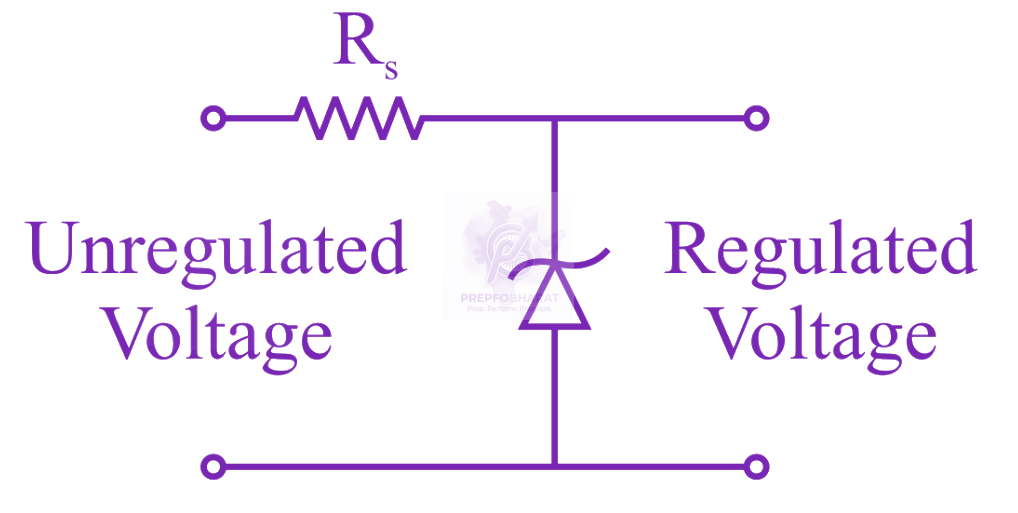
The difference between threshold wavelengths for two metal surfaces $A$ and $B$ having work function ${\phi }_{A}=9\mathrm{eV}$ and ${\phi }_{B}=4.5\mathrm{eV}$ in $\mathrm{nm}$ is: {Given, $hc=1242\mathrm{eV}\mathrm{nm}$}
The work functions of Aluminium and Gold are $4.1\mathrm{eV}$ and $5.1\mathrm{eV}$ respectively. The ratio of the slope of the stopping potential versus frequency plot for Gold to that of Aluminium is
An electron accelerated through a potential difference ${V}_{1}$ has a de-Broglie wavelength of $\lambda$. When the potential is changed to ${V}_{2}$, its de-Broglie wavelength increases by $50%$. The value of $(\frac{{V}_{1}}{{V}_{2}})$ is equal to :
Electron beam used in an electron microscope, when accelerated by a voltage of $20\mathrm{kV}$ has a de-Broglie wavelength of ${\lambda }_{0}$. If the voltage is increased to $40\mathrm{kV}$ then the de-Broglie wavelength associated with the electron beam would be:
If $917Å$ be the lowest wavelength of Lyman series then the lowest wavelength of Balmer series will be $Å$.
A light of energy $12.75\mathrm{eV}$ is incident on a hydrogen atom in its ground state. The atom absorbs the radiation and reaches to one of its excited states. The angular momentum of the atom in the excited state is $\frac{x}{\pi }\times {10}^{-17}\mathrm{eVs}$. The value of $x$ is ______ (use $h=4.14\times {10}^{–15}\mathrm{eVs},c=3\times {10}^{8}m{s}^{–1}$)
For hydrogen atom, ${\lambda }_{1}$ and ${\lambda }_{2}$ are the wavelengths corresponding to the transitions $1$ and $2$ respectively as shown in figure. The ratio of ${\lambda }_{1}$ and ${\lambda }_{2}$ is $\frac{x}{32}$. The value of $x$ is ______. 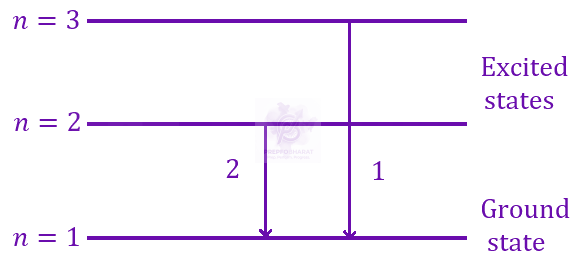
The output from a NAND gate having inputs A and B given below will be, 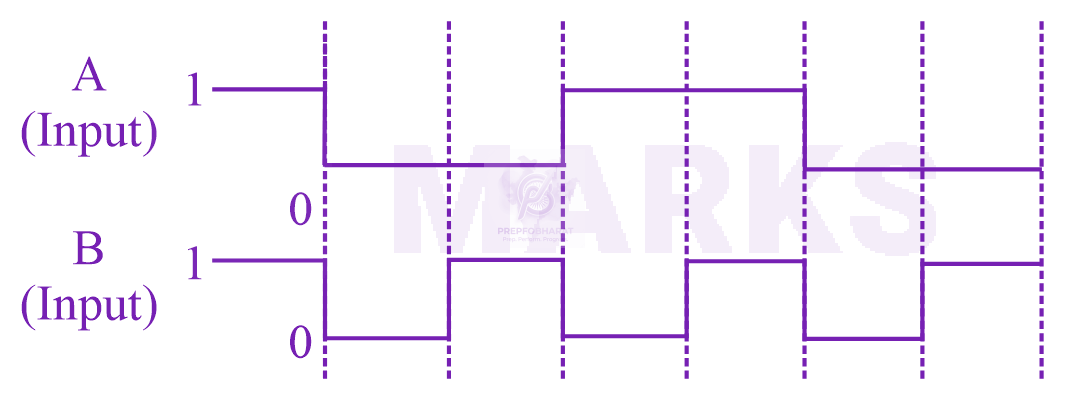
The logic operations performed by the given digital circuit is equivalent to: 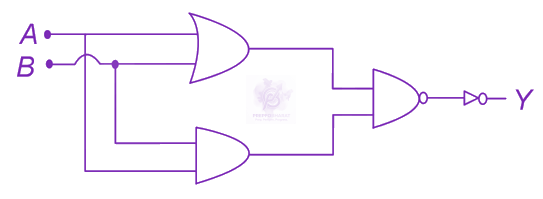
For the logic circuit shown, the output waveform at $Y$ is 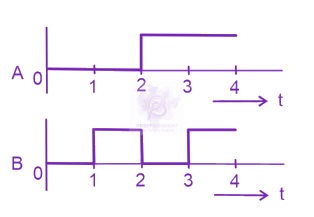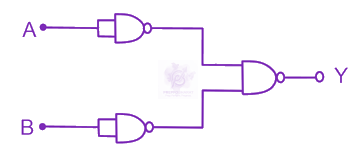
For the given logic gates combination, the correct truth table will be 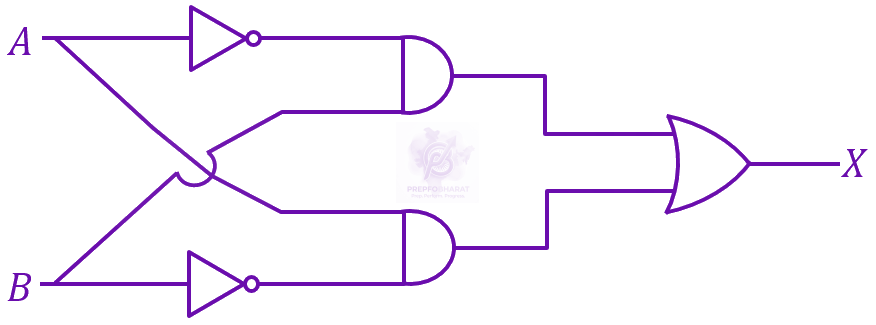
Given below are two statements : Statement I : Stopping potential in photoelectric effect does not depend on the power of the light source. Statement II : For a given metal, the maximum kinetic energy of the photoelectron depends on the wavelength of the incident light. In the light of above statements, choose the most appropriate answer from the options given below.
A $12.5\mathrm{eV}$ electron beam is used to bombard gaseous hydrogen at room temperature. The number of spectral lines emitted will be: