JEE Main Physics — Modern Physics previous year questions with solutions.
If the wavelength of the first member of Lyman series of hydrogen is $\lambda$. The wavelength of the second member will be
In a nuclear fission process, a high mass nuclide $(A\approx 236)$ with binding energy $7.6\mathrm{MeV}/$Nucleon dissociated into two middle mass nuclides $(A\approx 118)$, having binding energy of $8.6\mathrm{MeV}/$Nucleon. The energy released in the process would be _______ $\mathrm{MeV}$.
In the given circuit, the breakdown voltage of the Zener diode is $3.0V$. What is the value of ${I}_{z}$ ? 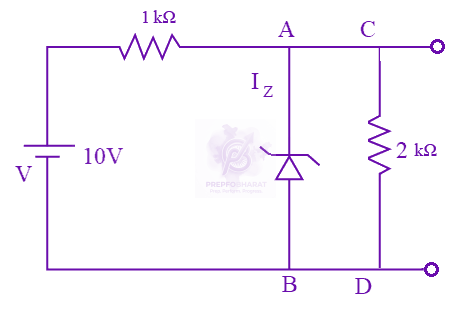
When a metal surface is illuminated by light of wavelength $\lambda$, the stopping potential is $8V$. When the same surface is illuminated by light of wavelength $3\lambda$, stopping potential is $2V$. The threshold wavelength for this surface is :
Which of the following statement is not true about stopping potential $\left(\mathrm{V}_0\right)$ ?
Which of the diode circuit shows correct biasing used for the measurement of dynamic resistance of p-n junction diode :
For the photoelectric effect, the maximum kinetic energy $({E}_{k})$ of the photoelectrons is plotted against the frequency $(v)$ of the incident photons as shown in figure. The slope of the graph gives 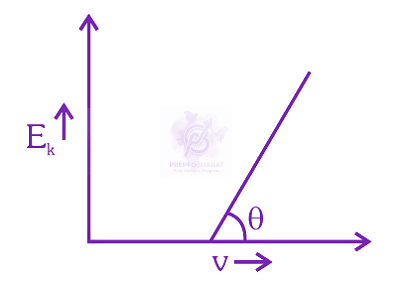
From the statements given below : (A) The angular momentum of an electron in ${n}^{th}$ orbit is an integral multiple of $h$. (B) Nuclear forces do not obey inverse square law. (C) Nuclear forces are spin dependent. (D) Nuclear forces are central and charge independent. (E) Stability of nucleus is inversely proportional to the value of packing fraction. Choose the correct answer from the options given below :
The mass number of nucleus having radius equal to half of the radius of nucleus with mass number $192$ is:
A Zener diode of breakdown voltage $10V$ is used as a voltage regulator as shown in the figure. The current through the Zener diode is 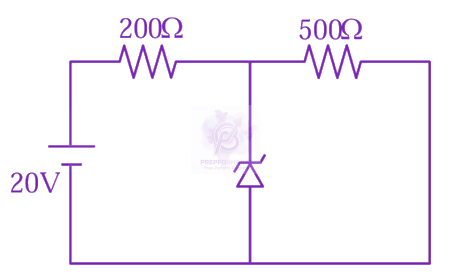
According to Bohr's theory, the moment of momentum of an electron revolving in $4^{\text {th }}$ orbit of hydrogen atom is:
Following gates section is connected in a complete suitable circuit. 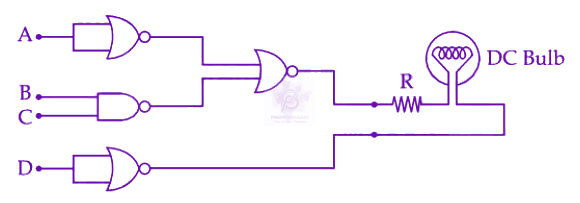 $\text { For which of the following combination, bulb will glow (ON) : }$
A point source of light is placed at the centre of curvature of a hemispherical surface. The source emits a power of $24W$. The radius of curvature of hemisphere is $10\mathrm{cm}$ and the inner surface is completely reflecting. The force on the hemisphere due to the light falling on it is ______ $\times {10}^{-8}N$.
Assume that protons and neutrons have equal masses. Mass of a nucleon is $1.6\times {10}^{-27}\mathrm{kg}$ and radius of nucleus is $1.5\times {10}^{-15}{A}^{\frac{1}{3}}m$. The approximate ratio of the nuclear density and water density is $n\times {10}^{13}$. The value of $n$ is _____.
As per given figure $A,B$ and $C$ are the first, second and third excited energy levels of hydrogen atom respectively. If the ratio of the two wavelengths$(i.e.\frac{{\lambda }_{1}}{{\lambda }_{2}})$ is $\frac{7}{4n}$, then the value of $n$ will be 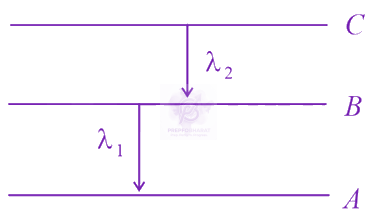
For the following circuit and given inputs $A$ and $B,$ choose the correct option for output $‘Y’$ 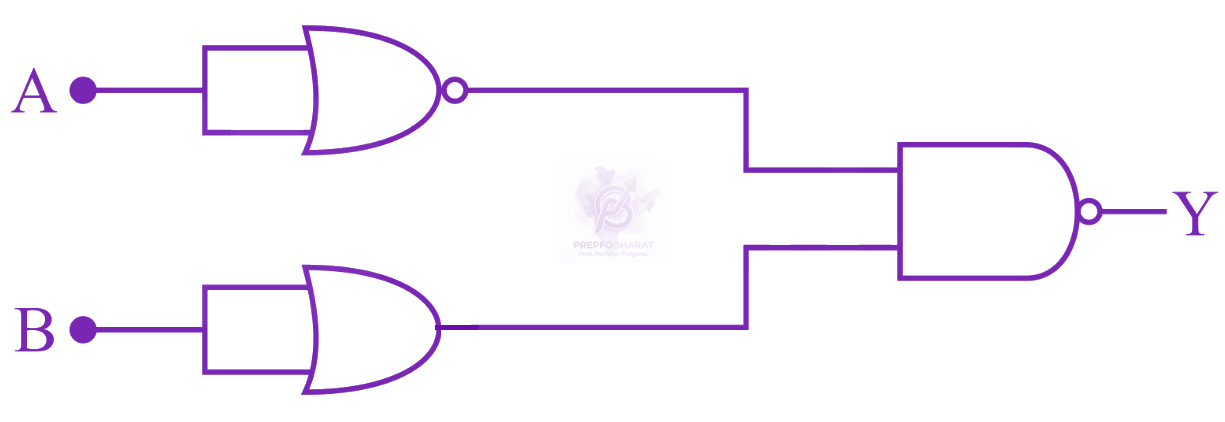 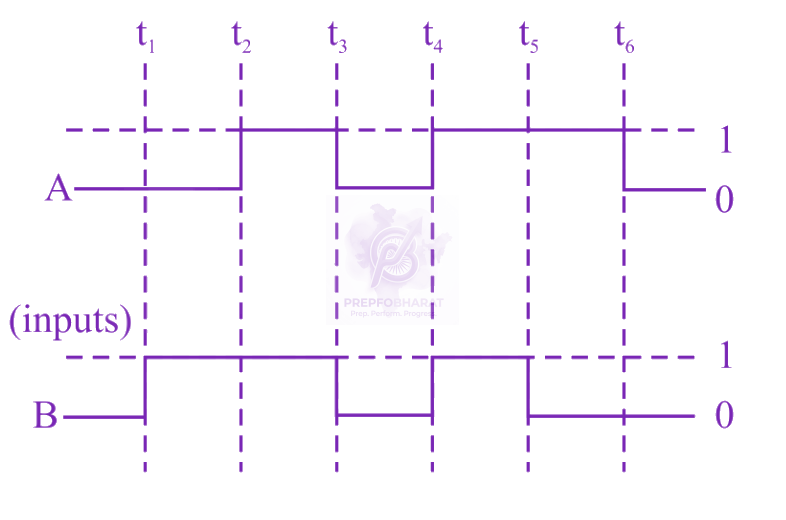
A small object at rest, absorbs a light pulse of power $20\mathrm{mW}$ and duration $300\mathrm{ns}$. Assuming speed of light as $3\times {10}^{8}m{s}^{-1}$. The momentum of the object becomes equal to :
A monochromatic light is incident on a hydrogen sample in ground state. Hydrogen atoms absorb a fraction of light and subsequently emit radiation of six different wavelengths. The frequency of incident light is $x\times {10}^{15}\mathrm{Hz}$. The value of x is ________ (Given $h=4.25\times {10}^{-15}\mathrm{eVs}$)
The output waveform of the given logical circuit for the following inputs $A$ and $B$ as shown below, is 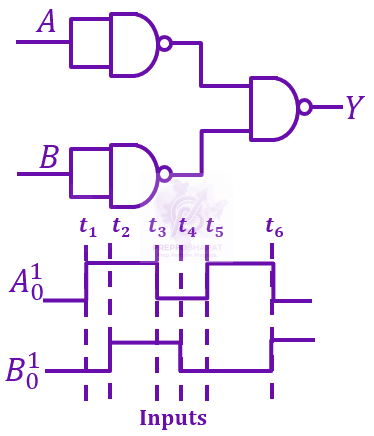
An electron of a hydrogen like atom, having $Z=4$, jumps from ${4}^{th}$ energy state to ${2}^{nd}$ energy state, The energy released in this process, will be: (Given $Rch=13.6eV$) Where $R=$ Rydberg constant $c=$Speed of light in vacuum $h=$ Planck's constant
The ratio of wavelength of spectral lines ${H}_{\alpha }$ and ${H}_{\beta }$ in the Balmer series is $\frac{x}{20}$. The value of $x$ is _____.
The de Broglie wavelength of an electron having kinetic energy $E$ is $\lambda$. If the kinetic energy of electron becomes $\frac{E}{4}$, then its de-Broglie wavelength will be:
The energy of ${\mathrm{He}}^{+}$ ion in its first state is, (The ground state energy for the Hydrogen atom$-13.6\mathrm{eV}$):
A proton and an $\alpha$-particle are accelerated from rest by $2V$ and $4V$ potentials, respectively. The ratio of their de-Broglie wavelength is :