Modern Physics PYQ — Page 8
JEE Main Physics — Modern Physics previous year questions with solutions.
All Modern Physics Questions (652)
The output $(Y)$ of logic circuit given below is 0 only when : 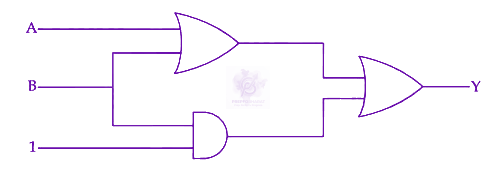
Which of the following circuits is reverse - biased ?
The ratio of the shortest wavelength of Balmer series to the shortest wavelength of Lyman series for hydrogen atom is :
A nucleus at rest disintegrates into two smaller nuclei with their masses in the ratio of $2: 1$. After disintegration they will move :
When UV light of wavelength $300 \mathrm{~nm}$ is incident on the metal surface having work function $2.13 \mathrm{eV}$, electron emission takes place. The stopping potential is: (Given hc $=1240 \mathrm{eV} \mathrm{nm}$ )
A hydrogen atom changes its state from $n=3$ to $n=2$. Due to recoil, the percentage change in the wave length of emitted light is approximately $1 \times 10^{-n}$. The value of $n$ is_____. [Given $\mathrm{Rhc}=13.6 \mathrm{eV}, \mathrm{hc}=1242 \mathrm{eV} \mathrm{nm}, \mathrm{h}=6.6 \times 10^{-34} \mathrm{~J} \mathrm{~s}$ mass of the hydrogenatom $=1.6 \times 10^{-27} \mathrm{~kg}$ ]
The shortest wavelength of the spectral lines in the Lyman series of hydrogen spectrum is $915 Ã…$. The longest wavelength of spectral lines in the Balmer series will be _____ $Ã…$.
In an alpha particle scattering experiment distance of closest approach for the $\alpha$ particle is $4.5 \times 10^{-14} \mathrm{~m}$. If target nucleus has atomic number 80 , then maximum velocity of $\alpha$ - particle is _______ $\times 10^5 \mathrm{~m} / \mathrm{s}$ approximately. $\left(\frac{1}{4 \pi \epsilon_0}=9 \times 10^9\right.$ SI unit, mass of $\alpha$ particle $\left.=6.72 \times 10^{-27} \mathrm{~kg}\right)$
The longest wavelength associated with Paschen series is : (Given $\mathrm{R}_{\mathrm{H}}=1.097 \times 10^7 \mathrm{SI}$ unit)
When a metal surface is illuminated by light of wavelength $\lambda$, the stopping potential is $8V$. When the same surface is illuminated by light of wavelength $3\lambda$, stopping potential is $2V$. The threshold wavelength for this surface is :
Monochromatic light of frequency $6\times {10}^{14}\mathrm{Hz}$ is produced by a laser. The power emitted is $2\times {10}^{-3}W.$ How many photons per second on an average, are emitted by the source? (Given $h=6.63\times {10}^{-34}Js$)
For the photoelectric effect, the maximum kinetic energy $({E}_{k})$ of the photoelectrons is plotted against the frequency $(v)$ of the incident photons as shown in figure. The slope of the graph gives 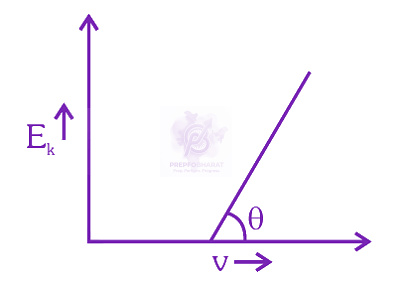
The ratio of the magnitude of the kinetic energy to the potential energy of an electron in the ${5}^{\text{th }}$ excited state of a hydrogen atom is :
From the statements given below : (A) The angular momentum of an electron in ${n}^{th}$ orbit is an integral multiple of $h$. (B) Nuclear forces do not obey inverse square law. (C) Nuclear forces are spin dependent. (D) Nuclear forces are central and charge independent. (E) Stability of nucleus is inversely proportional to the value of packing fraction. Choose the correct answer from the options given below :
A Zener diode of breakdown voltage $10V$ is used as a voltage regulator as shown in the figure. The current through the Zener diode is 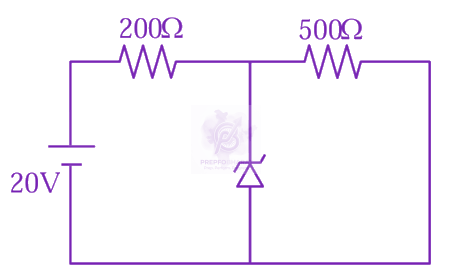
Which of the following statement is not true about stopping potential $\left(\mathrm{V}_0\right)$ ?
The $I-V$ characteristics of an electronic device shown in the figure. The device is: 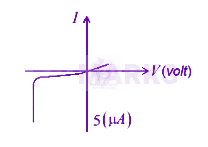
A proton, an electron and an alpha particle have the same energies. Their de-Broglie wavelengths will be compared as :
Given below are two statements : 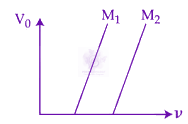 Statement I : Figure shows the variation of stopping potential with frequency $(v)$ for the two photosensitive materials $\mathrm{M}_1$ and $\mathrm{M}_2$. The slope gives value of $\frac{\mathrm{h}}{\mathrm{e}}$, where $\mathrm{h}$ is Planck's constant, $\mathrm{e}$ is the charge of electron. Statement II : $\mathrm{M}_2$ will emit photoelectrons of greater kinetic energy for the incident radiation having same frequency. In the light of the above statements, choose the most appropriate answer from the options given below.
A light emitting diode (LED) is fabricated using GaAs semiconducting material whose band gap is $1.42 \mathrm{eV}$. The wavelength of light emitted from the LED is :
UV light of $4.13 \mathrm{eV}$ is incident on a photosensitive metal surface having work function $3.13 \mathrm{eV}$. The maximum kinetic energy of ejected photoelectrons will be:
Following gates section is connected in a complete suitable circuit. 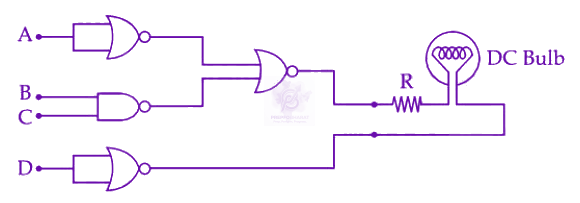 $\text { For which of the following combination, bulb will glow (ON) : }$
If $M_o$ is the mass of isotope ${ }_5^{12} B, M_P$ and $M_n$ are the masses of proton and neutron, then nuclear binding energy of isotope is :
The energy released in the fusion of $2 \mathrm{~kg}$ of hydrogen deep in the sun is $E_H$ and the energy released in the fission of $2 \mathrm{~kg}$ of ${ }^{235} \mathrm{U}$ is $E_U$. The ratio $\frac{E_H}{E_U}$ is approximately: (Consider the fusion reaction as $4 \mid H+2 \mathrm{e}^{-} \rightarrow{ }_2^4 \mathrm{He}+2 v+6 \gamma+26.7 \mathrm{MeV}$, energy released in the fission reaction of ${ }^{235} \mathrm{U}$ is $200 \mathrm{MeV}$ per fission nucleus and $\mathrm{N}_{\mathrm{A}}=$ $\left.6.023 \times 10^{23}\right)$