Modern Physics PYQ — Page 7
JEE Main Physics — Modern Physics previous year questions with solutions.
All Modern Physics Questions (652)
The mass number of nucleus having radius equal to half of the radius of nucleus with mass number $192$ is:
The mass defect in a particular reaction is $0.4g$. The amount of energy liberated is $n\times {10}^{7}\mathrm{kW}h$, where $n=$ _____. (speed of light $=3\times {10}^{8}m{s}^{-1}$)
The longest wavelength associated with Paschen series is : (Given $\mathrm{R}_{\mathrm{H}}=1.097 \times 10^7 \mathrm{SI}$ unit)
The explosive in a Hydrogen bomb is a mixture of $H21,H31$ and $\mathrm{Li}63$ in some condensed form. The chain reaction is given by $\mathrm{Li}63+n10\rightarrow \mathrm{He}42+H31$; $H21+H31\rightarrow \mathrm{He}42+n10$ During the explosion the energy released is approximately [Given : $M(\mathrm{Li})=6.01690\mathrm{amu},M(H21)=2.01471\mathrm{amu},M(\mathrm{He}42)=4.00388\mathrm{amu}$ and $1\mathrm{amu}=931.5\mathrm{MeV}$]
The energy released in the fusion of $2 \mathrm{~kg}$ of hydrogen deep in the sun is $E_H$ and the energy released in the fission of $2 \mathrm{~kg}$ of ${ }^{235} \mathrm{U}$ is $E_U$. The ratio $\frac{E_H}{E_U}$ is approximately: (Consider the fusion reaction as $4 \mid H+2 \mathrm{e}^{-} \rightarrow{ }_2^4 \mathrm{He}+2 v+6 \gamma+26.7 \mathrm{MeV}$, energy released in the fission reaction of ${ }^{235} \mathrm{U}$ is $200 \mathrm{MeV}$ per fission nucleus and $\mathrm{N}_{\mathrm{A}}=$ $\left.6.023 \times 10^{23}\right)$
The energy equivalent of $1 \mathrm{~g}$ of substance is :
The disintegration energy $Q$ for the nuclear fission of ${ }^{235} \mathrm{U} \rightarrow{ }^{140} \mathrm{Ce}+{ }^{94} \mathrm{Zr}+n$ is ______ $\mathrm{MeV}$. Given atomic masses of ${ }^{235} \mathrm{U}: 235.0439 u ;{ }^{140} \mathrm{Ce}: 139.9054 u$, ${ }^{94} \mathrm{Zr}: 93.9063 u ; n: 1.0086 u \text {, }$ Value of $c^2=931 \mathrm{MeV} / \mathrm{u}$
The de Broglie wavelengths of a proton and an $\alpha$ particle are $\lambda$ and $2\lambda$ respectively. The ratio of the velocities of proton and $\alpha$ particle will be :
The de-Broglie wavelength of an electron is the same as that of a photon. If velocity of electron is $25%$ of the velocity of light, then the ratio of K.E. of electron and K.E. of photon will be:
The correct truth table for the following logic circuit is : 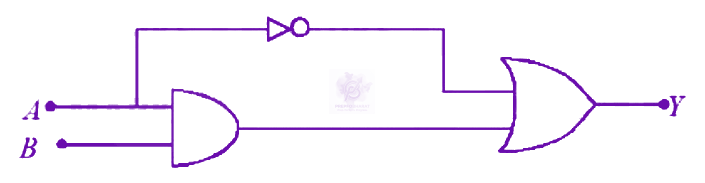
The $I-V$ characteristics of an electronic device shown in the figure. The device is: 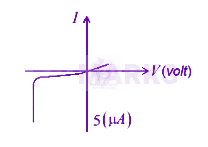
The atomic mass of $C126$ is $12.000000u$ and that of $C136$ is $13.003354u$. The required energy to remove a neutron from $C136$, if mass of neutron is $1.008665u$, will be:
The angular momentum of an electron in a hydrogen atom is proportional to : (Where $r$ is the radius of orbit of electron)
The acceptor level of a p-type semiconductor is $6 \mathrm{eV}$. The maximum wavelength of light which can create a hole would be : Given $\mathrm{hc}=1242 \mathrm{eV} \mathrm{nm}$.
Radius of a certain orbit of hydrogen atom is $8.48 Ã…$. If energy of electron in this orbit is $E / x$. then $x=$ _____ (Given $\mathrm{a}_0=0.529 Ã…, E=$ energy of electron in ground state).
Monochromatic light of frequency $6\times {10}^{14}\mathrm{Hz}$ is produced by a laser. The power emitted is $2\times {10}^{-3}W.$ How many photons per second on an average, are emitted by the source? (Given $h=6.63\times {10}^{-34}Js$)
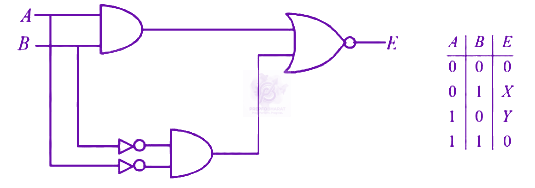 In the truth table of the above circuit the value of $\mathrm{X}$ and $\mathrm{Y}$ are :
In the given circuit, the voltage across load resistance $({R}_{L})$ is: 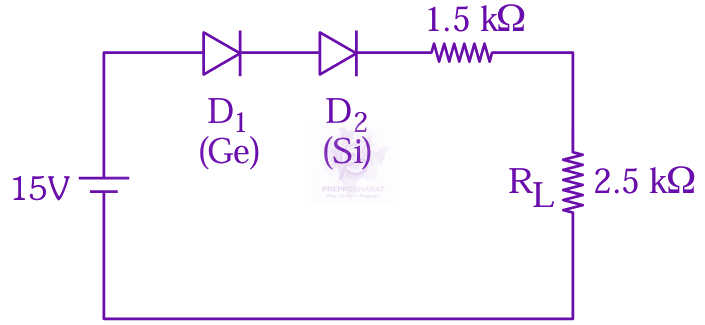
In the given circuit, the breakdown voltage of the Zener diode is $3.0V$. What is the value of ${I}_{z}$ ? 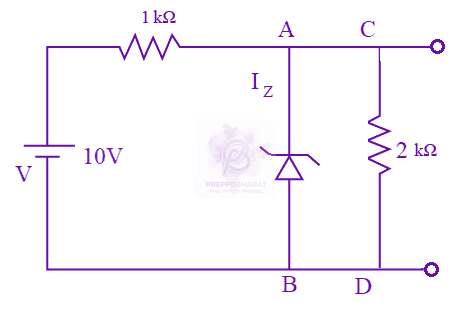
In the given circuit if the power rating of Zener diode is $10\mathrm{mW}$, the value of series resistance ${R}_{s}$ to regulate the input unregulated supply is: 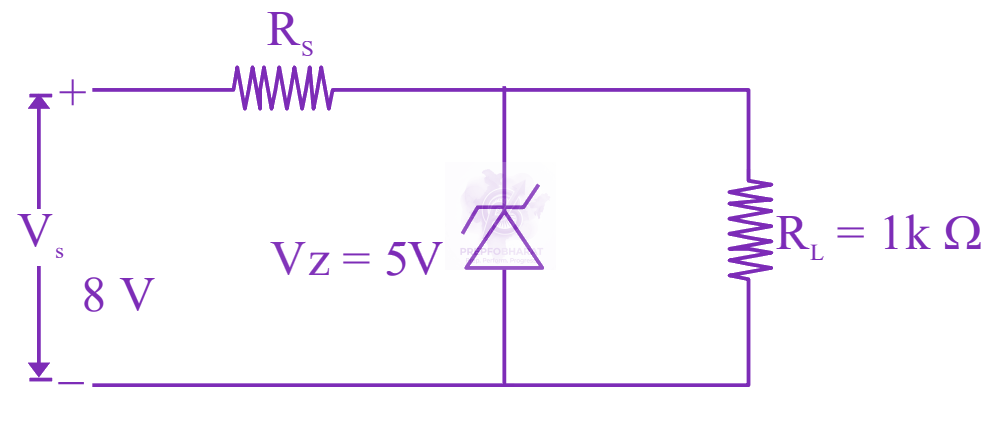
In photoelectric experiment energy of $2.48 \mathrm{eV}$ irradiates a photo sensitive material. The stopping potential was measured to be $0.5 \mathrm{~V}$. Work function of the photo sensitive material is :
In Franck-Hertz experiment, the first dip in the current-voltage graph for hydrogen is observed at 10.2 V. The wavelength of light emitted by hydrogen atom when excited to the first excitation level is _________ $\mathrm{nm}$. (Given $\mathrm{hc}=1245 \mathrm{eV} \mathrm{nm}, \mathrm{e}=1.6 \times 10^{-19} \mathrm{C}$ ).
In an alpha particle scattering experiment distance of closest approach for the $\alpha$ particle is $4.5 \times 10^{-14} \mathrm{~m}$. If target nucleus has atomic number 80 , then maximum velocity of $\alpha$ - particle is _______ $\times 10^5 \mathrm{~m} / \mathrm{s}$ approximately. $\left(\frac{1}{4 \pi \epsilon_0}=9 \times 10^9\right.$ SI unit, mass of $\alpha$ particle $\left.=6.72 \times 10^{-27} \mathrm{~kg}\right)$
In a photoelectric effect experiment a light of frequency $1.5$ times the threshold frequency is made to fall on the surface of photosensitive material. Now if the frequency is halved and intensity is doubled, the number of photo electrons emitted will be: