Modern Physics PYQ — Page 6
JEE Main Physics — Modern Physics previous year questions with solutions.
All Modern Physics Questions (652)
Given below are two statements: Statement I: Most of the mass of the atom and all its positive charge are concentrated in a tiny nucleus and the electrons revolve around it, is Rutherford's model. Statement II: An atom is a spherical cloud of positive charges with electrons embedded in it, is a special case of Rutherford's model. In the light of the above statements, choose the most appropriate from the options given below.
If the total energy transferred to a surface in time $t$ is $6.48\times {10}^{5}J$, then the magnitude of the total momentum delivered to this surface for complete absorption will be :
The radius of a nucleus of mass number $64$ is $4.8$ fermi. Then the mass number of another nucleus having radius of $4$ fermi is $\frac{1000}{x},$ where $x$ is _________.
In photoelectric experiment energy of $2.48 \mathrm{eV}$ irradiates a photo sensitive material. The stopping potential was measured to be $0.5 \mathrm{~V}$. Work function of the photo sensitive material is :
A proton and an electron are associated with same de-Broglie wavelength. The ratio of their kinetic energies is: (Assume h=6.63 $\times 10^{-34} \mathrm{~J} \mathrm{~s}, \mathrm{~m}_{\mathrm{e}}=9.0 \times 10^{-31} \mathrm{~kg}$ and $\mathrm{m}_{\mathrm{p}}=1836$ times $\mathrm{m}_{\mathrm{e}}$ )
Which of the following phenomena does not explain by wave nature of light. A. reflection B. diffraction C. photoelectric effect D. interference E. polarization Choose the most appropriate answer from the options given below:
In Franck-Hertz experiment, the first dip in the current-voltage graph for hydrogen is observed at 10.2 V. The wavelength of light emitted by hydrogen atom when excited to the first excitation level is _________ $\mathrm{nm}$. (Given $\mathrm{hc}=1245 \mathrm{eV} \mathrm{nm}, \mathrm{e}=1.6 \times 10^{-19} \mathrm{C}$ ).
The energy equivalent of $1 \mathrm{~g}$ of substance is :
In the given circuit, the voltage across load resistance $({R}_{L})$ is: 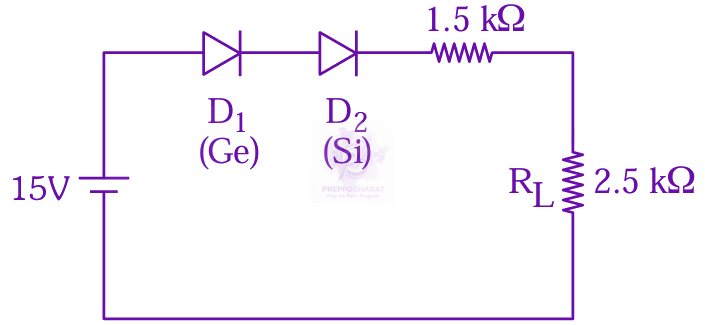
Which figure shows the correct variation of applied potential difference (V) with photoelectric current (I) at two different intensities of light $\left(\mathrm{I}_1 < \mathrm{I}_2\right)$ of same wavelengths :
Identify the logic gate given in the circuit: 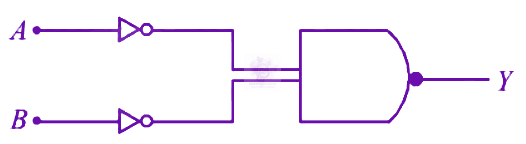
The disintegration energy $Q$ for the nuclear fission of ${ }^{235} \mathrm{U} \rightarrow{ }^{140} \mathrm{Ce}+{ }^{94} \mathrm{Zr}+n$ is ______ $\mathrm{MeV}$. Given atomic masses of ${ }^{235} \mathrm{U}: 235.0439 u ;{ }^{140} \mathrm{Ce}: 139.9054 u$, ${ }^{94} \mathrm{Zr}: 93.9063 u ; n: 1.0086 u \text {, }$ Value of $c^2=931 \mathrm{MeV} / \mathrm{u}$
A potential divider circuit is connected with a dc source of $20 \mathrm{~V}$, a light emitting diode of glow in voltage $1.8 \mathrm{~V}$ and a zener diode of breakdown voltage of $3.2 \mathrm{~V}$. The length (PR) of the resistive wire is $20 \mathrm{~cm}$. The minimum length of PQ to just glow the LED is _____$\mathrm{cm}$ 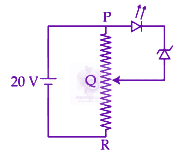
The correct truth table for the following logic circuit is : 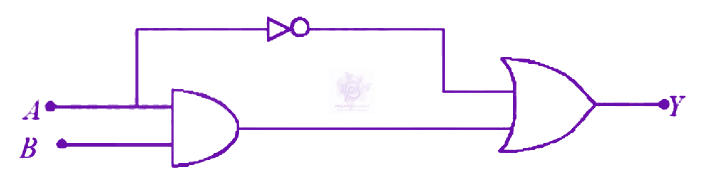
A nucleus has mass number ${A}_{1}$ and volume ${V}_{1}$. Another nucleus has mass number ${A}_{2}$ and volume ${V}_{2}$. If relation between mass number is ${A}_{2}=4{A}_{1}$, then $\frac{{V}_{2}}{{V}_{1}}=$ _______.
A star has $100 \%$ helium composition. It starts to convert three ${ }^4 \mathrm{He}$ into one ${ }^{12} \mathrm{C}$ via triple alpha process as ${ }^4 \mathrm{He}+{ }^4 \mathrm{He}+{ }^4 \mathrm{He} \rightarrow{ }^{12} \mathrm{C}+\mathrm{Q}$. The mass of the star is $2.0 \times 10^{32} \mathrm{~kg}$ and it generates energy at the rate of $5.808 \times 10^{30} \mathrm{~W}$. The rate of converting these ${ }^4 \mathrm{He}$ to ${ }^{12} \mathrm{C}$ is $\mathrm{n} \times 10^{42} \mathrm{~s}^{-1}$, where $\mathrm{n}$ is _________ [ Take, mass of ${ }^4 \mathrm{He}=4.0026 \mathrm{u}$, mass of ${ }^{12} \mathrm{C}=12 \mathrm{u}$ ]
Average force exerted on a non-reflecting surface at normal incidence is $2.4 \times 10^{-4} \mathrm{~N}$. If $360 \mathrm{~W} / \mathrm{cm}^2$ is the light energy flux during span of 1 hour 30 minutes, Then the area of the surface is:
If Rydberg's constant is $R$, the longest wavelength of radiation in Paschen series will be $\frac{\alpha }{7R}$, where $\alpha =$______.
Binding energy of a certain nucleus is $18 \times 10^8 \mathrm{~J}$. How much is the difference between total mass of all the nucleons and nuclear mass of the given nucleus:
Given below are two statements: one is labelled as Assertion $\mathbf{A}$ and the other is labelled as Reason R. Assertion A: Number of photons increases with increase in frequency of light. Reason R: Maximum kinetic energy of emitted electrons increases with the frequency of incident radiation. In the light of the above statements, choose the most appropriate answer from the options given below:
Radius of a certain orbit of hydrogen atom is $8.48 Ã…$. If energy of electron in this orbit is $E / x$. then $x=$ _____ (Given $\mathrm{a}_0=0.529 Ã…, E=$ energy of electron in ground state).
The de Broglie wavelengths of a proton and an $\alpha$ particle are $\lambda$ and $2\lambda$ respectively. The ratio of the velocities of proton and $\alpha$ particle will be :
In a nuclear fission process, a high mass nuclide $(A\approx 236)$ with binding energy $7.6\mathrm{MeV}/$Nucleon dissociated into two middle mass nuclides $(A\approx 118)$, having binding energy of $8.6\mathrm{MeV}/$Nucleon. The energy released in the process would be _______ $\mathrm{MeV}$.
Hydrogen atom is bombarded with electrons accelerated through a potential different of $V$, which causes excitation of hydrogen atoms. If the experiment is being formed at $T=0K$. The minimum potential difference needed to observe any Balmer series lines in the emission spectra will be $\frac{\alpha }{10}V$, where $\alpha =$_________.(Write the value to the nearest integer)