Mechanics PYQ — Page 80
JEE Main Physics — Mechanics previous year questions with solutions.
All Mechanics Questions (2069)
A large number of droplets, each of radius, $r$ coalesce to form a bigger drop of radius, $R$. An engineer designs a machine so that the energy released in this process is converted into the kinetic energy of the drop. Velocity of the drop is ( $T=$ surface tension, $\rho=$ density)
A thin liquid film formed between a U-shaped wire and a light slider supports a weight of $1.5 \times 10^{-2} \mathrm{~N}$ (see figure). The length of the slider is $30 \mathrm{~cm}$ and its weight negligible. The surface tension of the liquid film is 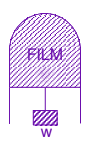
The force $\vec{F}=F \hat{i}$ on a particle of mass $2 \mathrm{~kg}$, moving along the $x$-axis is given in the figure as a function of its position $x$. The particle is moving with a velocity of $5 \mathrm{~m} / \mathrm{s}$ along the $x$-axis at $x=0$. What is the kinetic energy of the particle at $x=8 \mathrm{~m} ?$ 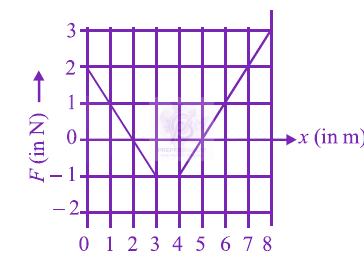
The electrical resistance $R$ of a conductor of length $l$ and area of cross section $a$ is given by $R=\frac{\rho l}{a}$ where ' $\rho$ ' is the electrical resistivity. What is the dimensional formula for electrical conductivity ' $\sigma$ ' which is reciprocal of resistivity?
A solid sphere having mass $m$ and radius $r$ rolls down an inclined plane. Then its kinetic energy is
A screw gauge gives the following reading when used to measure the diameter of a wire. Main scale reading : $0 \mathrm{~mm}$ Circular scale reading : 52 divisions Given that $1 \mathrm{~mm}$ on main scale corresponds to 100 divisions of the circular scale. The diameter of wire from the above date is :
A water fountain on the ground sprinkles water all around it. If the speed of water coming out of the fountain is $\mathrm{v}$, the total area around the fountain that gets wet is :
An object, moving with a speed of $6.25 \mathrm{~m} / \mathrm{s}$, is decelerated at a rate given by : $$ \frac{\mathrm{dv}}{\mathrm{dt}}=-2.5 \sqrt{\mathrm{v}} $$ where $v$ is the instantaneous speed. The time taken by the object, to come to rest, would be:
Two bodies of masses $\mathrm{m}$ and $4 \mathrm{~m}$ are placed at a distance $\mathrm{r}$. The gravitational potential at a point on the line joining them where the gravitational field is zero is:
If a wire is stretched to make it $0.1 \%$ longer, its resistance will :
A mass $\mathrm{m}$ hangs with the help of a string wrapped around a pulley on a frictionless bearing. The pulley has mass $\mathrm{m}$ and radius $\mathrm{R}$. Assuming pulley to be a perfect uniform circular disc, the acceleration of the mass $m$, if the string does not slip on the pulley, is
Work done in increasing the size of a soap bubble from a radius of $3 \mathrm{~cm}$ to $5 \mathrm{~cm}$ is nearly (Surface tension of soap solution $=0.03 \mathrm{Nm}^{-1}$ ):
A pulley of radius $2 \mathrm{~m}$ is rotated about its axis by a force $\mathrm{F}=\left(20 \mathrm{t}-5 \mathrm{t}^2\right)$ Newton (where $\mathrm{t}$ is measured in seconds) applied tangentially. If the moment of inertia of the pulley about its axis of rotation made by the pulley before its direction of motion if reversed, is :
A thin horizontal circular disc is rotating about a vertical axis passing through its centre. An insect is at rest at a point near the rim of the disc. The insect now moves along a diameter of the disc to reach its other end. During the journey of the insect, the angular speed of the disc:
Water is flowing continuously from a tap having an internal diameter $8 \times 10^{-3} \mathrm{~m}$. The water velocity as it leaves the tap is $0.4 \mathrm{~ms}^{-1}$. The diameter of the water stream at a distance $2 \times 10^{-1} \mathrm{~m}$ below the lap is close to :
A point $\mathrm{P}$ moves in counter-clockwise direction on a circular path as shown in the figure. The movement of ' $\mathrm{P}$ ' is such that it sweeps out a length $s=t^3+5$, where $s$ is in metres and $t$ is in seconds. The radius of the path is $20 \mathrm{~m}$. The acceleration of ' $\mathrm{P}$ ' when $t=2 \mathrm{~s}$ is nearly 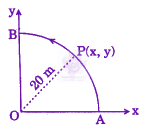
The potential energy function for the force between two atoms in a diatomic molecule is approximately given by $U(x)=\frac{a}{x^{12}}-\frac{b}{x^6}$, where a and $b$ are constants and $x$ is the distance between the atoms. If the dissociation energy of the molecule is $D=\left[U(x=\infty)-U_{\text {at equilbrium }}\right], D$ is
A ball is made of a material of density $\rho$ where $\rho_{\text {oil }} < \rho < \rho_{\text {water }}$ with $\rho_{\text {oil }}$ and $\rho_{\text {water }}$ representing the densities of oil and water, respectively. The oil and water are immiscible. If the above ball is in equilibrium in a mixture of this oil and water, which of the following pictures represents its equilibrium position?
Two fixed frictionless inclined plane making an angle $30^{\circ}$ and $60^{\circ}$ with the vertical are shown in the figure. Two block $A$ and $B$ are placed on the two planes. What is the relative vertical acceleration of $A$ with respect to $B$ ? 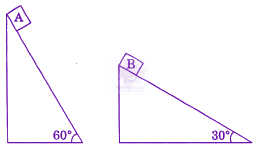
For a particle in uniform circular motion the acceleration $\vec{a}$ at a point $P(R, \theta)$ on the circle of radius $\mathrm{R}$ is (here $\theta$ is measured from the $x$-axis)
A particle is moving with velocity $\overrightarrow{\mathrm{v}}=\mathrm{K}(\mathrm{y} \hat{\mathrm{i}}+\mathrm{x} \hat{\mathrm{j}})$, where $\mathrm{K}$ is a constant. The general equation for its path is
Statement-1 : Two particles moving in the same direction do not lose all their energy in a completely inelastic collision. Statement-2 : Principle of conservation of momentum holds true for all kinds of collisions. Of the four choices given after the statements, choose the one that best describes the two statements. Of the four choices given after the statements, choose the one that best describes the two statements.
The respective number of significant figures for the numbers $23.023,0.0003$ and $2.1 \times 10^{-3}$ are
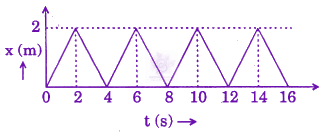
The figure shows the position - time $(x-t)$ graph of one-dimensional motion of a body of mass $0.4 \mathrm{~kg}$. The magnitude of each impulse is