Mechanics PYQ — Page 81
JEE Main Physics — Mechanics previous year questions with solutions.
All Mechanics Questions (2069)
A small particle of mass $m$ is projected at an angle $\theta$ with the $\mathrm{x}$-axis with an initial velocity $\mathrm{v}_0$ in the $\mathrm{x}-\mathrm{y}$ plane as shown in the figure. At a time $t < \frac{v_0 \sin \theta}{g}$, the angular momentum of the particle is where $\hat{\mathrm{i}}, \hat{\mathrm{j}}$ and $\hat{\mathrm{k}}$ are unit vectors along $\mathrm{x}, \mathrm{y}$ and $\mathrm{z}$-axis respectively.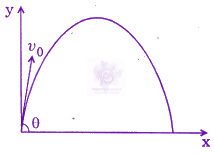
A thin uniform rod of length $\ell$ and mass $m$ is swinging freely about a horizontal axis passing through its end. Its maximum angular speed is $\omega$. Its centre of mass rises to a maximum height of
Consider a rubber ball freely falling from a height $h=4.9 \mathrm{~m}$ onto a horizontal elastic plate. Assume that the duration of collision is negligible and the collision with the plate is totally elastic. Then the velocity as a function of time the height as function of time will be
In an experiment the angles are required to be measured using an instrument. 29 divisions of the main scale exactly coincide with the 30 divisions of the vernier scale. If the smallest division of the main scale is half-a-degree $\left(=0.5^{\circ}\right)$, then the least count of the instrument is
Two wires are made of the same material and have the same volume. However wire 1 has crosssectional area $A$ and wire-2 has cross-sectional area $3 A$. If the length of wire 1 increases by $\Delta x$ on applying force $F$, how much force is needed to stretch wire 2 by the same amount?
A particle has an initial velocity $3 \hat{i}+4 \hat{j}$ and an acceleration of $0.4 \hat{i}+0.3 \hat{j}$. Its speed after 10 s is
The height at which the acceleration due to gravity becomes $\frac{\mathrm{g}}{9}$ (where $\mathrm{g}=$ the acceleration due to gravity on the surface of the earth) in terms of $R$, the radius of the earth is
A body is at rest at $x=0$. At $t=0$, it starts moving in the positive $x$-direction with a constant acceleration. At the same instant another body passes through $x=0$ moving in the positive $x$ direction with a constant speed. The position of the first body is given by $\mathrm{x}_1(\mathrm{t})$ after time ' $\mathrm{t}$ ' and that of the second body by $x_2(t)$ after the same time interval. Which of the following graphs correctly describes $\left(x_1-x_2\right)$ as a function of time ' $t$ '?
Two full turns of the circular scale of a screw gauge cover a distance of $1 \mathrm{~mm}$ on its main scale. The total number of divisions on the circular scale is 50 . Further, it is found that the screw gauge has a zero error of $-0.03 \mathrm{~mm}$ while measuring the diameter of a thin wire, a student notes the main scale reading of $3 \mathrm{~mm}$ and the number of circular scale divisions in line with the main scale as 35 . The diameter of the wire is
A thin rod of length ' $L$ ' is lying along the $x$-axis with its ends at $x=0$ and $x=L$. Its linear density (mass/length) varies with $x$ ask $\left(\frac{x}{L}\right)^n$, where $n$ can be zero or any positive number. If the position $x_{\mathrm{CM}}$ of the centre of mass of the rod is plotted against ' $n$ ', which of the following graphs best approximates the dependence of $x_{\mathrm{CM}}$ on $n$ ?
A block of mass $0.50 \mathrm{~kg}$ is moving with a speed of $2.00 \mathrm{~m} / \mathrm{s}$ on a smooth surface. It strikes another mass of $1.00 \mathrm{~kg}$ and then they move together as a single body. The energy loss during the collision is
Consider a uniform square plate of side ' $a$ ' and mass ' $m$ '. The moment of inertia of this plate about an axis perpendicular to its plane and passing through one of its corners is
A spherical solid ball of volume $V$ is made of a material of density $\rho_1$. It is falling through a liquid of density $\rho_2\left(\rho_2 < \rho_1\right)$. Assume that the liquid applies a viscous force on the ball that is proportional to the square of its speed v, i.e., $F_{\text {viscous }}=-k v^2(k>0)$. The terminal speed of the ball is
An athlete in the olympic games covers a distance of $100 \mathrm{~m}$ in $10 \mathrm{~s}$. His kinetic energy can be estimated to be in the range
A planet in a distant solar system is 10 times more massive than the earth and its radius is 10 times smaller. Given that the escape velocity from the earth is $11 \mathrm{kms}^{-1}$, the escape velocity from the surface of the planet would be
Shown in the figure below is a meter-bridge set up with null deflection in the galvanometer. 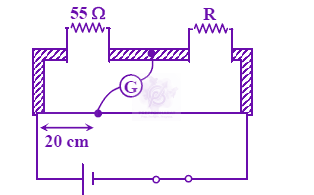 The value of the unknown resistor $R$ is
A body of mass $m=3.513 \mathrm{~kg}$ is moving along the $x$-axis with a speed of $5.00 \mathrm{~ms}^{-1}$. The magnitude of its momentum is recorded as
This question contains Statement $-1$ and Statement-2. Of the four choices given after the statements, choose the one that best describes the two statements. Statement - I: For a mass $M$ kept at the centre of a cube of side ' $a$ ', the flux of gravitational field passing through its sides is $4 \pi$ GM. and Statement - II If the direction of a field due to a point source is radial and its dependence on the distance ' $r$ ' for the source is given as $1 / r^2$, its flux through a closed surface depends only on the strength of the source enclosed by the surface and not on the size or shape of the surface
A capillary tube $(\mathrm{A})$ is dropped in water. Another identical tube $(\mathrm{B})$ is dipped in a soap water solution. Which of the following shows the relative nature of the liquid columns in the two tubes? 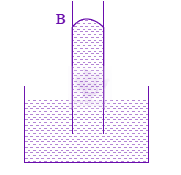
A jar filled with two non mixing liquids 1 and 2 having densities $\rho_1$ and $\rho_2$ respectively. A solid ball, made of a material of density $\rho_3$, is dropped in the jar. It comes to equilibrium in the position shown in the figure. Which of the following is true for $\rho_1, \rho_2$ and $\rho_3$ ? 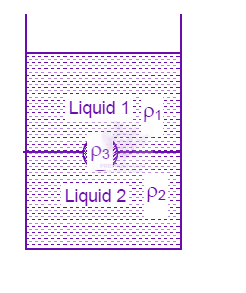
The dimension of magnetic field in $\mathrm{M}, \mathrm{L}, \mathrm{T}$ and $\mathrm{C}$ (Coulomb) is given as
For the given uniform square lamina $\mathrm{A B C D}$, whose centre is $\mathrm{O}$, 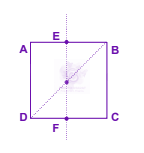
A circular disc of radius $\mathrm{R}$ is removed from a bigger circular disc of radius $\mathrm{2R}$ such that the circumferences of the discs coincide. The centre of mass of the new disc is $\mathrm{\alpha / R}$ from the centre of the bigger disc. The value of $\mathrm{\alpha}$ is
A round uniform body of radius $\mathrm{R}$, mass $\mathrm{M}$ and moment of inertia '$\mathrm{I}$', rolls down (without slipping) an inclined plane making an angle $\theta$ with the horizontal. Then its acceleration is