Mechanics PYQ — Page 72
JEE Main Physics — Mechanics previous year questions with solutions.
All Mechanics Questions (2069)
A physical quantity $P$ is described by the relation $P={a}^{\frac{1}{2}} {b}^{2} {c}^{3}{d}^{-4}$. If the relative errors in the measurement of $a$, $b$, $c$ and $d$ respectively, are $2%$, $1%$, $3%$ and $5%$. Then the relative error in $P$ will be:
A car is standing $200 m$ behind a bus, which is also at rest. The two start moving at the same instant but with different forward accelerations. The bus has acceleration $2m{s}^{-2}$ and the car has acceleration $4 m{s}^{-2}$ . The car will catch up with the bus after time :
The following observations were taken for determining surface tension $T$ of water by capillary method: diameter of capillary, $D=1.25\times {10}^{-2}m$ rise of water, $h=1.45\times {10}^{-2}m$ Using $g=9.80 m{s}^{-2}$ and the simplified relation $T=\frac{rhg}{2}\times {10}^{3}N{m}^{-1}$ the possible error in surface tension is closest to:
The mass density of a spherical body is given by $\rho (r)=\frac{k}{r}$ for $r\leq R$ and $\rho (r)=0$ for $r>R,$ where $r$ is the distance from the center. The correct graph that describes qualitatively the acceleration, $a$ of a test particle as a function of $r$ is:
A time dependent force $F=6t$ acts on a particle of mass $1\mathrm{kg}$. If the particle starts from the rest, the work done by the force during the first $1\mathrm{sec}$ will be:
A conical pendulum of length $l$ makes an angle $\theta =45^{\circ}$ with respect to $Z-$axis and moves in a circle in the $XY$ plane. The radius of the circle is $0.4m$ and its center is vertically below $O$. The speed of the pendulum, in its circular path, will be - $(Take g=10 m{s}^{-2})$ 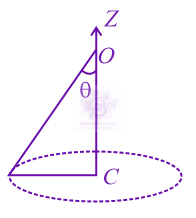
Two tubes of radii ${r}_{1}$ and ${r}_{2}$ and lengths ${l}_{1}$ and ${l}_{2,}$ respectively, are connected in series and a liquid flows through each of them in stream line conditions. ${P}_{1}$ and ${P}_{2}$ are pressure differences across the two tubes. If ${P}_{2}$ is $4{P}_{1}$ and ${l}_{2}$ is $\frac{ {l}_{1} }{ 4 }$ then the radius ${r}_{2}$ will be equal to :
Time $(T)$, velocity $(C)$ and angular momentum $(h)$ are chosen as fundamental quantities instead of mass, length and time. In terms of these, the dimensions of mass would be:
A body is thrown vertically upwards. Which one of the following graphs correctly represents the velocity$(v)$ vs time $(t)$?
A uniform disc of radius $R$ and mass $M$ is free to rotate only about its axis. A string is wrapped over its rim and a body of mass $m$ is tied to the free end of the string as shown in the figure. The body is released from rest. Then the acceleration of the body is: 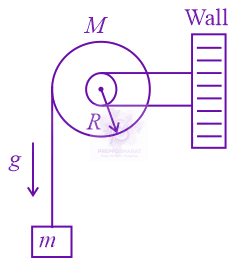
An object is dropped from a height $h$ from the ground. Every time it hits the ground it loses $50%$ of its kinetic energy. The total distance covered as $t\rightarrow \infty$ is:
A uniformly tapering conical wire is made from a material of Young's modulus $Y$ and has a normal, unextended length $L$. The radii, at the upper and lower ends of this conical wire, have values $R$ and $3R$, respectively. The upper end of the wire is fixed to a rigid support and a mass $M$ is suspended from its lower end. The equilibrium extended length, of this wire, would equal:
A roller is made by joining together two cones at their vertices O. It is kept on two rails AB and CD which are placed asymmetrically (see figure), with its axis perpendicular to CD and its centre O at the centre of line joining AB and CD (see figure). It is given a light push so that it starts rolling with its centre O moving parallel to CD in the direction shown. As it moves, the roller will tend to: 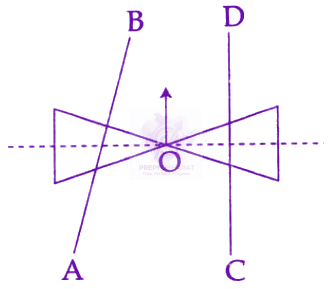
A cubical block of side $30\mathrm{cm}$ is moving with velocity $2m{s}^{-1}$ on a smooth horizontal surface. The surface has a bump at a point $O$ as shown in the figure. The angular velocity (in rad/s) of the block immediately after it hits the bump, is : 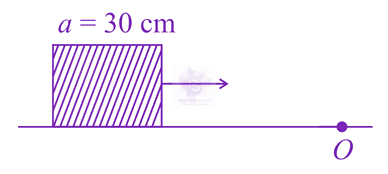
$A, B, C$, and $D$ are four different physical quantities having different dimensions. None of them is dimensionless. But we know that the equation $AD=C ln( BD )$ holds true. Then which of the combination is not a meaningful quantity?
Concrete mixture is made by mixing cement, stone and sand in a rotating cylindrical drum. If the drum rotates too fast, the ingredients remain stuck to the wall of the drum and proper mixing of ingredients does not take place. The maximum rotational speed of the drum in revolutions per minute (rpm) to ensure proper mixing is close to : (Take the radius of the drum to be 1.25 m and its axle to be horizontal) :
The velocity-time graph of a particle of mass $10\mathrm{kg}$ is shown in the figure. The net work done on the particle in the first two seconds of the motion is 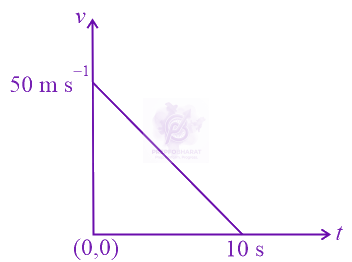
A satellite is revolving in a circular orbit at a height $h$ from the earth's surface (radius of earth $R$; $\text{h} \text{<<} \text{R}$ ). The minimum increase in its orbital velocity required, so that the satellite could escape from the earth's gravitational field, is close to (Neglect the effect of atmosphere.)
The figure shows an elliptical path $ABCD$ of a planet around the sun $S$ such that the area of triangle $CSA$ is $\frac{1}{4}$ the area of the ellipse. (see figure) with $DB$ as the major axis, and $CA$ as the minor axis. If ${t}_{1}$ is the time taken for the planet to go over path $ABC$ and ${t}_{2}$ for path taken over $CDA$ then: 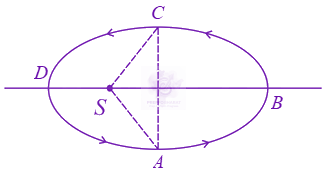
A particle of mass M is moving in a circle of fixed radius R in such a way that its centripetal acceleration at time t is given by ${n}^{2}R{t}^{2}$, where $n$ is a constant. The power delivered to the particle by the force acting on it, is :
A thin $1m$ long rod has a radius of $5\mathrm{mm}$. A force of $50{\text{π×10}}^{3}N$ is applied at one end to determine its Young's modulus. Assume that the force is exactly known. If the least count in the measurement of all lengths is $0.01\mathrm{mm}$, which of the following statements is false?
A particle of mass $m$ is acted upon by a force $F$ given by the empirical law $F=\frac{R}{{t}^{2}} v(t).$ If this law is to be tested experimentally by observing the motion starting from rest, the best way is to plot
A bottle has an opening of radius $a$ and length $b$. A cork of length $b$ and radius $(a+\Delta a)$ where $(\Delta a\ll a)$, is compressed to fit into the opening completely (see figure). If the bulk modulus of cork is $B$ and the coefficient of friction between the bottle and cork is $\mu$, then the force needed to push the cork into the bottle is 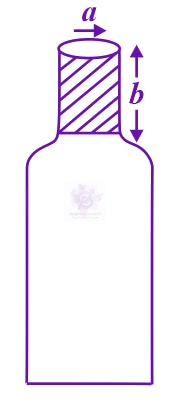
An astronaut of mass $m$ is working on a satellite orbiting the earth at a distance $h$ from the earth's surface. The radius of the earth is $R$, while its mass is $M$. The gravitational pull ${F}_{G}$ on the astronaut is