JEE Main Physics — Mechanics previous year questions with solutions.
A block of mass $M$ slides down on a rough inclined plane with constant velocity. The angle made by the incline plane with horizontal is $\theta$. The magnitude of the contact force will be :
In a Vernier Caliper $10$ divisions of Vernier scale is equal to the $9$ divisions of main scale. When both jaws of Vernier calipers touch each other, the zero of the Vernier scale is shifted to the left of zero of the main scale and ${4}^{\mathrm{th}}$ Vernier scale division exactly coincides with the main scale reading. One main scale division is equal to $1\mathrm{mm}$. While measuring diameter of a spherical body, the body is held between two jaws. It is now observed that zero of the Vernier scale lies between $30$ and $31$ divisions of main scale reading and ${6}^{\mathrm{th}}$ Vernier scale division exactly. coincides with the main scale reading. The diameter of the spherical body will be:
The position vector of $1\mathrm{kg}$ object is $\vec{r}=(3\hat{i}-\hat{j})m$ and its velocity $\vec{v}=(3\hat{j}+\hat{k})m{s}^{-1}$. The magnitude of its angular momentum is $\sqrt{x}Nms$, where $x$ is
Velocity $(v)$ and acceleration $(a)$ in two systems of units $1$ and $2$ are related as ${v}_{2}=\frac{n}{{m}^{2}}{v}_{1}$ and ${a}_{2}=\frac{{a}_{1}}{mn}$ respectively. Here $m$ and $n$ are constants. The relations for distance and time in two systems respectively are
A block of mass $2\mathrm{kg}$ moving on a horizontal surface with speed of $4{ms}^{-1}$ enters a rough surface ranging from $x=0.5m$ to $x=1.5m$. The retarding force in this range of rough surface is related to distance by $F=-kx$ where $k=12N{m}^{-1}$. The speed of the block as it just crosses the rough surface will be
A block of mass $40\mathrm{kg}$ slides over a surface, when a mass of $4\mathrm{kg}$ is suspended through an inextensible massless string passing over frictionless pulley as shown below. The coefficient of kinetic friction between the surface and block is $0.02$. The acceleration of block is: (Given $g=10{ms}^{-2}$.) 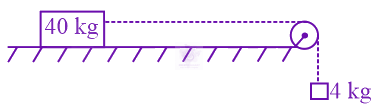
A block $A$ takes $2s$ to slide down a frictionless incline of $30^{\circ}$ and length $l$, kept inside a lift going up with uniform velocity $v$. If the incline is changed to $45^{\circ}$, the time taken by the block, to slide down the incline, will be approximately:
A water drop of radius $1\mathrm{cm}$ is broken into $729$ equal droplets. If surface tension of water is $75\mathrm{dyne}{\mathrm{cm}}^{-1}$, then the gain in surface energy upto first decimal place will be [Given $\pi =3.14$]
A wire of length $L$ is hanging from a fixed support. The length changes to ${L}_{1}$ and ${L}_{2}$ when masses $1\mathrm{kg}$ and $2\mathrm{kg}$ are suspended respectively from its free end. Then the value of $L$ is equal to
The torque of a force $5\hat{i}+3\hat{j}-7\hat{k}$ about the origin is $\tau$. If the force acts on a particle whose position vector is $2\hat{i}+2\hat{j}+\hat{k}$, then the value of $\tau$ will be
At time $t=0$ a particle starts travelling from a height $7\hat{z}\mathrm{cm}$ in a plane keeping $z$ coordinate constant. At any instant of time, it's position along the $x$ and $y$ directions are defined as $3t$ and $5{t}^{3}$ respectively. At $t=1s$ acceleration of the particle will be
A ball is released from a height $h$. If ${t}_{1}$ and ${t}_{2}$ be the time required to complete first half and second half of the distance respectively. Then, choose the correct relation between ${t}_{1}$ and ${t}_{2}$.
The dimension of mutual inductance is
A body of mass $8\mathrm{kg}$ and another of mass $2\mathrm{kg}$ are moving with equal kinetic energy. The ratio of their respective momenta will be
A bullet is shot vertically downwards with an initial velocity of $100m{s}^{-1}$ from a certain height. Within $10s$, the bullet reaches the ground and instantaneously comes to rest due to the perfectly inelastic collision. The velocity-time curve for total time $t=20s$ will be : (Take $g=10m{s}^{-2}$)
Two billiard balls of mass $0.05\mathrm{kg}$ each moving in opposite directions with $10{\mathrm{ms}}^{-1}$ collide and rebound with the same speed. If the time duration of contact is $t=0.005s$, then what is the force exerted on the ball due to each other?
An expression for a dimensionless quantity $P$ is given by $P=\frac{\alpha }{\beta }{\mathrm{log}}_{e}(\frac{kT}{\beta x})$; where $\alpha$ and $\beta$ are constants, $x$ is distance; $k$ is Boltzmann constant and $T$ is the temperature. Then the dimensions of $\alpha$ will be
Four identical discs each of mass '$M$' and diameter '$a$' are arranged in a small plane as shown in figure. If the moment of inertia of the system about $O{O}^{'}$ is $\frac{x}{4}M{a}^{2}$. Then, the value of $x$ will be _____ . 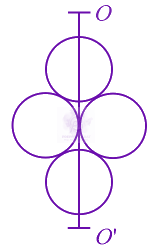
If $Z=\frac{{A}^{2}{B}^{3}}{{C}^{4}}$, then the relative error in $Z$ will be
For a free body diagram shown in the figure, the four forces are applied in the '$x$' and '$y$' directions. What additional force must be applied and at what angle with positive $x$-axis so that the net acceleration of body is zero? 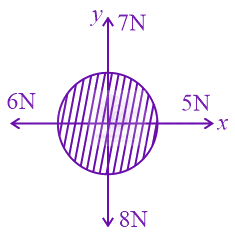
An ideal fluid of density $800\mathrm{kg}{m}^{-3}$, flows smoothly through a bent pipe (as shown in figure) that tapers in cross-sectional area from a to $\frac{a}{2}$. The pressure difference between the wide and narrow sections of pipe is $4100\mathrm{Pa}$. At wider section, the velocity of fluid is $\frac{\sqrt{x}}{6}{ms}^{-1}$ for $x=$_____ . (Given $g=10{ms}^{-2}$) 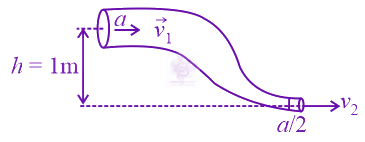
Given below are two statements. One is labelled as Assertion A and the other is labelled as Reason R. Assertion A: Two identical balls $A$ and $B$ thrown with same velocity '$u$' at two different angles with horizontal attained the same range $R$. If A and $B$ reached the maximum height ${h}_{1}$ and ${h}_{2}$ respectively, then $R=4\sqrt{{h}_{1}{h}_{2}}$ Reason R: Product of said heights. ${h}_{1}{h}_{2}=(\frac{{u}^{2}{\mathrm{sin}}^{2}\theta }{2g})\cdot (\frac{{u}^{2}{\mathrm{cos}}^{2}\theta }{2g})$
A body of mass $M$ at rest explodes into three pieces, in the ratio of masses $1:1:2$. Two smaller pieces fly off perpendicular to each other with velocities of $30{ms}^{-1}$ and $40{ms}^{-1}$ respectively. The velocity of the third piece will be
A water drop of diameter $2\mathrm{cm}$ is broken into $64$ equal droplets. The surface tension of water is $0.075N{m}^{-1}$. In this process the gain in surface energy will be