JEE Main Physics — Mechanics previous year questions with solutions.
If $L,C$ and $R$ are the self inductance, capacitance and resistance respectively, which of the following does not have the dimension of time?
As per the given figure, two blocks each of mass $250g$ are connected to a spring of spring constant $2N{m}^{-1}$. If both are given velocity $v$ in opposite directions, then maximum elongation of the spring is 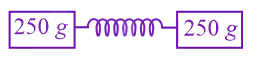
A person can throw a ball upto a maximum range of $100m$. How high above the ground he can throw the same ball?
A ball is projected from the ground with a speed $15{ms}^{-1}$ at an angle $\theta$ with horizontal so that its range and maximum height are equal, then $\mathrm{tan}\theta$ will be equal to
A body is projected from the ground at an angle of $45^{\circ}$ with the horizontal. Its velocity after $2s$ is $20{ms}^{-1}$. The maximum height reached by the body during its motion is _____ $m$. (use $g=10{ms}^{-2}$)
A metal wire of length $0.5m$ and cross-sectional area ${10}^{-4}{m}^{2}$ has breaking stress $5\times {10}^{8}N{m}^{-2}$. A block of $10\mathrm{kg}$ is attached at one end of the string and is rotating in a horizontal circle. The maximum linear velocity of block will be _____ $m{s}^{-1}$.
Given below are two statements: One is labelled as Assertion (A) and other is labelled as Reason (R) Assertion (A) : Time period of oscillation of a liquid drop depends on surface tension $(S)$, if density of the liquid is $\rho$ and radius of the drop is $r$, then $T=K\sqrt{\frac{\rho {r}^{3}}{{S}^{\frac{3}{2}}}}$ is dimensionally correct, where $K$ is dimensionless. Reason (R) : Using dimensional analysis we get R.H.S. having different dimension than that of time period. In the light of above statements, choose the correct answer from the options given below.
In two different experiments, an object of mass $5\mathrm{kg}$ moving with a speed of $25{\mathrm{ms}}^{-1}$ hits two different walls and comes to rest within (i) $3$ second, (ii) $5$ seconds, respectively. Choose the correct option out of the following :
A hanging mass $M$ is connected to a four times bigger mass by using a string pulley arrangement, as shown in the figure. The bigger mass is placed on a horizontal ice-slab and being pulled by $2\mathrm{Mg}$ force. In this situation, tension in the string is $\frac{x}{5}\mathrm{Mg}$ for $x=$_____. Neglect mass of the string and friction of the block (bigger mass) with ice slab. (Given $g=$ acceleration due to gravity) 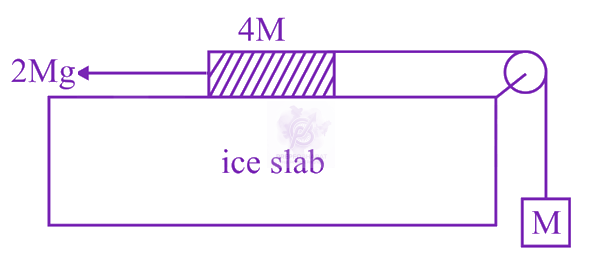
In an experiment to find out the diameter of wire using screw gauge, the following observation were noted: 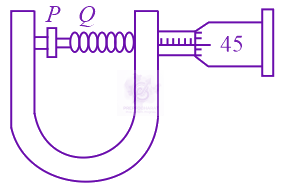 (a) Screw moves $0.5\mathrm{mm}$ on main scale in one complete rotation (b) Total divisions on circular scale $=50$ (c) Main scale reading is $2.5\mathrm{mm}$ (d) ${45}^{\mathrm{th}}$ division of circular scale is in the pitch line (e) Instrument has $0.03\mathrm{mm}$ negative error Then the diameter of wire is :
A ball of mass $m$ is thrown vertically upward. Another ball of mass $2m$ is thrown an angle $\theta$ with the vertical. Both the balls stay in air for the same period of time. The ratio of the heights attained by the two balls respectively is $\frac{1}{x}$. The value of $x$ is _____ .
A water drop of radius $1\mu m$ falls in a situation where the effect of buoyant force is negligible. Co-efficient of viscosity of air is $1.8\times {10}^{-5}Ns{m}^{-2}$ and its density is negligible as compared to that of water ${10}^{6}g{m}^{-3}$. Terminal velocity of the water drop is (Take acceleration due to gravity $=10{ms}^{-2}$)
Two satellites ${S}_{1}$ and ${S}_{2}$ are revolving in circular orbits around a planet with radius ${R}_{I}=3200\mathrm{km}$ and ${R}_{2}=800\mathrm{km}$ respectively. The ratio of speed of satellite ${S}_{1}$ to the speed of satellite ${S}_{2}$ in their respective orbits would be $\frac{1}{x}$ where $x=$
The distance of centre of mass from end $A$ of a one dimensional rod $(AB)$ having mass density $\rho ={\rho }_{0}(1-\frac{{x}^{2}}{{L}^{2}})\mathrm{kg}{m}^{-1}$ and length $L$ (in meter) is $\frac{3L}{\alpha }m$. The value of $\alpha$ is _____ (where $x$ is the distance form end $A$)
A pendulum of length $2m$ consists of a wooden bob of mass $50g$. A bullet of mass $75g$ is fired towards the stationary bob with a speed $v$. The bullet emerges out of the bob with a speed $\frac{v}{3}$ and the bob just completes the vertical circle. The value of $v$ is _____ $m{s}^{-1}$ (if $g=10m{s}^{-2}$).
In an experiment to find acceleration due to gravity $(g)$ using simple pendulum, time period of $0.5s$ is measured from time of $100$ oscillation with a watch of $1s$ resolution. If measured value of length is $10\mathrm{cm}$ known to $1\mathrm{mm}$ accuracy. The accuracy in the determination of $g$ is found to be $x%$. The value of $x$ is
When a ball is dropped into a lake from a height $4.9m$ above the water level, it hits the water with a velocity $v$ and then sinks to the bottom with the constant velocity $v$. It reaches the bottom of the lake $4.0s$ after it is dropped. The approximate depth of the lake is
If the radius of earth shrinks by $2%$ while its mass remains same. The acceleration due to gravity on the earth's surface will approximately
If momentum $[P]$, area $[A]$ and time $[T]$ are taken as fundamental quantities, then the dimensional formula for coefficient of viscosity is
The force required to stretch a wire of cross-section $1{\mathrm{cm}}^{2}$ to double its length will be : (Given Yong's modulus of the wire $=2\times {10}^{11}N{m}^{-2}$)
Which of the following physical quantities have the same dimensions?
A square aluminium (shear modulus is $25\times {10}^{9}{\mathrm{Nm}}^{-2}$) slab of side $60\mathrm{cm}$ and thickness $15\mathrm{cm}$ is subjected to a shearing force (on its narrow face) of $18.0\times {10}^{4}N$. The lower edge is riveted to the floor. The displacement of the upper edge is _____ $\mu m$.
In van dar Wall equation $[P+\frac{a}{{V}^{2}}][V-b]=RT;P$ is pressure, $V$ is volume, $R$ is universal gas constant and $T$ is temperature. The ratio of constants $\frac{a}{b}$ is dimensionally equal to :
A disc of mass $1\mathrm{kg}$ and radius $R$ is free of rotate about a horizontal axis passing through its centre and perpendicular to the plane of disc. A body of same mass as that of disc is fixed at the highest point of the disc. Now the system is released, when the body comes to the lowest position, its angular speed will be $4\sqrt{\frac{x}{3R}}\mathrm{rad}{s}^{-1}$ where $x=$ _____ .