JEE Main Physics — Mechanics previous year questions with solutions.
A space ship of mass $2\times {10}^{4}\mathrm{kg}$ is launched into a circular orbit close to the earth surface. The additional velocity to be imparted to the space ship in the orbit to overcome the gravitational pull will be (if $g=10m{s}^{-2}$ and radius of earth $=6400\mathrm{km}$ ):
Eight equal drops of water are falling through air with a steady speed of $10\mathrm{cm}{s}^{-1}$. If the drops coalesce, the new velocity is:-
A hydraulic automobile lift is designed to lift vehicles of mass $5000\mathrm{kg}$. The area of cross section of the cylinder carrying load is $250{\mathrm{cm}}^{2}$. The maximum pressure the smaller piston would have to bear is [Assume $g=10m{s}^{-2}$]
Match List I with List II : <table class="pyq-table"><tbody><tr><td></td><td>List-I (Physical Quantity)</td><td></td><td>List-II (Dimensional Formula)</td></tr><tr><td>A</td><td>Pressure gradient</td><td>I</td><td>$[{M}^{0}{L}^{2}{T}^{-2}]$</td></tr><tr><td>B</td><td>Energy density</td><td>II</td><td>$[{M}^{1}{L}^{-1}{T}^{-2}]$</td></tr><tr><td>C</td><td>Electric Field</td><td>III</td><td>$[{M}^{1}{L}^{-2}{T}^{-2}]$</td></tr><tr><td>D</td><td>Latent heat</td><td>IV</td><td>$[{M}^{1}{L}^{1}{T}^{-3}{A}^{-1}]$</td></tr></tbody></table>Choose the correct answer from the options given below:
Match List I with List II <table class="pyq-table"><tbody><tr><td></td><td>List I</td><td></td><td>List II</td></tr><tr><td>A</td><td>Angular momentum</td><td>I</td><td>$[{\mathrm{ML}}^{2}{T}^{-2}]$</td></tr><tr><td>B</td><td>Torque</td><td>II</td><td>$[{\mathrm{ML}}^{-2}{T}^{-2}]$</td></tr><tr><td>C</td><td>Stress</td><td>III</td><td>$[{\mathrm{ML}}^{2}{T}^{-1}]$</td></tr><tr><td>D</td><td>Pressure gradient</td><td>IV</td><td>$[{\mathrm{ML}}^{-1}{T}^{-2}]$</td></tr></tbody></table>Choose the correct answer from the options given below :
If a solid sphere of mass $5\mathrm{kg}$ and a disc of mass $4\mathrm{kg}$ have the same radius, then the ratio of moment of inertia of the disc about a tangent in its plane to the moment of inertia of the sphere about its tangent will be $\frac{x}{7}$. The value of $x$ is ______.
For a train engine moving with speed of $20{\mathrm{ms}}^{–1}$, the driver must apply brakes at a distance of $500m$ before the station for the train to come to rest at the station. If the brakes were applied at half of this distance, the train engine would cross the station with speed $\sqrt{x}{\mathrm{ms}}^{-1}$. The value of $x$ is ______. (Assuming same retardation is produced by brakes)
Match Column-I with Column-II : <table class="pyq-table"><tbody><tr><td></td><td>Column-I (x-t graphs)</td><td></td><td>Column-II (v-t graphs)</td></tr><tr><td>A</td><td><img src="https://prepforbharat.s3.ap-south-1.amazonaws.com/exam/615f0e999476412f48314daf/Physics/images/Motion_In_One_Dimension/648b5a6f417cc3fb48d681ca/question_1__q_648b5a6f417cc3fb48d681ca__cdn-question-pool.getmarks.app__a93a3577-e9a7-4822-ac03-ed49a273718c-9895369_1__6a09e268fd_final_ppt_sync.png" alt="JEE Main 2023 Physics, Motion In One Dimension — question figure 1"></td><td>I</td><td><img src="https://prepforbharat.s3.ap-south-1.amazonaws.com/exam/615f0e999476412f48314daf/Physics/images/Motion_In_One_Dimension/648b5a6f417cc3fb48d681ca/question_2__q_648b5a6f417cc3fb48d681ca__cdn-question-pool.getmarks.app__9823f8a8-ea83-4cbb-a6a8-dc0c24d00d03-9895369_5__bdadca48ee_final_ppt_sync.png" alt="JEE Main 2023 Physics, Motion In One Dimension — question figure 2"></td></tr><tr><td>B</td><td><img src="https://prepforbharat.s3.ap-south-1.amazonaws.com/exam/615f0e999476412f48314daf/Physics/images/Motion_In_One_Dimension/648b5a6f417cc3fb48d681ca/question_3__q_648b5a6f417cc3fb48d681ca__cdn-question-pool.getmarks.app__cbabd51f-2221-4567-95cc-e956a042b78a-6db6f371-02ff-4ed5-81d2__f76592d204_final_ppt_sync.png" alt="JEE Main 2023 Physics, Motion In One Dimension — question figure 3"></td><td>II</td><td><img src="https://prepforbharat.s3.ap-south-1.amazonaws.com/exam/615f0e999476412f48314daf/Physics/images/Motion_In_One_Dimension/648b5a6f417cc3fb48d681ca/question_4__q_648b5a6f417cc3fb48d681ca__cdn-question-pool.getmarks.app__c234cd67-2a0e-499d-ace8-a01abf2d0f38-9895369_6__30e6398b57_final_ppt_sync.png" alt="JEE Main 2023 Physics, Motion In One Dimension — question figure 4"></td></tr><tr><td>C</td><td><img src="https://prepforbharat.s3.ap-south-1.amazonaws.com/exam/615f0e999476412f48314daf/Physics/images/Motion_In_One_Dimension/648b5a6f417cc3fb48d681ca/question_5__q_648b5a6f417cc3fb48d681ca__cdn-question-pool.getmarks.app__a1245e56-3f30-411b-b778-83b713901ed8-9895369_3__60e4b97f81_final_ppt_sync.png" alt="JEE Main 2023 Physics, Motion In One Dimension — question figure 5"></td><td>III</td><td><img src="https://prepforbharat.s3.ap-south-1.amazonaws.com/exam/615f0e999476412f48314daf/Physics/images/Motion_In_One_Dimension/648b5a6f417cc3fb48d681ca/question_6__q_648b5a6f417cc3fb48d681ca__cdn-question-pool.getmarks.app__f6c6c70f-6c61-433d-aed9-fdf42b9e5cec-9895369_7__832b8642a6_final_ppt_sync.png" alt="JEE Main 2023 Physics, Motion In One Dimension — question figure 6"></td></tr><tr><td>D</td><td><img src="https://prepforbharat.s3.ap-south-1.amazonaws.com/exam/615f0e999476412f48314daf/Physics/images/Motion_In_One_Dimension/648b5a6f417cc3fb48d681ca/question_7__q_648b5a6f417cc3fb48d681ca__cdn-question-pool.getmarks.app__2bf6fb79-1819-4db7-b3f7-71bb9af1298c-9895369_4__0aba3b47e2_final_ppt_sync.png" alt="JEE Main 2023 Physics, Motion In One Dimension — question figure 7"></td><td>IV</td><td><img src="https://prepforbharat.s3.ap-south-1.amazonaws.com/exam/615f0e999476412f48314daf/Physics/images/Motion_In_One_Dimension/648b5a6f417cc3fb48d681ca/question_8__q_648b5a6f417cc3fb48d681ca__cdn-question-pool.getmarks.app__83ac15f1-1639-4008-80af-3aa79c1a99bd-9895369_8__1164d77f0b_final_ppt_sync.png" alt="JEE Main 2023 Physics, Motion In One Dimension — question figure 8"></td></tr></tbody></table>Choose the correct answer from the options given below:
A stone is projected at angle $30^{\circ}$ to the horizontal. The ratio of kinetic energy of the stone at point of projection to its kinetic energy at the highest point of flight will be :
The distance travelled by a particle is related to time $t$ as $x=4{t}^{2}$. The velocity of the particle at $t=5s$ is
A uniform disc of mass $0.5\mathrm{kg}$ and radius $r$ is projected with velocity $18m{s}^{-1}$ at $t=0s$ on a rough horizontal surface. It starts off with a purely sliding motion at $t=0s$. After $2s$ it acquires a purely rolling motion (see figure). The total kinetic energy of the disc after $2s$ will be ______ $J$. (given, coefficient of friction is $0.3$ and $g=10m{s}^{-2}$). 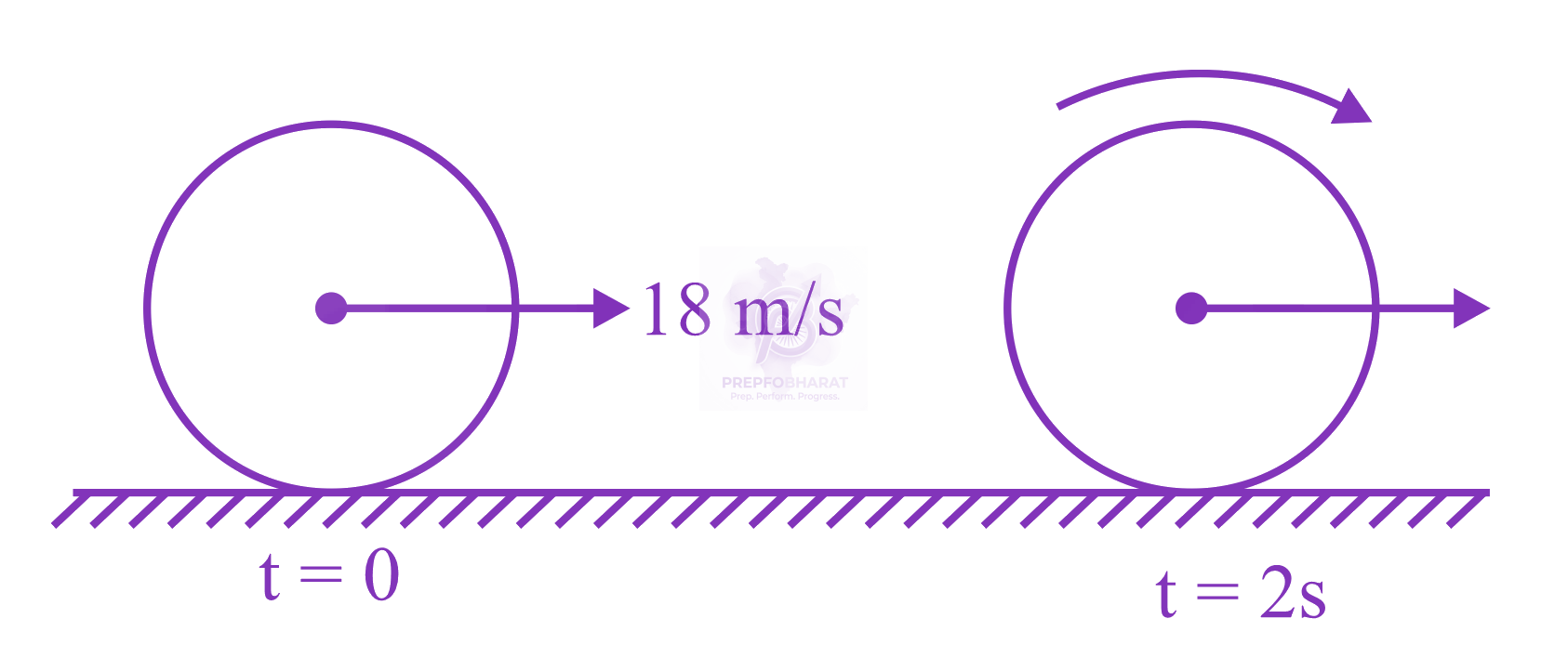
As per the given figure, a small ball $P$ slides down the quadrant of a circle and hits the other ball $Q$ of equal mass which is initially at rest. Neglecting the effect of friction and assume the collision to be elastic, the velocity of ball $Q$ after collision will be : $(g=10m{s}^{-2})$ 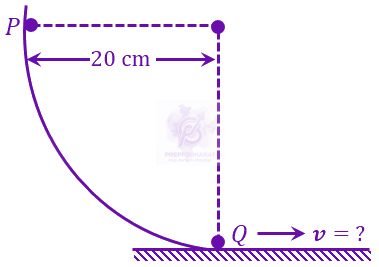
An object of mass $8\mathrm{kg}$ is hanging from one end of a uniform rod $CD$ of mass $2\mathrm{kg}$ and length $1m$ pivoted at its end $C$ on a vertical wall as shown in figure. It is supported by a cable $AB$ such that the system is in equilibrium. The tension in the cable is: (Take $g=10m{s}^{-2}$) 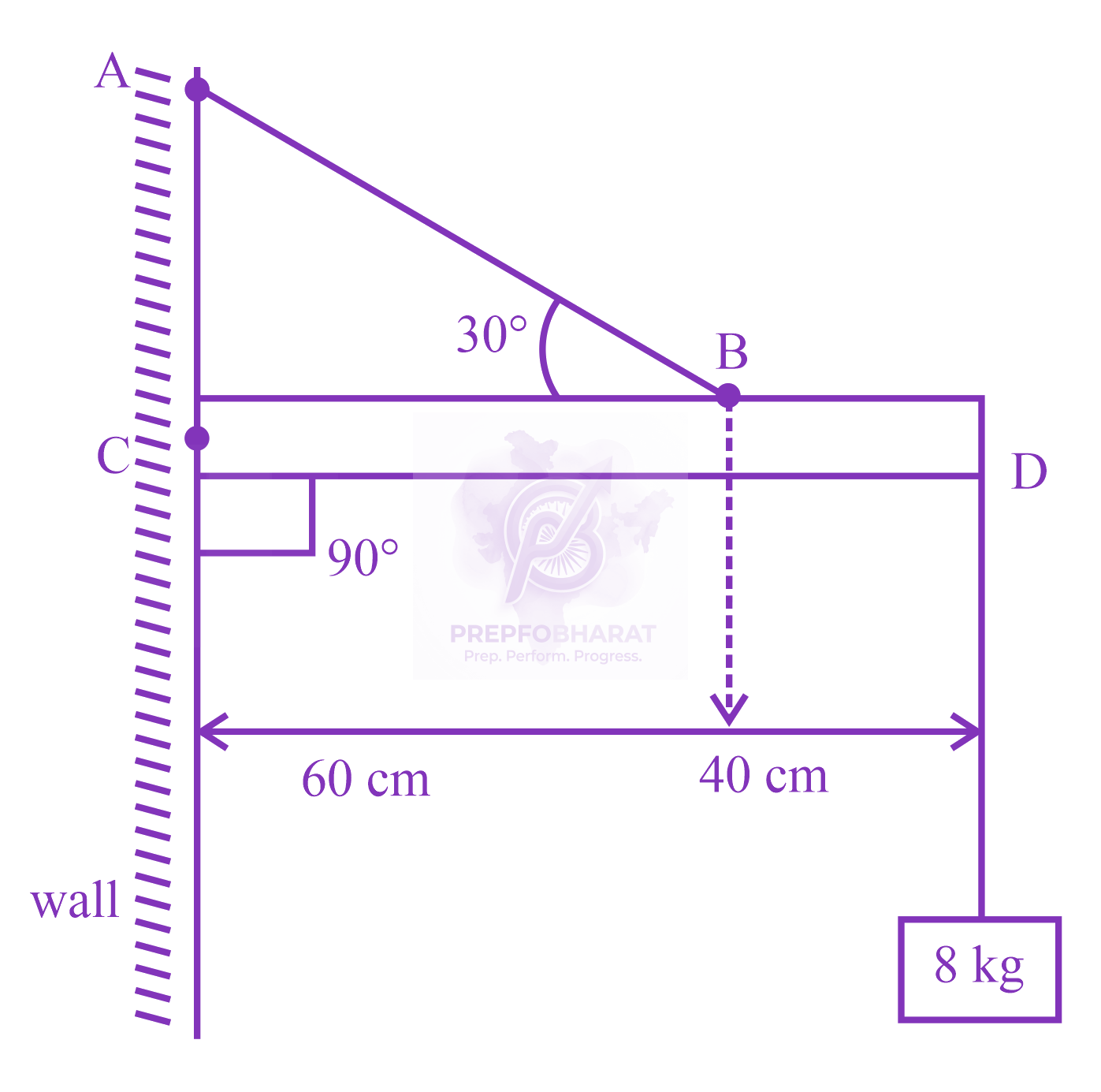
Match List I with List II<table class="pyq-table"><tbody><tr><td></td><td>List I</td><td></td><td>List II</td></tr><tr><td>A.</td><td>Torque</td><td>I.</td><td>$M{L}^{-2}{T}^{-2}$</td></tr><tr><td>B.</td><td>Stress</td><td>II.</td><td>$M{L}^{2}{T}^{-2}$</td></tr><tr><td>C.</td><td>Pressure gradient</td><td>III.</td><td>$M{L}^{-1}{T}^{-1}$</td></tr><tr><td>D.</td><td>Coefficient of viscosity</td><td>IV.</td><td>$M{L}^{-1}{T}^{-2}$</td></tr></tbody></table>Choose the correct answer from the options given below :
A uniform solid cylinder with radius $R$ and length $L$ has moment of inertia ${I}_{1}$, about the axis of cylinder. A concentric solid cylinder of radius ${R}^{'}=\frac{R}{2}$ and length ${L}^{'}=\frac{L}{2}$ is carved out of the original cylinder. If ${I}_{2}$ is the moment of inertia of the carved out portion of the cylinder then $\frac{{I}_{1}}{{I}_{2}}=$ __________. (Both ${I}_{1}$ and ${I}_{2}$ are about the axis of the cylinder)
A car is moving on a horizontal curved road with radius $50m$. The approximate maximum speed of car will be, if friction between tyres and road is $0.34$. [Take $g=10m{s}^{-2}$]
The position of a particle related to time is given by $x=(5{t}^{2}-4t+5)m$. The magnitude of velocity of the particle at $t=2$ s will be :
Two planets A and B of radii $R$ and $1.5R$ have densities $\rho$ and $\frac{\rho }{2}$ respectively. The ratio of acceleration due to gravity at the surface of B to A is:
If $\vec{P}=3\hat{i}+\sqrt{3}\hat{j}+2\hat{k}$ and $\vec{Q}=4\hat{i}+\sqrt{3}\hat{j}+2.5\hat{k}$ then, the unit vector in the direction of $\vec{P}\times \vec{Q}$ is $\frac{1}{x}(\sqrt{3}\hat{i}+\hat{j}-2\sqrt{3}\hat{k})$. The value of $x$ is
The weight of a body on the earth is $400N.$ Then weight of the body when taken to a depth half of the radius of the earth will be:
At any instant the velocity of a particle of mass $500g$ is $(2t\hat{i}+3{t}^{2}\hat{j})m{s}^{-1}$ . If the force acting on the particle at $t=1s$ is $(\hat{i}+x\hat{j})N$ . Then the value of $x$ will be:
Two wires each of radius $0.2\mathrm{cm}$ and negligible mass, one made of steel and the other made of brass are loaded as shown in the figure. The elongation of the steel wire is ______${10}^{–6}m$. [Young's modulus for steel $=2\times {10}^{11}N{m}^{–2}$ and $g=10m{s}^{–2}$] 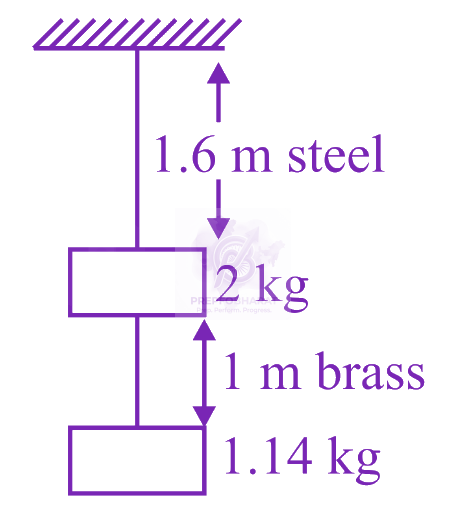
$64$ identical drops each charged upto potential of $10\mathrm{mV}$ are combined to form a bigger drop. The potential of the bigger drop will be _____ $\mathrm{mV}$.
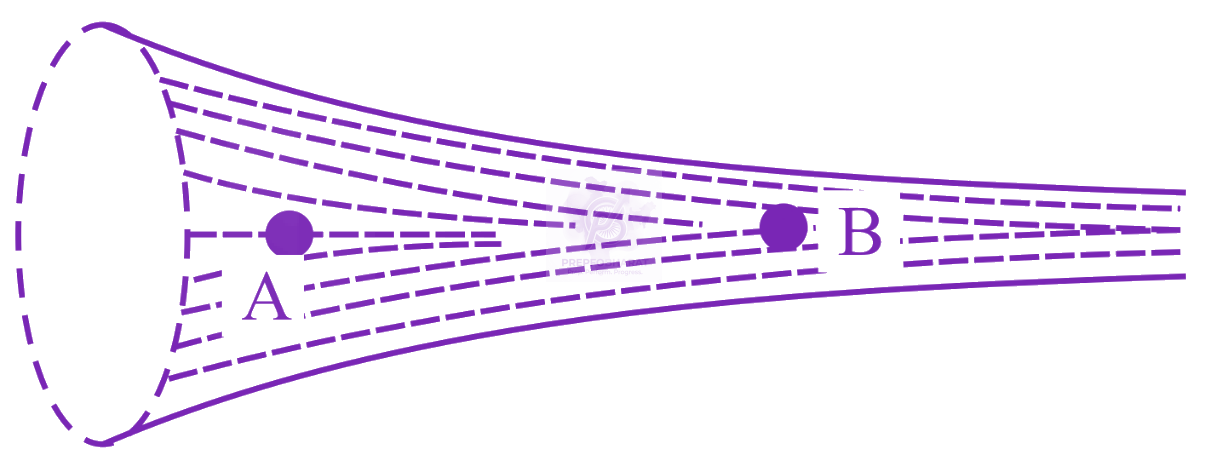 The figure shows a liquid of given density flowing steadily in horizontal tube of varying cross-section. Cross-sectional areas at $A$ is $1.5{\mathrm{cm}}^{2},$ and $B$ is $25{\mathrm{mm}}^{2},$ if the speed of liquid at $B$ is $60\mathrm{cm}{s}^{-1}$ then $({P}_{A}–{P}_{B})$ is (Given ${P}_{A}$ and ${P}_{B}$ are liquid pressures at $A$ and $B$ points. Density $\rho =1000\mathrm{kg}{m}^{-3}$ $A$ and $B$ are on the axis of tube)