JEE Main Physics — Mechanics previous year questions with solutions.
A small block of mass $100g$ is tied to a spring of spring constant $7.5N{m}^{-1}$ and length $20\mathrm{cm}.$ The other end of spring is fixed at a particular point $A.$ If the block moves in a circular path on a smooth horizontal surface with constant angular velocity $5\mathrm{rad}{s}^{-1}$about point $A,$ then tension in the spring is
If force $(F)$, velocity $(V)$ and time $(T)$ are considered as fundamental physical quantity, then dimensional formula of density will be :
Two objects are projected with same velocity $u$ however at different angles $\alpha$ and $\beta$ with the horizontal. If $\alpha +\beta =90^{\circ}$, the ratio of horizontal range of the first object to the ${2}^{\mathrm{nd}}$ object will be :
A certain pressure '$P$' is applied to $1$ litre of water and $2$ litre of a liquid separately. Water gets compressed to $0.01%$ whereas the liquid gets compressed to $0.03%$. The ratio of Bulk modulus of water to that of the liquid is $\frac{3}{x}$. The value of $x$ is ______.
The time period of a satellite of earth is $24$ hours. If the separation between the earth and the satellite is decreased to one fourth of the previous value, then its new time period will become.
A nucleus disintegrates into two nuclear parts, in such a way that ratio of their nuclear sizes is $1:{2}^{1/3}$. Their respective speed have a ratio of $n:1$. The value of $n$ is_________
The time taken by an object to slide down $45^{\circ}$ rough inclined plane is $n$ times as it takes to slide down a perfectly smooth $45^{\circ}$ incline plane. The coefficient of kinetic friction between the object and the incline plane is:
The Young's modulus of a steel wire of length $6m$ and cross-sectional area $3{\mathrm{mm}}^{2}$, is $2\times {11}^{11}N/{m}^{2}$ . The wire is suspended from its support on a given planet. A block of mass $4\mathrm{kg}$ is attached to the free end of the wire. The acceleration due to gravity on the planet is $\frac{1}{4}$ of its value on the earth. The elongation of wire is (Take $g$ on the earth $=10m/{s}^{2}$ ):
A car accelerates from rest of $um{s}^{-1}$. The energy spent in this process is $EJ$. The energy required to accelerate the car from $um{s}^{-1}$ to $2um{s}^{-1}$ is $nEJ$. The value of $n$ is _____.
Glycerin of density $1.25\times {10}^{3}\mathrm{kg}{m}^{–3}$ is flowing through the conical section of pipe. The area of cross-section of the pipe at its ends are $10{\mathrm{cm}}^{2}$ and $5{\mathrm{cm}}^{2}$ and pressure drop across its length is $3N{m}^{–2}$. The rate of flow of glycerine through the pipe is $x\times {10}^{–5}{m}^{3}{s}^{–1}$. The value of $x$ is _____.
If earth has a mass nine times and radius twice to the of a planet $P$. Then $\frac{{v}_{e}}{3}\sqrt{x}m{s}^{-1}$ will be the minimum velocity required by a rocket to pull out of gravitational force of $P$, where ve is escape velocity on earth. The value of $x$ is
Spherical insulating ball and a spherical metallic ball of same size and mass are dropped from the same height. Choose the correct statement out of the following {Assume negligible air friction}
Two bodies are projected from ground with same speeds $40m{s}^{-1}$ at two different angles with respect to horizontal. The bodies were found to have same range. If one of the body was projected at an angle of $60^{\circ}$, with horizontal then sum of the maximum heights, attained by the two projectiles, is _____ $m$. (Given $g=10m{s}^{-2}$)
A solid cylinder is released from rest from the top of an inclined plane of inclination $30^{\circ}$ and length $60\mathrm{cm}$. If the cylinder rolls without slipping, its speed upon reaching the bottom of the inclined plane is ______ $m{s}^{-1}$. (Given $g=10m{s}^{-2}$) 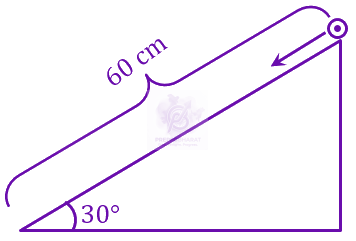
A planet having mass $9{M}_{e}$ and radius $4{R}_{e},$ where ${M}_{e}$ and ${R}_{e}$ are mass and radius of earth respectively, has escape velocity in $\mathrm{km}{s}^{-1}$ given by: (Given escape velocity on earth ${V}_{e}=11.2\times {10}^{3}m{s}^{-1}$)
The radii of two planets $A$ and $B$ are $R$ and $4R$ and their densities are $\rho$ and $\frac{\rho }{3}$ respectively. The ratio of acceleration due to gravity at their surfaces $({g}_{A}:{g}_{B})$ will be
Match List I with List II <table class="pyq-table"><tbody><tr><td></td><td>List-I</td><td></td><td>List-II</td></tr><tr><td>A</td><td>Spring constant</td><td>I</td><td>$[{T}^{–1}]$</td></tr><tr><td>B</td><td>Angular speed</td><td>II</td><td>$[M{T}^{–2}]$</td></tr><tr><td>C</td><td>Angular momentum</td><td>III</td><td>$[M{L}^{2}]$</td></tr><tr><td>D</td><td>Moment of Inertia</td><td>IV</td><td>$[M{L}^{2}{T}^{–1}]$</td></tr></tbody></table>Choose the correct answer from the options given below:
When two resistance ${R}_{1}$ and ${R}_{2}$ connected in series and introduced into the left gap of a meter bridge and a resistance of $10\Omega$ is introduced into the right gap, a null point is found at $60\mathrm{cm}$ from left side. When ${R}_{1}$ and ${R}_{2}$ are connected in parallel and introduced into the left gap, a resistance of $3\Omega$ is introduced into the right-gap to get null point at $40\mathrm{cm}$ from left end. The product of ${R}_{1}{R}_{2}$ is ______ ${\Omega }^{2}$
Given below are two statements : Statement-I: Acceleration due to gravity is different at different places on the surface of earth. Statement-II: Acceleration due to gravity increases as we go down below the earth's surface. In the light of the above statements, choose the correct answer from the options given below
If $R,{X}_{L}\text{and}{X}_{C}$ represent resistance, inductive reactance and capacitive reactance. Then which of the following is dimensionless:
The elastic potential energy stored in a steel wire of length $20m$ stretched through $2\mathrm{cm}$ is $80J.$ The cross sectional area of the wire is _____ ${\mathrm{mm}}^{2}.$ (Given, $Y=2.0\times {10}^{11}N{m}^{–2}$)
If the gravitational field in the space is given as $(-\frac{K}{{r}^{2}})$. Taking the reference point to be at $r=2\mathrm{cm}$ with gravitational potential $V=10J{\mathrm{kg}}^{-1}$. Find the gravitational potentials at $r=3\mathrm{cm}$ in SI unit (Given, that $K=6J\mathrm{cm}{\mathrm{kg}}^{-1}$)
In a metre bridge experiment the balance point is obtained if the gaps are closed by $2\Omega$ and $3\Omega$. A shunt of $X\Omega$ is added to $3\Omega$ resistor to shift the balancing point by $22.5\mathrm{cm}$. The value of $X$ is ______.
Match List I with List II <table class="pyq-table"><tbody><tr><td colspan="2" rowspan="1">List - I</td><td colspan="2" rowspan="1">List - II</td></tr><tr><td>A</td><td>Surface tension</td><td>I.</td><td>$\mathrm{kg}{m}^{-1}{s}^{-1}$</td></tr><tr><td>B</td><td>Pressure</td><td>II.</td><td>$\mathrm{kg}m{s}^{-1}$</td></tr><tr><td>C</td><td>Viscosity</td><td>III.</td><td>$\mathrm{kg}{m}^{-1}{s}^{-2}$</td></tr><tr><td>D</td><td>Impulse</td><td>IV.</td><td>$\mathrm{kg}{s}^{-2}$</td></tr></tbody></table>Choose the correct answer from the options given below: