JEE Main Physics — Mechanics previous year questions with solutions.
A wire of length $L$ and radius $r$ is clamped rigidly at one end. When the other end of the wire is pulled by a force$f$, its length increases by $l$. Another wire of same material of length $2L$ and radius $2r$ is pulled by a force $2f$. Then the increase in its length will be:
Surface tension of a soap bubble is $2.0\times {10}^{-2}N{m}^{-1}$ . Work done to increase the radius of soap bubble from $3.5\mathrm{cm}$ to $7\mathrm{cm}$ will be : [Take $\pi =\frac{22}{7}$ ]
Figure below shows a liquid being pushed out of the tube by a piston having area of cross section $2.0{\mathrm{cm}}^{2}$. The area of cross section at the outlet is $10{\mathrm{mm}}^{2}$. If the piston is pushed at a speed of $4\mathrm{cm}{s}^{-1}$, the speed of outgoing fluid is _____ $\mathrm{cm}{s}^{-1}$ 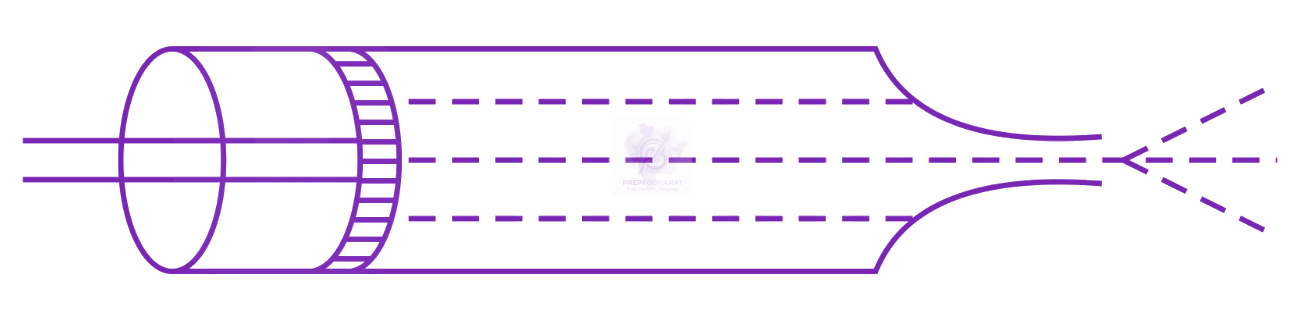
A block of $\sqrt{3}\mathrm{kg}$ is attached to a string whose other end is attached to the wall. An unknown force $F$ is applied so that the string makes an angle of $30^{\circ}$ with the wall. The tension $T$ is : (Given g $=10m{s}^{–2}$) 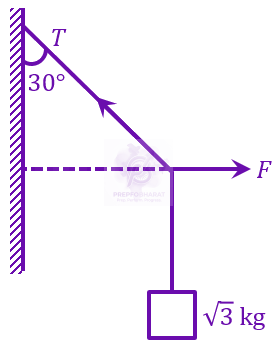
Given below are two statements: Statement I: Area under velocity-time graph gives the distance travelled by the body in a given time. Statement II: Area under acceleration-time graph is equal to the change in velocity in the given time. In the light of given statements, choose the correct answer from the options given below.
For a body projected at an angle with the horizontal from the ground, choose the correct statement
Given below are two statements: Statement I : A truck and a car moving with same kinetic energy are brought to rest by applying breaks which provide equal retarding forces. Both come to rest in equal distance. Statement II : A car moving towards east takes a turn and moves towards north, the speed remains unchanged. The acceleration of the car is zero. In the light of given statements, choose the most appropriate answer from the options given below
To maintain a speed of $80\mathrm{km}{h}^{-1}$ by a bus of mass $500\mathrm{kg}$ on a plane rough road for $4\mathrm{km}$ distance, the work done by the engine of the bus will be _____ $\mathrm{kJ}$. [The coefficient of friction between tyre of bus and road is $0.04$]
If $1000$ droplets of water of surface tension $0.07N{m}^{-1}$. having same radius $1\mathrm{mm}$ each, combine to from a single drop. In the process the released surface energy is- $(\text{Take}\pi =\frac{22}{7})$
$T$ is the time period of simple pendulum on the earth's surface. Its time period becomes $xT$ when taken to a height $R$ (equal to earth's radius) above the earth's surface. Then, the value of $x$ will be:
If two vectors $\vec{P}=\hat{i}+2m\hat{j}+m\hat{k}$ and $\vec{Q}=4\hat{i}-2\hat{j}+m\hat{k}$ are perpendicular to each other. Then, the value of $m$ will be
A closed circular tube of average radius $15\mathrm{cm}$, whose inner walls are rough, is kept in vertical plane. A block of mass $1\mathrm{kg}$ just fit inside the tube. The speed of block is $22m{s}^{-1}$, when it is introduced at the top of tube. After completing five oscillations, the block stops at the bottom region of tube. The work done by the tube on the block is ________ $J$. (Given $g=10m{s}^{-2}$). 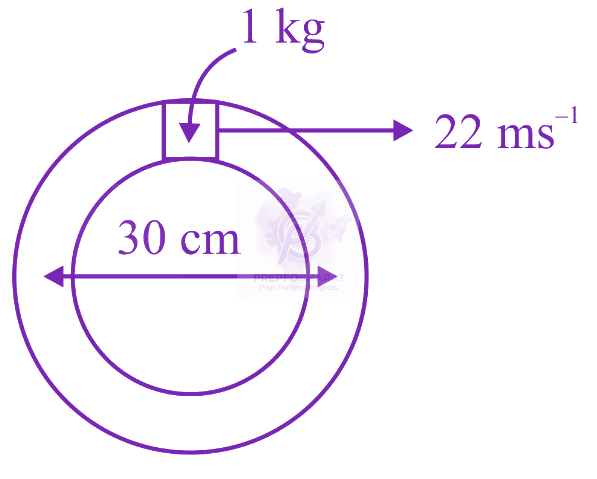
The equation of a circle is given by ${x}^{2}+{y}^{2}={a}^{2}$, where $a$ is the radius. If the equation is modified to change the origin other than $(0,0)$, then find out the correct dimensions of $A$ and $B$ in a new equation : ${(x-At)}^{2}+{(y-\frac{t}{B})}^{2}={a}^{2}$ The dimensions of $t$ is given as $[{T}^{-1}]$
Given below are two statements : Statement I : Astronomical unit (Au), Parsec (Pc) and Light year (ly) are units for measuring astronomical distances. Statement II : Au < Parsec (Pc) < ly In the light of the above statements, choose the most appropriate answer from the options given below:
A $0.4\mathrm{kg}$ mass takes $8s$ to reach ground when dropped from a certain height $P$ above surface of earth. The loss of potential energy in the last second of fall is ______ $J$. [Take $g=10m{s}^{-2}$]
Solid sphere $A$ is rotating about an axis $PQ$. If the radius of the sphere is $5\mathrm{cm}$, then its radius of gyration about $PQ$ will be $\sqrt{x}\mathrm{cm}$. The value of $x$ is _____. 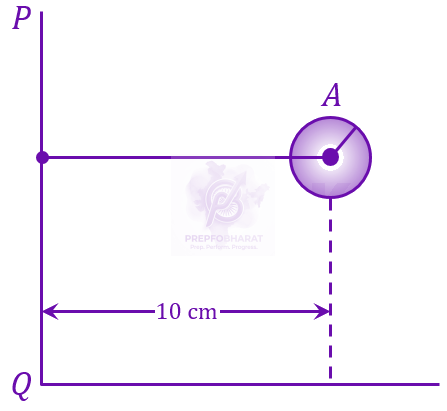
A body of mass $1\mathrm{kg}$ collides head on elastically with a stationary body of mass $3\mathrm{kg}$. After collision, the smaller body reverses its direction of motion and moves with a speed of $2m{s}^{-1}$. The initial speed of the smaller body before collision is ______ $m{s}^{-1}$.
In an experiment of measuring the refractive index of a glass slab using travelling microscope in physics lab, a student measures real thickness of the glass slab as $5.25\mathrm{mm}$ and apparent thickness of the glass slab at $5.00\mathrm{mm}$. Travelling microscope has $20$ divisions in one $\mathrm{cm}$ on main scale and $50$ divisions on Vernier scale is equal to $49$ divisions on main scale. The estimated uncertainty in the measurement of refractive index of the slab is $\frac{x}{10}\times {10}^{-3}$, where $x$ is ______
A ball of mass $200g$ rests on a vertical post of height $20m$. A bullet of mass $10g$, travelling in horizontal direction, hits the centre of the ball. After collision both travels independently. The ball hits the ground at a distance $30m$ and the bullet at a distance of $120m$ from the foot of the post. The value of initial velocity of the bullet will be (if $g=10m{s}^{-2}$) :
Two bodies are having kinetic energies in the ratio $16:9.$ If they have same linear momentum, the ratio of their masses respectively is:
The ratio of escape velocity of a planet to the escape velocity of earth will be:- Given: Mass of the planet is $16$ times mass of earth and radius of the planet is $4$ times the radius of earth.
Choose the incorrect statement from the following:
A particle of mass $100g$ is projected at time $t=0$ with a speed $20m{s}^{–1}$ at an angle $45^{\circ}$ to the horizontal as given in the figure. The magnitude of the angular momentum of the particle about the starting point at time $t=2s$ is found to be $\sqrt{K}\mathrm{kg}{m}^{2}{s}^{-1}$. The value of $K$ is ______. (Take $g=10m{s}^{-2}$) 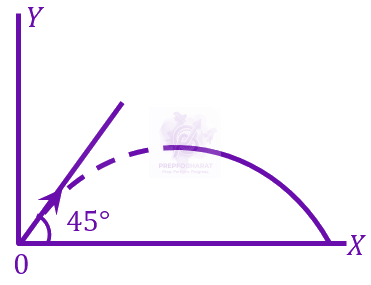
The orbital angular momentum of a satellite is $L$, when it is revolving in a circular orbit at height $h$ from earth surface. If the distance of satellite from the earth centre is increased by eight times to its initial value, then the new angular momentum will be