Mechanics PYQ — Page 19
JEE Main Physics — Mechanics previous year questions with solutions.
All Mechanics Questions (2069)
A particle initially at rest starts moving from reference point $x=0$ along $x$-axis, with velocity $v$ that varies as $v=4\sqrt{x}m{s}^{-1}$. The acceleration of the particle is _____ $m{s}^{-2}$.
A body of mass $m$ is projected with a speed $u$ making an angle of ${45}^{o}$ with the ground. The angular momentum of the body about the point of projection, at the highest point is expressed as $\frac{\sqrt{2}m{u}^{3}}{Xg}$. The value of $X$ is_______.
A light string passing over a smooth light pulley connects two blocks of masses $m_1$ and $m_2$ (where $m_2>m_1$ ). If the acceleration of the system is $\frac{g}{\sqrt{2}}$, then the ratio of the masses $\frac{m_1}{m_2}$ is:
A vernier callipers has 20 divisions on the vernier scale, which coincides with $19^{\text {th }}$ division on the main scale. The least count of the instrument is $0.1 \mathrm{~mm}$. One main scale division is equal to _____$\mathrm{mm}$.
A player caught a cricket ball of mass $150 \mathrm{~g}$ moving at a speed of $20 \mathrm{~m} / \mathrm{s}$. If the catching process is completed in $0.1 \mathrm{~s}$, the magnitude of force exerted by the ball on the hand of the player is:
The diameter of a sphere is measured using a vernier caliper whose 9 divisions of main scale are equal to 10 divisions of vernier scale. The shortest division on the main scale is equal to $1 \mathrm{~mm}$. The main scale reading is $2 \mathrm{~cm}$ and second division of vernier scale coincides with a division on main scale. If mass of the sphere is 8.635 g, the density of the sphere is:
A body of mass $4\mathrm{kg}$ experiences two forces ${\vec{F}}_{1}=5\hat{i}+8\hat{j}+7\hat{k}$ and ${\vec{F}}_{2}=3\hat{i}-4\hat{j}-3\hat{k.}$ The acceleration acting on the body is:
A heavy iron bar of weight $12\mathrm{kg}$ is having its one end on the ground and the other on the shoulder of a man. The rod makes an angle $60^{\circ}$ with the horizontal, the normal force applied by the man on bar is:
The maximum height reached by a projectile is $64 \mathrm{~m}$. If the initial velocity is halved, the new maximum height of the projectile is _____ $\mathrm{m}$.
If the radius of earth is reduced to three-fourth of its present value without change in its mass then value of duration of the day of earth will be ______ hours 30 minutes.
A $1 \mathrm{~kg}$ mass is suspended from the ceiling by a rope of length $4 \mathrm{~m}$. A horizontal force ' $F$ ' is applied at the mid point of the rope so that the rope makes an angle of $45^{\circ}$ with respect to the vertical axis as shown in figure. The magnitude of $F$ is : (Assume that the system is in equilibrium and $g=10 \mathrm{~m} / \mathrm{s}^2$ ) 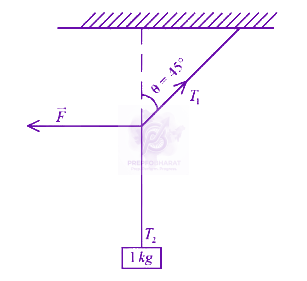
The relation between time ‘$t$’ and distance ‘$x$’ is $t=\alpha {x}^{2}+\beta x$, where $\alpha$ and $\beta$ are constants. The relation between acceleration $(a)$ and velocity $(v)$ is:
A particle of mass $m$ projected with a velocity $u$ making an angle of $30^{\circ}$ with the horizontal. The magnitude of angular momentum of the projectile about the point of projection when the particle is at its maximum height $h$ is :
A uniform rod $AB$ of mass $2\mathrm{kg}$ and Length $30\mathrm{cm}$ at rest on a smooth horizontal surface. An impulse of force $0.2Ns$ is applied to end B. The time taken by the rod to turn through at right angles will be $\frac{\pi }{x}s,$ where $x=$ ____.
The gravitational potential at a point above the surface of earth is $-5.12\times {10}^{7}J{\mathrm{kg}}^{-1}$ and the acceleration due to gravity at that point is $6.4m{s}^{-2}$. Assume that the mean radius of earth to be $6400\mathrm{km}$. The height of this point above the earth's surface is:
Two persons pull a wire towards themselves. Each person exerts a force of $200 \mathrm{~N}$ on the wire. Young's modulus of the material of wire is $1 \times 10^{11} \mathrm{~N} \mathrm{~m}^{-2}$. Original length of the wire is $2 \mathrm{~m}$ and the area of cross section is $2 \mathrm{~cm}^2$. The wire will extend in length by ______ $\mu \mathrm{m}$.
A simple pendulum doing small oscillations at a place $\mathrm{R}$ height above earth surface has time period of $T_1=4 \mathrm{~s}$. $T_2$ would be it's time period if it is brought to a point which is at a height $2 \mathrm{R}$ from earth surface. Choose the correct relation $[R=$ radius of earth $]$ :
Least count of a vernier caliper is $\frac{1}{20 \mathrm{~N}} \mathrm{~cm}$. The value of one division on the main scale is $1 \mathrm{~mm}$. Then the number of divisions of main scale that coincide with $\mathrm{N}$ divisions of vernier scale is :
While measuring diameter of wire using screw gauge the following readings were noted. Main scale reading is $1 \mathrm{~mm}$ and circular scale reading is equal to 42 divisions. Pitch of screw gauge is $1 \mathrm{~mm}$ and it has 100 divisions on circular scale. The diameter of the wire is $\frac{x}{50} \mathrm{~mm}$. The value of $x$ is :
Small water droplets of radius $0.01 \mathrm{~mm}$ are formed in the upper atmosphere and falling with a terminal velocity of $10 \mathrm{~cm} / \mathrm{s}$. Due to condensation, if 8 such droplets are coalesced and formed a larger drop, the new terminal velocity will be _____$\mathrm{cm} / \mathrm{s}$.
A bullet is fired into a fixed target looses one third of its velocity after travelling $4\mathrm{cm}$. It penetrates further $D\times {10}^{-3}m$ before coming to rest. The value of $D$ is :
Four particles, each of mass $1\mathrm{kg}$ are placed at four corners of a square of side $2m$. The moment of inertia of the system about an axis perpendicular to its plane and passing through one of its vertex is $______\mathrm{kg}{m}^{2}$.
A small liquid drop of radius $R$ is divided into $27$ identical liquid drops. If the surface tension is $T$, then the work done in the process will be :
A force $\left(3 x^2+2 x-5\right) \mathrm{N}$ displaces a body from $x=2 \mathrm{~m}$ to $x=4 \mathrm{~m}$. Work done by this force is ________ $J$.