Mechanics PYQ — Page 18
JEE Main Physics — Mechanics previous year questions with solutions.
All Mechanics Questions (2069)
A ball rolls off the top of a stairway with horizontal velocity $u$. The steps are $0.1m$ high and $0.1m$ wide. The minimum velocity $u$ with which that ball just hits the step $5$ of the stairway will be $\sqrt{x}m{s}^{-1}$, where $x=$_______ [use $g=10m{s}^{-2}$].
A $2 \mathrm{~kg}$ brick begins to slide over a surface which is inclined at an angle of $45^{\circ}$ with respect to horizontal axis. The co-efficient of static friction between their surfaces is:
Match List I with List II $\begin{array}{|l|l|r|l|} \hline \text{ LIST I } & \text{ LIST II } \\ \hline \text{A.} & \text{Torque} & \text{I.} & {\left[M^1 L^1 T^{-2} A^{-2}\right]} \\ \hline \text{B.} & \text{Magnetic field} & \text{II.} & {\left[L^2 A^1\right]} \\ \hline \text{C.} & \text{Magnetic moment} & \text{III.} & {\left[M^1 T^{-2} A^{-1}\right]} \\ \hline \text{D.} & \text{Permeability of free space} & \text{IV.} & {\left[M^1 L^2 T^{-2}\right]} \\ \hline \end{array}$ Choose the correct answer from the options given below:
A particle is moving in a circle of radius $50\mathrm{cm}$ in such a way that at any instant the normal and tangential components of its acceleration are equal. If its speed at $t=0$ is $4m{s}^{-1}$, the time taken to complete the first revolution will be $\frac{1}{\alpha }[1-{e}^{-2\pi }]s$, where $\alpha =$______.
Given below are two statements : one is labelled as Assertion (A) and the other is labelled as Reason (R) Assertion (A) : The property of body, by virtue of which it tends to regain its original shape when the external force is removed, is Elasticity. Reason (R) : The restoring force depends upon the bonded inter atomic and inter molecular force of solid. In the light of the above statements, choose the correct answer from the options given below :
The reading of pressure metre attached with a closed pipe is $4.5\times {10}^{4}N{m}^{-2}$. On opening the valve, water starts flowing and the reading of pressure metre falls to $2.0\times {10}^{4}N{m}^{-2}$. The velocity of water is found to be $\sqrt{V}m{s}^{-1}$. The value of $V$ is _________.
The depth below the surface of sea to which a rubber ball be taken so as to decrease its volume by $0.02%$ is _____ $m$. (Take density of sea water $={10}^{3}\mathrm{kg}{m}^{-3}$, Bulk modulus of rubber $=9\times {10}^{8}N{m}^{-2}$, and $g=10m{s}^{-2}$)
A bullet of mass $50 \mathrm{~g}$ is fired with a speed $100 \mathrm{~m} / \mathrm{s}$ on a plywood and emerges with $40 \mathrm{~m} / \mathrm{s}$. The percentage loss of kinetic energy is :
A particle moving in a circle of radius $R$ with uniform speed takes time $T$ to complete one revolution. If this particle is projected with the same speed at an angle $\theta$ to the horizontal, the maximum height attained by it is equal to $4R$. The angle of projection $\theta$ is then given by :
A body starts falling freely from height $H$ hits an inclined plane in its path at height $h$. As a result of this perfectly elastic impact, the direction of the velocity of the body becomes horizontal. The value of $\frac{H}{h}$ for which the body will take the maximum time to reach the ground is _____.
A cyclist starts from the point $P$ of a circular ground of radius $2 \mathrm{~km}$ and travels along its circumference to the point $\mathrm{S}$. The displacement of a cyclist is: 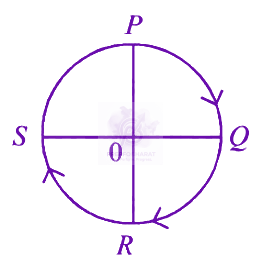
The acceleration due to gravity on the surface of earth is $g$. If the diameter of earth reduces to half of its original value and mass remains constant, then acceleration due to gravity on the surface of earth would be :
A light string passing over a smooth light fixed pulley connects two blocks of masses ${m}_{1}$ and ${m}_{2}$. If the acceleration of the system is $\frac{g}{8}$, then the ratio of masses is 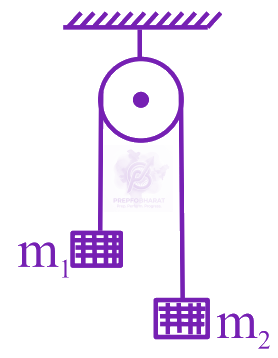
A disc of radius $R$ and mass $M$ is rolling horizontally without slipping with speed $v$. It then moves up an inclined smooth surface as shown in figure. The maximum height that the disc can go up the incline is: 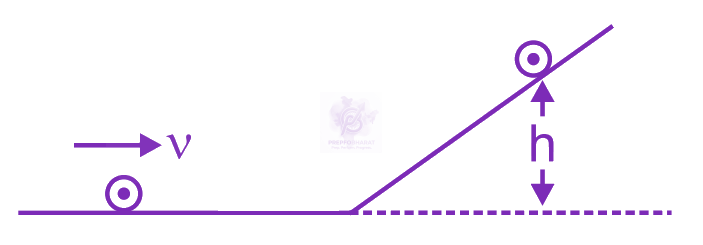
Ratio of radius of gyration of a hollow sphere to that of a solid cylinder of equal mass, for moment of Inertia about their diameter axis $\mathrm{AB}$ as shown in figure is $\sqrt{8 / x}$. The value of $x$ is : 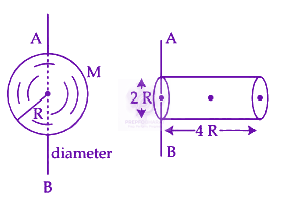
A thin circular disc of mass $M$ and radius $R$ is rotating in a horizontal plane about an axis passing through its centre and perpendicular to its plane with angular velocity $\omega$. If another disc of same dimensions but of mass $\mathrm{M} / 2$ is placed gently on the first disc co-axially, then the new angular velocity of the system is :
To find the spring constant $(k)$ of a spring experimentally, a student commits $2 \%$ positive error in the measurement of time and $1 \%$ negative error in measurement of mass. The percentage error in determining value of $k$ is :
Given below are two statements: Statement (I) : Planck's constant and angular momentum have the same dimensions. Statement (II) : Linear momentum and moment of force have the same dimensions. In light of the above statements, choose the correct answer from the options given below :
In a test experiment on a model aeroplane in wind tunnel, the flow speeds on the upper and lower surfaces of the wings are $70m{s}^{-1}$ and $65m{s}^{-1}$ respectively. If the wing area is $2{m}^{2}$, the lift of the wing is _______$N$. (Given density of air $=1.2\mathrm{kg}{m}^{-3}$)
A particle starts from origin at $t=0$ with a velocity $5\hat{i}m{s}^{-1}$ and moves in $x-y$ plane under action of a force which produces a constant acceleration of $(3\hat{i}+2\hat{j})m{s}^{-2}$. If the $x$-coordinate of the particle at that instant is $84m$, then the speed of the particle at this time is $\sqrt{\alpha }m{s}^{-1}$. The value of $\alpha$ is _______.
With rise in temperature, the Young's modulus of elasticity
A light unstretchable string passing over a smooth light pulley connects two blocks of masses $m_1$ and $m_2$. If the acceleration of the system is $\frac{g}{8}$, then the ratio of the masses $\frac{m_2}{m_1}$ is :
Two forces $\bar{F}_1$ and $\bar{F}_2$ are acting on a body. One force has magnitude thrice that of the other force and the resultant of the two forces is equal to the force of larger magnitude. The angle between $\vec{F}_1$ and $\vec{F}_2$ is $\cos ^{-1}\left(\frac{1}{n}\right)$. The value of $|n|$ is _____.
Match List-I with List-II : $\begin{array}{|c|c|c|c|} \hline & \text { List-I } & & \text { List-II } \\ \hline \text { (A) } & \text { A force that restores an elastic body of unit area to its original state } & \text { (I) } & \text { Bulk modulus } \\ \hline \text { (B) } & \text { Two equal and opposite forces parallel to opposite faces } & \text { (II) } & \text { Young's modulus } \\ \hline \text { (C) } & \begin{array}{l} \text { Forces perpendicular everywhere to the surface per unit area } \\ \text { same everywhere } \end{array} & \text { (III) } & \text { Stress } \\ \hline \text { (D) } & \text { Two equal and opposite forces perpendicular to opposite faces } & \text { (IV) } & \text { Shear modulus } \\ \hline \end{array}$ Choose the correct answer from the options given below :