JEE Main Physics — Electromagnetism previous year questions with solutions.
A wire of length $L=20 cm$ is bent into a semi-circular arc and the two equal halves of the arc are uniformly charged with charges $+Q$ and $-Q$ as shown in the figure. The magnitude of the charge on each half is $|Q|={10}^{3}{\epsilon }_{0}$, where ${\epsilon }_{0}$ is the permittivity of free the space. The net electric field at the centre $O$ is 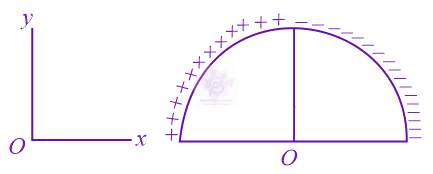
A $10 \text{V}$ battery with internal resistance $\text{1} \Omega$ and a $15 \text{V}$ battery with internal resistance $0.6 \Omega$ are connected in parallel to a voltmeter (see figure). The reading in the voltmeter will be close to: 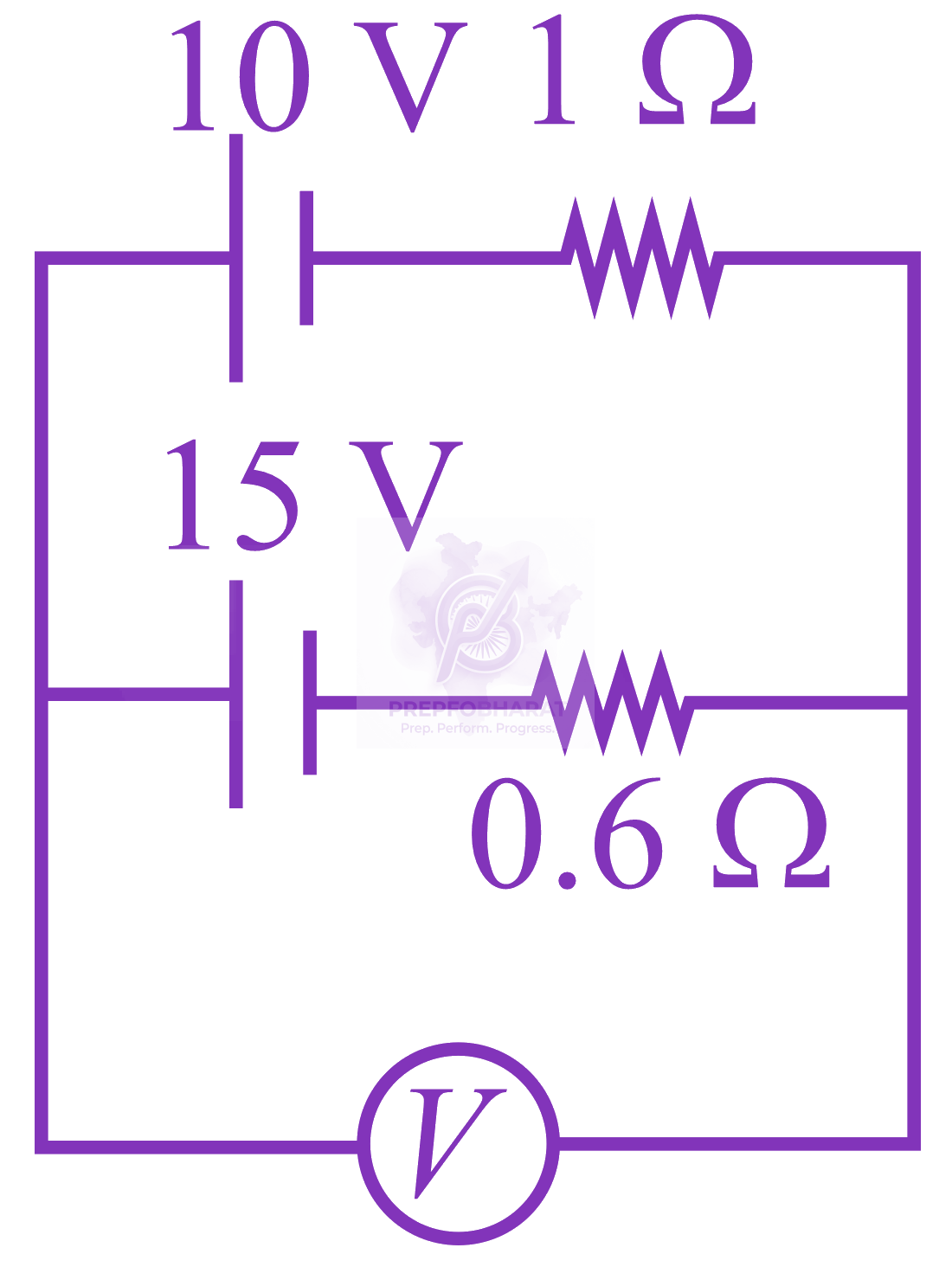
In the given circuit, charge ${Q}_{2}$ on the $2\mu F$ capacitor changes as C is varied from $1\mu F$ to $3\mu F$. ${Q}_{2}$ as a function of 'C' is given properly by: (figures are drawn schematically and are not to scale) 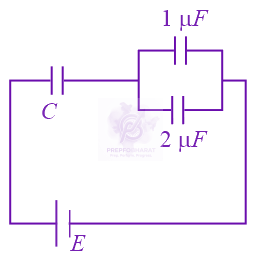
In the electric network shown, when no current flows through the $4 \Omega$ resistor in the arm EB, the potential difference between the points A and D will be: 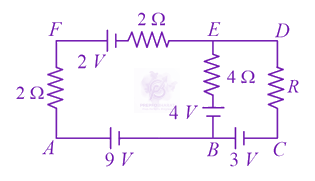
For plane electromagnetic waves propagating in the $+z$-direction, which one of the following combinations gives the correct possible direction for $\vec{E}$ and $\vec{B}$ field respectively?
A proton (mass $m$) accelerated by a potential difference $V$ flies through a uniform transverse magnetic field $B$. The field occupies a region of space by width $d$. If $\alpha$ be the angle of deviation of proton from the initial direction of motion (see figure), the value of $\mathrm{sin}\alpha$ will be: 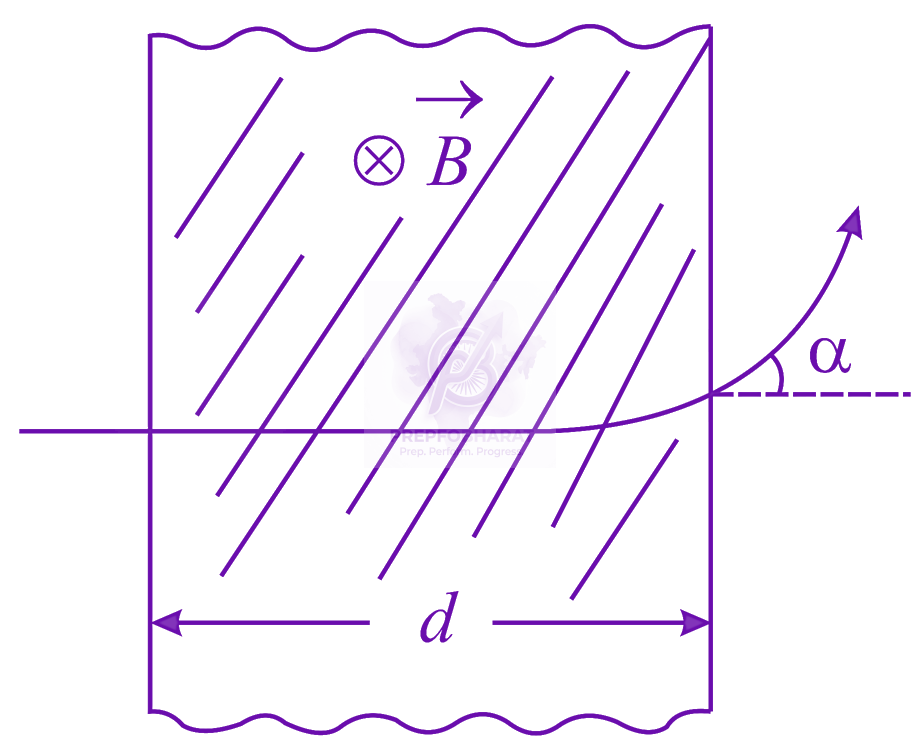
A short bar magnet is placed in the magnetic meridian of the earth with North Pole pointing north. Neutral points are found at a distance of $30\mathrm{cm}$ from the magnet on the East-West line, drawn through the middle point of the magnet. The magnetic moment of the magnet in ${\mathrm{Am}}^{2}$ is close to: (Given $\frac{{\mu }_{0}}{4\pi }={10}^{-7}$ in SI units and ${B}_{H}=$ Horizontal component of earth's magnetic field $=3.6\times {10}^{-5}$ Tesla.)
When the current in a coil changes from $\text{5 A}$ to $\text{2 A}$ in $\text{0}\text{.1 s}$, an average voltage of $\text{50} \text{V}$ is produced. The self-inductance of the coil is
Two long straight parallel wires, carrying (adjustable) currents ${I}_{1}$ and ${I}_{2}$ , are kept at a distance $d$ apart. If the force $F$ between the two wires is taken as 'positive' when the wires repel each other and 'negative' when the wires attract each other, the graph showing the dependence of $F$, on the product ${I}_{1}{I}_{2}$ , would be:
Suppose the drift velocity ${v}_{d}$ in a material varied with the applied electric field E as ${v}_{d }\propto \sqrt{E}$. Then $V-I$ graph for a wire made of such a material is best given by:
A thin disc of radius $b=2a$ has a concentric hole of radius $a$ in it (see figure). It carries uniform surface charge $\sigma$ on it. If the electric field on its axis at a height $\text{h}(\text{h}<<\text{a})$ from its centre is given as $\text{C}\text{h}$ then the value of $C$ is 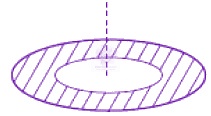
A long cylindrical shell carries positive surface charge $\sigma$ in the upper half and negative surface charge $–\sigma$ in the lower half. The electric field lines around the cylinder will look like figure given in: (figures are schematic and not drawn to scale)
When $5V$ potential difference is applied across a wire of length $0.1m$, the drift speed of electrons is $2.5\times {10}^{-4} m{s}^{-1}$ . If the electron density in the wire is $8\times {10}^{28} {m}^{-3}$ , the resistivity of the material is close to:
Match List - I (Electromagnetic wave type) with List - II (Its association/application) and select the correct option from the choices given below the lists : <table class="pyq-table"><tbody><tr><th></th><th>List - I</th><th></th><th>List - II</th></tr><tr><td>(a)</td><td>Infrared waves</td><td>(i)</td><td>To treat muscular strain</td></tr><tr><td>(b)</td><td>Radio waves</td><td>(ii)</td><td>For broadcasting</td></tr><tr><td>(c)</td><td>X - rays</td><td>(iii)</td><td>To detect fracture of bones</td></tr><tr><td>(d)</td><td>Ultraviolet rays</td><td>(iv)</td><td>Absorbed by the ozone layer of the atmosphere</td></tr></tbody></table>
If microwaves, $X‐$rays, infrared, gamma rays, ultraviolet, radio waves and visible parts of the electromagnetic spectrum are denoted respectively by $M$, $X$, $I$, $G$, $U$, $R$ and $V$ the following is the arrangement in ascending order of the wavelength
A positive charge ' $\mathrm{q}$ ' of mass ' $\mathrm{m}$ ' is moving along the $+x$ axis. We wish to apply a uniform magnetic field B for time $\Delta t$ so that the charge reverses its direction crossing the $\mathrm{y}$ axis at a distance $\mathrm{d}$. Then:
In the circuit shown, current (in A) through $50 \mathrm{~V}$ and $30 \mathrm{~V}$ batteries are, respectively: 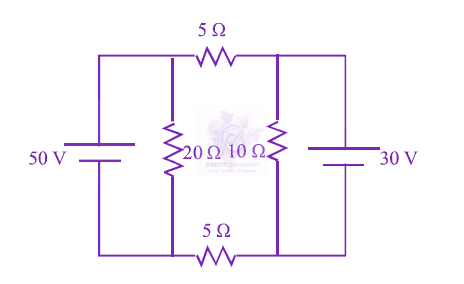
Assume that an electric field $\vec{\text{E}} = 3 0 { x }^{2} \hat{ i }$ exists in space. Then the potential difference ${\text{V}}_{\text{A}} - {\text{V}}_{\text{O}}$ , where V$_{O}$ is the potential at the origin and V$_{A}$ the potential at x = 2 m is :
A parallel plate capacitor is made of two plates of length 1 , width $w$ and separated by distance $d$. A dielectric slab (dielectric constant $\mathrm{K}$ ) that fits exactly between the plates is held near the edge of the plates. It is pulled into the capacitor by a force $\mathrm{F}=-\frac{\partial \mathrm{U}}{\partial \mathrm{x}}$ where $\mathrm{U}$ is the energy of the capacitor when dielectric is inside the capacitor up to distance $x$ (See figure). If the charge on the capacitor is Q then the force on the dielectric when it is near the edge is: 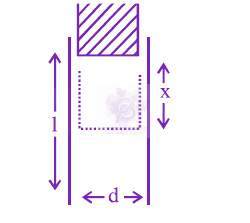
A coil of circular cross-section having 1000 turns and $4 \mathrm{~cm}^2$ face area is placed with its axis parallel to a magnetic field which decreases by $10^{-2} \mathrm{~Wb}$ $\mathrm{m}^{-2}$ in $0.01 \mathrm{~s}$. The e.m.f. induced in the coil is:
Match List I (Wavelength range of electromagnetic spectrum) with List II (Method of production of these waves) and select the correct option from the options given below the lists.<table class="pyq-table"><tbody><tr><th></th><th>List I</th><th></th><th>List II</th></tr><tr><td>(a)</td><td>$700\mathrm{nm}$ to $1\mathrm{mm}$</td><td>(i)</td><td>Vibration of atoms and molecules.</td></tr><tr><td>(b)</td><td>$1\mathrm{nm}$ to $400\mathrm{nm}$</td><td>(ii)</td><td>Inner shell electrons in atoms moving from one energy level to a lower level.</td></tr><tr><td>(c)</td><td>$<{10}^{-3}\mathrm{nm}$</td><td>(iii)</td><td>Radioactive decay of the nucleus.</td></tr><tr><td>(d)</td><td>$1\mathrm{mm}$ to $0.1m$</td><td>(iv)</td><td>Magnetron valve.</td></tr></tbody></table>
The magnitude of the average electric field normally present in the atmosphere just above the surface of the Earth is about $150N/C$, directed inward towards the center of the Earth. This gives the total net surface charge carried by the Earth to be : [Given : ${\in }_{\text{O}} = \text{8.85} \times 1 {0}^{ - 1 2 } {\text{ C}}^{2} / {\text{N-m}}^{2} \text{, } {\text{R}}_{\text{E}} = \text{6.37} \times 1 {0}^{6} \text{m}$]
A conductor lies along the z-axis at $- \text{1.5} \leq \text{z} <\text{1.5} m$ and carries a fixed current of 10.0 A in ${ -\hat{\text{a}} }_{\text{z}}$ direction (see figure). For a field $\vec{\text{B}} = \text{3.0} \times 1 {0}^{ - 4 } {\text{ e}}^{ - \text{0.2x } } { \hat{\text{a}} }_{\text{y}}$ T, find the power required to move the conductor at constant speed to x = 2.0 m, y = 0 m in $5 \times 1 {0}^{ - 3 } \text{ s}$. Assume parallel motion along the x-axis. 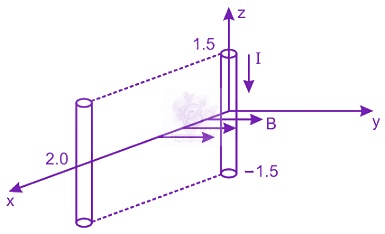
The electric field in a region of space is given by, $\vec{E}={E}_{0}\hat{i}+2{E}_{0}\hat{j}$ where ${E}_{0}=100N{C}^{-1}$. The flux of this field through a circular surface of radius $0.02m$ parallel to the $Y‐Z$ plane is nearly