JEE Main Physics — Electromagnetism previous year questions with solutions.
An electric field of $1000 \mathrm{~V} / \mathrm{m}$ is applied to an electric dipole at angle of $45^{\circ}$. The value of electric dipole moment is $10^{-29} \mathrm{C} \cdot \mathrm{m} .$ What is the potential energy of the electric dipole?
A uniform metallic wire has a resistance of $18\Omega$ and is bent into an equilateral triangle. Then, the resistance between any two vertices of the triangle is:
Shown in the figure is a shell made of a conductor. It has inner radius $a$ and outer radius $b$, and carries charge $Q$ . At its centre a dipole $\vec{p}$ is placed as shown then: 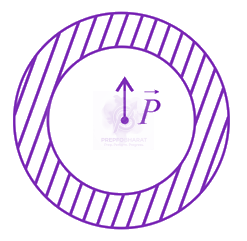
Voltage rating of a parallel plate capacitor is $500 V.$ Its dielectric can withstand a maximum electric field of ${10}^{6}V/m.$ The plate area is ${10}^{-4} {m}^{2}$ . What is the dielectric constant if the capacitance is $15 pF$ ? $(given{\epsilon }_{0}=8.86\times {10}^{-12}{C}^{2}/N{m}^{2})$
The region between $y=0$ and $y=\mathrm{d}$ contains a magnetic field $\overrightarrow{\mathrm{B}}=\mathrm{B} \hat{\mathrm{z}}$. A particle of mass $\mathrm{m}$ and charge $\mathrm{q}$ enters the region with a velocity $\vec{v}=v \hat{i} .$ if $\mathrm{d}=\frac{\mathrm{m} v}{2 \mathrm{qB}},$ the acceleration of the charged particle at the point of its emergence at the other side is :
A copper wire is wound on a wooden frame, whose shape is that of an equilateral triangle. If the linear dimension of each side of the frame is increased by a factor of $3,$ keeping the number of turns of the coil per unit length of the frame the same, then the self inductance of the coil:
A galvanometer, whose resistance is $50 \mathrm{ohm}$ , has $25$ divisions in it. When a current of $4\times {10}^{-4}$ A passes through it, its needle (pointer) deflects by one division. To use this galvanometer as a voltmeter of range $2.5 V$ it should be connected to a resistance of:
A rectangular coil (Dimension $5 cm \times 2.5 cm$ ) with $100$ turns, carrying a current of $3 A$ in the clock-wise direction, is kept centered at the origin and in the $X-Z$ plane. A magnetic field of $1 T$ is applied along $X-axis$ . If the coil is tilted through $45^{\circ}$ about $Z-axis$ , then the torque on the coil is:
In the given circuit, the charge on $4 \mu F$ capacitor will be: 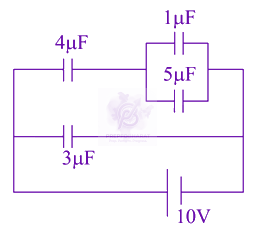
The galvanometer deflection, when key ${K}_{1}$ is closed but ${K}_{2}$ is open, equals ${\theta }_{0}$ (see figure). On closing ${K}_{2}$ also and adjusting ${R}_{2}$ to $5\Omega ,$ the deflection in galvanometer becomes $\frac{{\theta }_{0}}{5}.$ The resistance of the galvanometer is, then, given by [Neglect the internal resistance of battery]: 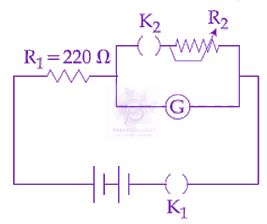
The charge on a capacitor plate in a circuit, as a function of time, is shown in the figure: 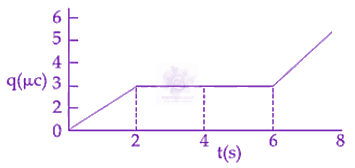 What is the value of current at $t=4 s?$
In the given circuit the internal resistance of the $18V$ cell is negligible. If ${R}_{1}=400 \Omega , {R}_{3}=100 \Omega$ and ${R}_{4}=500 \Omega$ and the reading of an ideal voltmeter across ${R}_{4}$ is $5 V,$ then the value of ${R}_{2}$ will be: 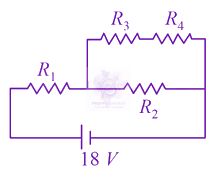
Two coils $'P'$ and $'Q'$ are separated by some distance. When a current of $3 A$ flows through coil $'{P}^{'},$ a magnetic flux of ${10}^{-3} Wb$ passes through $'{Q}^{'}.$ No current is passed through $'{Q}^{'}.$ When no current passes through $'P'$ and a current of $2 A$ passes through $'{Q}^{'},$ the flux through $'P'$ is:
A parallel plate capacitor having capacitance $12 \mathrm{pF}$ is charged by a battery to a potential difference of $10 V$ between its plates. The charging battery is now disconnected and a porcelain slab of dielectric constant $6.5$ is slipped between the plates. The work done by the capacitor on the slab is
Two electric dipoles, $A,$ $B$ with respective dipole moments $\vec{{d}_{A}}=-4qa\hat{i}$ and $\vec{{d}_{B}}=-2qa\hat{i}$ are placed on the $x$ -axis with a separation $R,$ as shown in the figure 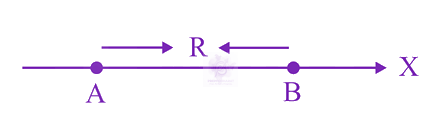 The distance from $A$ at which both of them produce the same potential is:
A current of $1 \mathrm{~A}$ is flowing on the sides of an equilateral triangle of side $4.5 \times 10^{-2} \mathrm{~m}$. The magnetic field at the centre of the triangle will be:
A Helmholtz coil has a pair of loops, each with $N$ turns and radius $R$. They are placed coaxially at distance $R$ and the same current $I$ flows through the loops in the same direction. The magnitude of the magnetic field at $P,$ midway between the centres $A$ and $C,$ is given by [Refer to figure given below]: 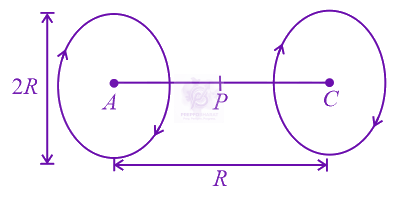
An ideal capacitor of capacitance $0.2\mu F$ is charged to a potential difference of $10V$. The charging battery is then disconnected. The capacitor is then connected to an ideal inductor of self inductance $0.5\mathrm{mH}$. The current at a time when the potential difference across the capacitor is $5V$ is:
A plane polarized monochromatic EM wave is travelling a vacuum along $z$ direction such that at $\mathrm{t}=\mathrm{t}_1$ it is found that the electric field is zero at a spatial point $z_1$. The next zero that occurs in its neighbourhood is at $z_2$. The frequency of the electromagnetic wave is:
A heating element has a resistance of $100 \Omega$ at room temperature. When it is connected to a supply of $220V$, a steady current of $2A$ passes in it and temperature is $500{}^{o}C$ more than the room temperature. The temperature coefficient of resistance of the heating element is
The dipole moment of a circular loop carrying a current I, is m and the magnetic field at the centre of the loop is ${B}_{1}$ . When the dipole moment is doubled by keeping the current constant, the magnetic field at the centre of the loop is ${B}_{2}$ . The ratio $\frac{{B}_{1}}{{B}_{2}}$ is:
A charge $Q$ is placed at a distance $\frac{a}{2}$ above the centre of a square surface of side length $a$. The electric flux through the square surface due to the charge would be? 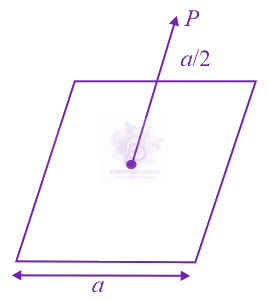
A Helmholtz coil has pair of loops, each with $N$ turns and radius $R$. They are placed coaxially at distance $R$ and the same current $I$ flows through the loops in the same direction. The magnitude of magnetic field at $P$, midway between the centres $A$ and $C$, is given by (Refer to figure): 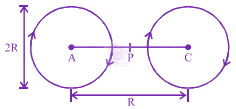
On interchanging the resistances, the balance point of a meter bridge shifts to the left by $10\mathrm{cm}$. The resistance of their series combination is $1k\Omega$ . How much was the resistance on the left slot before interchanging the resistances?