JEE Main Physics — Electromagnetism previous year questions with solutions.
A series $AC$ circuit containing an inductor $(20 \mathrm{mH}),$ a capacitor $(120\text{ μ}F)$ and a resistor $(60 \Omega )$ is driven by an $AC$ source of $24 V/50 \mathrm{Hz}.$ The energy dissipated in the circuit in $60 s$ is:
A system of three charges are placed as shown in the figure: 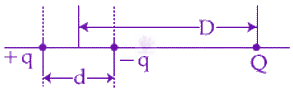 If $D >> d,$ the potential energy of the system is best given by:
An electromagnetic wave is represented by the electric filed $\vec{E}={E}_{0}\hat{n}\mathrm{sin}[\omega t+(6y-8z)].$ Taking unit vectors in $x,y$ and $z$ directions to be $\hat{i},\hat{j},\hat{k},$ the directions of propogations $\hat{s},$ is:
Two identical parallel plate capacitors, of capacitance $C$ each, have plates of area $A,$ separated by a distance $d$ . The space between the plates of the two capacitors, is filled with three dielectrics, of equal thickness and dielectric constants ${K}_{1}, {K}_{2}$ and ${K}_{3}$ . The first capaciitor is filled as shown in figure $I,$ and the second one is filled as shown in figure $II.$ If these two modified capacitors are charged by the same potential $V$ , the ratio of the energy stored in the two, would be $({E}_{1}$ refers to capacitor $(I)$ and ${E}_{2}$ to capacitor $(II)$ ): 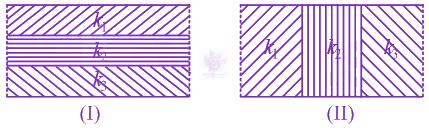
A current of $2 \mathrm{mA}$ was passed through an unknown resistor which dissipated a power of $4.4 W.$ Dissipated power when an ideal power supply of $11 V$ is connected across it is:
Determine the electric dipole moment of the system of three charges, placed on the vertices of an equilateral triangle, as shown in the figure: 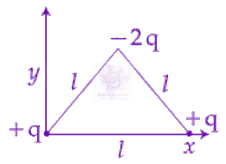
Charge is distributed within a sphere of radius $R$ with a volume charge density $\rho (r)=\frac{A}{{r}^{2}}{e}^{-\frac{2r}{a}},$ where $A$ and $a$ are constants. If $Q$ is the total charge of this charge distribution, the radius $R$ is:
A parallel plate capacitor is of area $6 c{m}^{2}$ and a separation $3 mm.$ The gap is filled with three dielectric materials of equal thickness (see figure) with dielectric constant ${K}_{1}=10, {K}_{2}=12$ and ${K}_{3}=14.$ The dielectric constant of a material which when fully inserted in above capacitor, gives same capacitance would be: 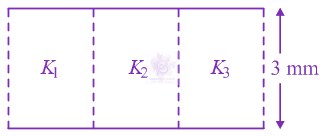
A proton, an electron, and a Helium nucleus, have the same energy. They are in circular orbits in a plane due to magnetic field perpendicular to the plane. Let ${r}_{p},{r}_{e}$ and ${r}_{He}$ be their respective radii, then,
A bar magnet is demagnetized by inserting it inside a solenoid of length $0.2 m, 100$ turns, and carrying a current of $5.2 A.$ The coercivity of the bar magnet is:
Drift speed of electrons, when $1.5 A$ current flows in a copper wire of cross section $5 {\mathrm{mm}}^{2}$ is ${v}_{d}.$ If the electron density in copper is $9\times {10}^{28}{m}^{-3}$ the value of ${v}_{d}$ in $\mathrm{mm}{s}^{-1}$ is close to (Take charge of an electron to be $=1.6\times {10}^{-19} C$)
A particle of mass $m$ and charge $q$ is in an electric and magnetic field given by $$ \overrightarrow{\mathrm{E}}=2 \hat{i}+3 \hat{j} ; \overrightarrow{\mathrm{B}}=4 \hat{j}+6 \hat{k} $$ The charged particle is shifted from the origin to the point $\mathrm{P}(x=1 ; y=1)$ along a straight path. The magnitude of the total work done is :
The self induced emf of a coil is $25$ volts. When the current in it is changed at uniform rate from $10A$ to $25A$ in $1s$ , the change in the energy of the inductance is:
An electron, moving along the $x-$ axis with an initial energy of $100 eV,$ enters a region of magnetic field $\vec{B}=(1.5\times {10}^{-3} T)\hat{k}$ at S (see figure). The field extends between $x=0$ and $x=2 cm.$ The electron is detected at the point $Q$ on a screen placed $8 cm$ away from the point $S.$ The distance d between $P$ and $Q$ (on the screen) is: (electron’s charge $1.6\times {10}^{-19} C$ , mass of electron $=9.1\times {10}^{-31} kg$ ) 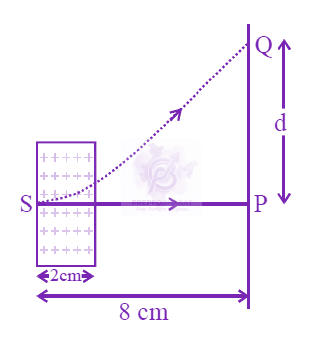
The Wheatstone bridge shown in the figure below, gets balanced when the carbon resistor used as ${R}_{1}$ has the colour code (orange, red, brown). The resistors ${R}_{2}$ and ${R}_{4}$ are $80\Omega$ and $40\Omega$, respectively. Assuming that the colour code for the carbon resistors gives their accurate values, the colour code for the carbon resistor, used as ${R}_{3}$, would be 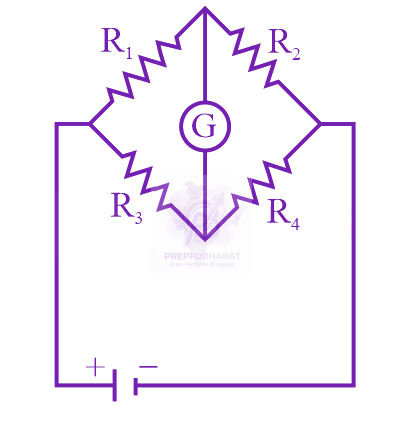
A moving coil galvanometer has a coil with $175$ turns and area $1 c{m}^{2}.$ It uses a torsion band of torsion constant ${10}^{-6} Nm/rad$ The coil is placed in a magnetic field B parallel to its plane. The coil deflects by ${1}^{o}$ for a current of $1 mA$ The value of B (in tesla) is approximately:
Four equal point charges $Q$ each are placed in the $xy$ plane at $(0, 2),(4, 2),(4, -2)$ and $(0, -2)$ . The work required to put a fifth charge $Q$ at the origin of the coordinate system will be:
The figure shows a square loop $L$ of side $5 cm$ which is connected to a network of resistances. The whole setup is moving towards the right with a constant speed of $1cm{s}^{-1}$ . At some instant, a part of $L$ is in a uniform magnetic field of $1T$ perpendicular to the plane of the loop. If the resistance of $L$ is $1.7 \Omega ,$ the current in the loop at that instant will be close to: 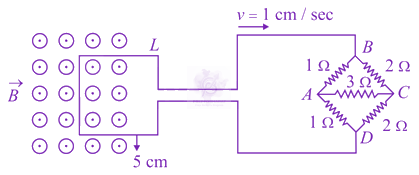
A simple pendulum of length $L$ is placed between the plates of a parallel plate capacitor having electric field $E$ , as shown in figure. Its bob has mass $m$ and charge $q$ . The time period of the pendulum is given by: 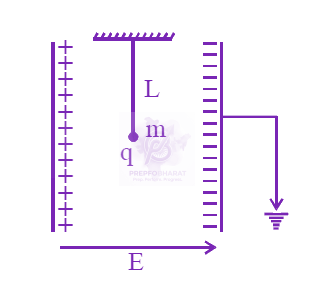
To verify Ohm’s law, a student connects the voltmeter across the battery as shown in the figure. The measured voltage is plotted as a function of the current, and the following graph is obtained: 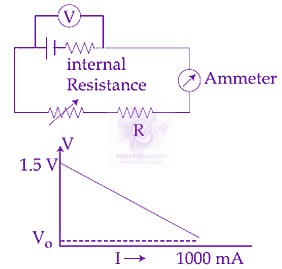 If ${V}_{o}$ is almost zero, identify the correct statement:
A proton and an $\alpha$- particle (with their masses in the ratio of $1:4$ and charges in the ratio of $1:2$ ) are accelerated from rest through a potential difference $V.$ If a uniform magnetic field $(B)$ is set up perpendicular to their velocities, the ratio of the radii ${r}_{p}:{r}_{\alpha }$ of the circular paths described by them will be:
A rigid square loop of side $‘a’$ and carrying current ${I}_{2}$ is lying on a horizontal surface near a long current ${I}_{1}$ carrying wire in the same plane as shown in figure. The net force on the loop due to the wire will be: 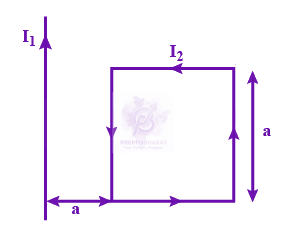
A current of $5 A$ passes through a copper conductor (resistivity $=1.7\times {10}^{-8} \Omega m$ ) of radius of cross-section $5 mm$ . Find the mobility of the charges if their drift velocity is $1.1\times {10}^{-3} {\mathrm{ms}}^{-1}$ .
A conducting circular loop made of a thin wire has area $3.5\times {10}^{-2} {m}^{2}$ and resistance $10 \Omega$ It is placed perpendicular to a time-dependent magnetic field $B(t)=(0.4T)\mathrm{sin}(50\pi t)$ The field is uniform in space. Then the net charge flowing through the loop during $t=0 s$ and $t=10 \mathrm{ms}$ is close to