JEE Main Physics — Electromagnetism previous year questions with solutions.
An electron, moving along the $x-$ axis with an initial energy of $100 eV,$ enters a region of magnetic field $\vec{B}=(1.5\times {10}^{-3} T)\hat{k}$ at S (see figure). The field extends between $x=0$ and $x=2 cm.$ The electron is detected at the point $Q$ on a screen placed $8 cm$ away from the point $S.$ The distance d between $P$ and $Q$ (on the screen) is: (electron’s charge $1.6\times {10}^{-19} C$ , mass of electron $=9.1\times {10}^{-31} kg$ ) 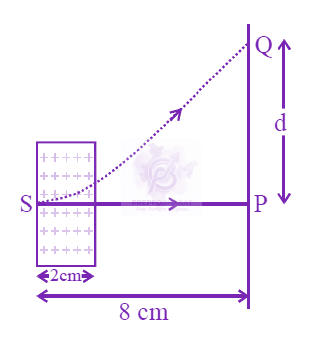
An electromagnetic wave of intensity $50 \mathrm{Wm}^{-2}$ enters in a medium of refractive index 'n' without any loss. The ratio of the magnitudes of electric fields, and the ratio of the magnitudes of magnetic fields of the wave before and after entering into the medium are respectively, given by :
An electromagnetic wave is represented by the electric filed $\vec{E}={E}_{0}\hat{n}\mathrm{sin}[\omega t+(6y-8z)].$ Taking unit vectors in $x,y$ and $z$ directions to be $\hat{i},\hat{j},\hat{k},$ the directions of propogations $\hat{s},$ is:
An electric field of $1000 \mathrm{~V} / \mathrm{m}$ is applied to an electric dipole at angle of $45^{\circ}$. The value of electric dipole moment is $10^{-29} \mathrm{C} \cdot \mathrm{m} .$ What is the potential energy of the electric dipole?
An electric dipole is formed by two equal and opposite charges $q$ with separation $d$ . The charges have same mass m. It is kept in a uniform electric field $E.$ If it is slightly rotated from its equilibrium orientation, then its angular frequency $\omega$ is:
An alternating voltage $V(t)=220\mathrm{sin}(100\pi t)$ volt is applied to a purely resistive load of $50 \Omega$ . The time taken for the current to rise from half of the peak value to the peak value is:
A wire of resistance $R$ is bent to form a square $ABCD$ as shown in the figure. The effective resistance between $E$ and $C$ is: ( $E$ is mid-point of arm $CD$ ) 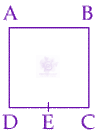
A very long solenoid of radius $R$ is carrying current $I(t)=kt{e}^{-\alpha t}(k>0),$ as a function of time $(t\geq 0).$ Counterclockwise current is taken to be positive. A circular conducting coil of radius $2R$ is placed in the equitorial plane of the solenoid and concentric with the solenoid. The current induced in the outer coil is correctly depicted, as a function of time, by:
A uniformly charged ring of radius $3a$ and total charge $q$ is placed in $x‐y$ plane centred at origin. A point charge $q$ is moving towards the ring along the $z-$ axis and has speed $v$ at $z=4a$ . The minimum value of $v$ such that it crosses the origin is:
A uniform metallic wire has a resistance of $18\Omega$ and is bent into an equilateral triangle. Then, the resistance between any two vertices of the triangle is:
A transformer consisting of $300$ turns in the primary and $150$ turns in the secondary gives output power of $2.2 kW$ . If the current in the secondary coil is $10 A$ , then the input voltage and current in the primary coil are:
A thin strip $10 cm$ long is on a $U$ shaped wire of negligible resistance and it is connected to a spring of spring constant $0.5 N {m}^{-1}$ (see figure). The assembly is kept in a uniform magnetic field of $0.1 T.$ If the strip is pulled from its equilibrium position and released, the number of oscillations it performs before its amplitude decreases by a factor of $e$ is $N$ . If the mass of the strip is $50$ grams, its resistance $10\Omega$ and air drag negligible, $N$ will be close to: 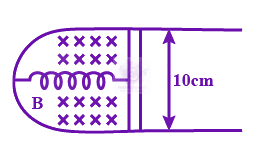
A thin ring of $10 cm$ radius carries a uniformly distributed charge. The ring rotates at a constant angular speed of $40\pi rad{s}^{-1}$ about its axis, perpendicular to its plane. Is the magnetic field its centre is $3.8\times {10}^{-9}T$ , then the charge carried by the ring is close to $({\mu }_{0}=4\pi \times {10}^{-7}N/{A}^{2}).$
A system of three charges are placed as shown in the figure: 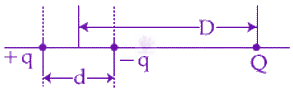 If $D >> d,$ the potential energy of the system is best given by:
A square loop is carrying a steady current $I$ and the magnitude of its magnetic dipole moment is $m$ . If this square loop is changed to a circular loop and it carries the same current, the magnitude of the magnetic dipole moment of circular loop will be:
A solid metal cube of edge length $2 \mathrm{cm}$ is moving in the positive $y$-direction, at a constant speed of $6 m{s}^{-1}$. There is a uniform magnetic field of $\text{0.1} T$ in the positive $z$-direction. The potential difference between the two faces of the cube, perpendicular to the $x$-axis, is
A solid conducting sphere, having a charge $Q,$ is surrounded by an uncharged conducting hollow spherical shell. Let the potential difference between the surface of the solid sphere and that of the outer surface of the hollow shell be $V.$ If the shell is now given a charge of $–4Q,$ the new potential difference between the same two surfaces is:
A simple pendulum of length $L$ is placed between the plates of a parallel plate capacitor having electric field $E$ , as shown in figure. Its bob has mass $m$ and charge $q$ . The time period of the pendulum is given by: 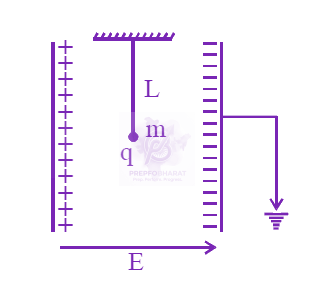
A series $AC$ circuit containing an inductor $(20 \mathrm{mH}),$ a capacitor $(120\text{ μ}F)$ and a resistor $(60 \Omega )$ is driven by an $AC$ source of $24 V/50 \mathrm{Hz}.$ The energy dissipated in the circuit in $60 s$ is:
A rigid square loop of side $‘a’$ and carrying current ${I}_{2}$ is lying on a horizontal surface near a long current ${I}_{1}$ carrying wire in the same plane as shown in figure. The net force on the loop due to the wire will be: 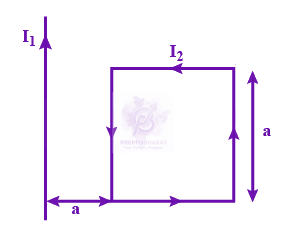
A rectangular coil (Dimension $5 cm \times 2.5 cm$ ) with $100$ turns, carrying a current of $3 A$ in the clock-wise direction, is kept centered at the origin and in the $X-Z$ plane. A magnetic field of $1 T$ is applied along $X-axis$ . If the coil is tilted through $45^{\circ}$ about $Z-axis$ , then the torque on the coil is:
A proton and an $\alpha$- particle (with their masses in the ratio of $1:4$ and charges in the ratio of $1:2$ ) are accelerated from rest through a potential difference $V.$ If a uniform magnetic field $(B)$ is set up perpendicular to their velocities, the ratio of the radii ${r}_{p}:{r}_{\alpha }$ of the circular paths described by them will be:
A proton, an electron, and a Helium nucleus, have the same energy. They are in circular orbits in a plane due to magnetic field perpendicular to the plane. Let ${r}_{p},{r}_{e}$ and ${r}_{He}$ be their respective radii, then,
A power transmission line feeds input power at $2300 V$ to a step down transformer with its primary windings having $4000$ turns. The output power is delivered at $230 V$ by the transformer. If the current in the primary of the transformer is $5A$ and its efficiency is $90%$, the output current would be: