JEE Main 2009 — Electromagnetism
Physics Electromagnetism questions from JEE Main 2009.
Other Years
8 Electromagnetism Questions from 2009
The magnitude of the magnetic field $(B)$ due to loop $A B C D$ at the origin $(O)$ is
This question contains Statement-1 and Statement-2. Of the four choices given after the statements, choose the one that best describes the two statements. Statement-1: The temperature dependence of resistance is usually given as $R=R_0(1+\alpha \Delta t)$. The resistance of a wire changes from $100 \Omega$ to $150 \Omega$ when its temperature is increased from $27^{\circ} \mathrm{C}$ to $227^{\circ} \mathrm{C}$. This implies that $\alpha=2.5 \times 10^{-3} /{ }^{\circ} \mathrm{C}$. Statement 2: $R=R_i(1+\alpha \Delta T)$ is valid only when the change in the temperature $\Delta T$ is small and $\Delta R=$ $\left(R-R_0\right) \ll R_0$.
Two points $P$ and $Q$ are maintained at the potentials of $10 \mathrm{~V}$ and $-4 \mathrm{~V}$ respectively. The work done in moving 100 electrons from $P$ to $Q$ is
An inductor of inductance $\mathrm{L}=400 \mathrm{mH}$ and resistors of resistances $\mathrm{R}_1$ $=2 \Omega$ and $R_2=2 \Omega$ are connected to a battery of emf $12 \mathrm{~V}$ as shown in the figure. The internal resistance of the battery is negligible. The switch $S$ is closed at $t=0$. The potential drop across $L$ as a function of time is 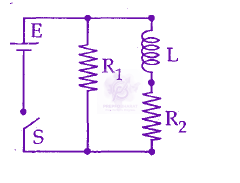
This question contains Statement-1 and Statement-2. Of the four choices given after the statements, choose the one that best describes the two statements. Statement - 1: For a charged particle moving from point $P$ to point $Q$, the net work done by an electrostatic field on the particle is independent of the path connecting point $P$ to point $Q$. Statement-2: The net work done by a conservative force on an object moving along a closed loop is zero
Due to the presence of the current $\mathrm{l}_1$ at the origin
A charge $Q$ is placed at each of the opposite corners of a square. A charge $q$ is placed at each of the other two corners. If the net electrical force on $Q$ is zero, then the $Q / q$ equals
Let $P(r)=\frac{Q}{\pi R^4} r$ be the charge density distribution for a solid sphere of radius $R$ and total charge $Q$. for a point ' $p$ ' inside the sphere at distance $r_1$ from the centre of the sphere, the magnitude of electric field is